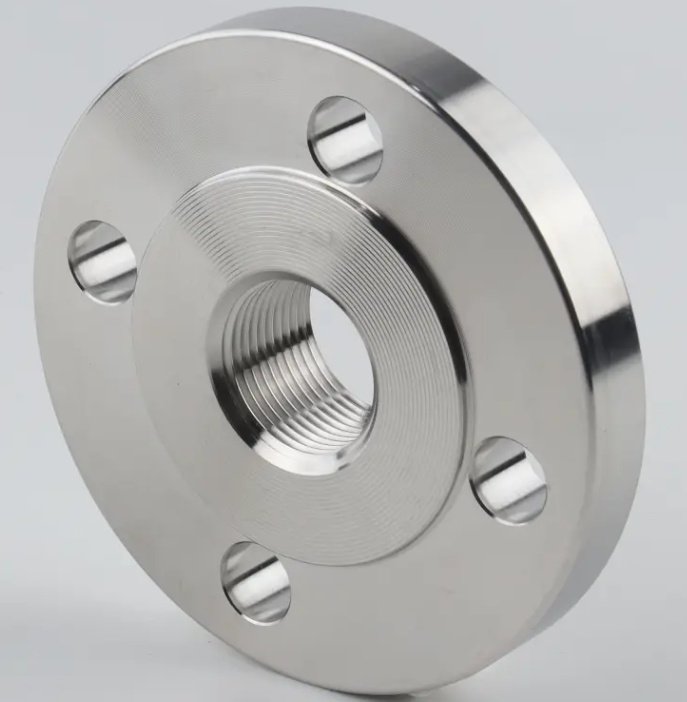
A threaded flange, also called a screwed flange, is designed with internal pipe threads that allow it to be connected to externally threaded pipe without welding. In industrial piping, Threaded Flanges are commonly selected for small-bore lines, utility piping, low-pressure services, maintenance-intensive systems and field locations where hot work is restricted.
Compared with weld neck or slip-on flanges, threaded pipe flanges simplify installation because no circumferential weld is required. They are widely used in water treatment, compressed air, fire protection, instrumentation, oil and gas utility lines, chemical auxiliary piping, marine systems and low-temperature service where welding may be impractical.
What Is a Threaded Flange?
A threaded flange is a pipe flange manufactured with a machined female thread in the bore. The flange is screwed onto a pipe with matching male threads, and the sealing between flanges is achieved by a gasket compressed between two flange faces. The thread connection provides mechanical engagement between the pipe and flange.
The most common thread form for ASME products is NPT according to ASME B1.20.1. For European and international projects, BSPT or BSPP threads may be specified according to ISO 7-1, ISO 228-1 or project standards. Thread accuracy is critical because poor pitch, taper or surface finish can cause assembly difficulty, leakage or premature galling.
| Product Name | Threaded Flange / Screwed Flange |
|---|---|
| Typical Standard | ASME B16.5, ASME B16.47, EN 1092-1, JIS, DIN, project drawings |
| Common Size Range | NPS 1/2" to 24" depending on standard and pressure class |
| Pressure Class | Class 150, 300, 600, 900, 1500, 2500 |
| Thread Options | NPT, BSPT, BSPP, metric thread, custom thread by drawing |
| Facing Options | Raised Face, Flat Face, Ring Type Joint where applicable |
| Materials | Carbon steel, stainless steel, alloy steel, duplex stainless steel, nickel alloy |
Key Benefits of Threaded Flanges
- No welding is required during basic assembly, reducing hot-work permits and field labor.
- Suitable for maintenance areas where components may need to be replaced or adjusted.
- Useful for small-diameter piping where welding access is limited.
- Compatible with standard flange gaskets, bolts and nuts in ASME or EN systems.
- Available in a broad range of forged materials for corrosion, temperature and pressure requirements.
- Can be supplied with coating, galvanizing, passivation, pickling or special surface protection.
For buyers and project engineers, the main commercial advantage is installation flexibility. In a small-bore utility skid project, replacing welded small-bore flange connections with threaded flanges reduced average field fit-up and hot-work preparation time from about 35-50 minutes per connection to 12-18 minutes, depending on pipe size and site access. The result was lower field labor exposure and faster commissioning preparation.
Types of Threaded Flanges
Threaded flanges can be supplied in several configurations based on pressure class, face type, sealing method and industry standard. The right type depends on the pipe schedule, thread specification, gasket design, media, temperature and applicable piping code.
Raised Face Threaded Flange
Raised face threaded flanges are the most common type used in ASME piping. The raised face concentrates gasket load in the sealing area, improving gasket compression in general industrial service.
Flat Face Threaded Flange
Flat face threaded flanges are typically used with cast iron equipment, low-pressure water systems or applications where a full-face gasket is required. They help reduce bending stress on brittle mating flanges.
RTJ Threaded Flange
Ring type joint threaded flanges are used where metallic ring gaskets are required. This configuration is less common than raised face designs but may be specified for high-pressure applications where the piping code and project standard allow threaded connections.
Forged Threaded Flange
Forged threaded flanges offer superior grain structure and strength compared with cast alternatives. They are preferred for pressure piping, oil and gas systems, chemical plants and power-related auxiliary lines.
When should a threaded flange not be the first choice?
Threaded flanges are generally not recommended for severe cyclic service, high bending loads, high vibration, hazardous leakage-sensitive media or extreme thermal cycling unless approved by the responsible engineer. For critical high-pressure or high-temperature systems, weld neck flanges are often preferred because they provide better stress distribution and permanent pipe-to-flange integrity.
Materials and Grades
Material selection should match the design pressure, temperature, corrosion allowance, fluid compatibility and project specification. Our threaded flanges can be produced from forged bar, billet or forging blanks with traceable heat numbers and mill test certificates.
| Material Category | Common Grades | Typical Applications |
|---|---|---|
| Carbon Steel | ASTM A105, ASTM A350 LF2 | Water, air, oil, gas utility lines, low-temperature carbon steel piping |
| Stainless Steel | ASTM A182 F304, F304L, F316, F316L, F321, F347 | Chemical service, food processing, marine piping, corrosion-resistant systems |
| Alloy Steel | ASTM A182 F5, F9, F11, F22, F91 | High-temperature service, power plant auxiliary piping, refinery systems |
| Duplex Stainless Steel | F51, F53, F55 | Chloride-containing environments, offshore systems, seawater-related piping |
| Nickel Alloy | Alloy 400, Alloy 600, Alloy 625, Alloy 825 | Highly corrosive chemical, sour gas and special process applications |
For sour service, low-temperature service or chloride-bearing environments, material requirements such as NACE MR0175 / ISO 15156, impact testing, ferrite control, hardness limits and positive material identification may be added to the purchase specification.
Standards, Dimensions and Thread Specifications
Threaded flanges are usually manufactured to recognized dimensional standards so they can be installed with standard gaskets, bolts and mating flanges. Dimensional verification includes outer diameter, bolt circle diameter, number and diameter of bolt holes, flange thickness, hub dimensions, facing height and bore thread geometry.
- ASME B16.5: Pipe flanges and flanged fittings from NPS 1/2" to NPS 24".
- ASME B16.47: Large diameter steel flanges where applicable.
- ASME B1.20.1: Pipe threads, general purpose, inch, including NPT thread requirements.
- EN 1092-1: European circular steel flanges with PN ratings.
- ISO 7-1: Pipe threads where pressure-tight joints are made on the threads.
- MSS SP-44: Steel pipeline flanges for selected applications.
The exact thread type must be confirmed before production. An NPT threaded flange is not interchangeable with BSP threaded pipe. Differences in thread angle, pitch and taper can create incomplete engagement, leakage and thread damage.
Engineering note on NPT thread engagement
NPT threads seal by controlled metal-to-metal thread interference and thread sealant. Correct thread taper, pitch diameter and gauging are essential. For pressure piping, assembly torque, thread sealant compatibility and pipe wall thickness should be reviewed by the piping engineer, especially for stainless steel where galling risk is higher.
Manufacturing and Machining Process
A high-quality threaded flange depends on both forging quality and precision machining. The internal thread is one of the most important features because it affects installation, sealing performance and service reliability.
- Raw material control: Forging blanks or bars are checked against chemical composition, heat number and material grade.
- Forging and heat treatment: Forged blanks are normalized, annealed, solution treated or quenched and tempered according to material requirements.
- Rough machining: OD, thickness, hub profile and bore are rough turned to controlled allowance.
- Precision CNC machining: Flange face, bolt holes, sealing surface and bore are machined to dimensional tolerances.
- Thread cutting: Internal NPT, BSP or custom threads are machined using calibrated tools and verified with plug gauges.
- Face finishing: Raised face serration is controlled to meet gasket sealing requirements, commonly within ASME B16.5 surface finish expectations.
- Inspection and marking: Dimensions, thread quality, material traceability and surface condition are checked before packing.
For stainless steel threaded flanges, cutting speed, coolant control and tool geometry are important to prevent work hardening and thread tearing. For duplex and nickel alloys, thread machining requires tighter control because these materials have higher strength and lower machinability than carbon steel.
Quality Control and Inspection
Each threaded flange can be inspected according to project requirements. Standard quality control normally covers dimensional inspection, thread gauging, visual examination, material certificate review and marking verification. Additional non-destructive testing can be arranged for critical service.
| Inspection Item | Purpose | Available Method |
|---|---|---|
| Dimensional Check | Confirms flange geometry and bolting compatibility | Caliper, micrometer, height gauge, CMM where required |
| Thread Verification | Confirms correct thread form and engagement | NPT plug gauge, BSP gauge, custom thread gauge |
| Material Verification | Confirms grade and traceability | MTC review, PMI, heat number tracking |
| Surface Examination | Detects cracks, dents, flange machining defects and corrosion | Visual inspection, PT, MT |
| Mechanical Testing | Verifies strength, impact or hardness requirements | Tensile test, Charpy impact test, hardness test |
Documentation can include EN 10204 3.1 material test certificates, heat treatment records, dimensional reports, PMI reports, NDT reports, coating certificates and packing lists. For regulated projects, third-party inspection by agencies such as SGS, BV, TUV or ABS may be arranged according to the inspection and test plan.
Common quality issue: thread mismatch
One of the most frequent procurement problems is ordering a flange with the correct pressure class but the wrong thread type. For example, an ASME Class 300 threaded flange with NPT threads cannot be safely assembled with BSPT threaded pipe. To avoid rework, purchase orders should specify standard, size, class, material, face type, thread type, pipe schedule and coating requirement.
Engineering Applications and Service Considerations
Threaded flanges are practical for many utility and auxiliary systems, but they should be applied within the limits of the piping code and project engineering practice. They are commonly used for compressed air, cooling water, fuel oil utility lines, steam tracing accessories, hydraulic support lines, instrument air headers, fire water branches and temporary connections.
Engineers should evaluate vibration, cyclic temperature changes, corrosion, thread sealant compatibility and pipe wall thickness. In some systems, a seal weld may be specified after threading to reduce leakage risk, but the design responsibility should remain with the piping engineer and applicable code requirements.
- For vibration: consider support spacing, flexible connectors and alternative welded flange types.
- For stainless steel: use compatible thread lubricant or sealant to reduce galling.
- For corrosive media: specify appropriate alloy grade and avoid crevice corrosion risks at threads.
- For low temperature: select impact-tested materials such as ASTM A350 LF2 when required.
- For maintenance systems: confirm that the flange can be disassembled without damaging the pipe thread.
Buyer and Engineer Ordering Guide
A complete threaded flange inquiry should include technical and commercial details that allow accurate manufacturing and inspection. Clear specifications reduce clarification time, prevent thread mismatch and help ensure that delivered flanges fit the intended piping system.
| Required Information | Example |
|---|---|
| Standard | ASME B16.5 |
| Size | NPS 2" |
| Pressure Class | Class 300 |
| Material Grade | ASTM A182 F316L |
| Face Type | Raised Face |
| Thread Type | NPT according to ASME B1.20.1 |
| Pipe Schedule | SCH 40 or SCH 80 |
| Inspection | MTC 3.1, PMI, dimensional report |
| Surface Protection | Black paint, anti-rust oil, hot-dip galvanizing or passivation |
For repeat purchases, drawings or previous batch records are useful for confirming thread depth, bore clearance, marking format, packing method and project-specific tolerances. For EPC and distributor procurement, consolidated size lists can be produced with heat-number traceability and batch inspection records.
Packaging, Marking and Traceability
Threaded flanges are marked according to standard and project requirements. Typical marking includes manufacturer identification, material grade, size, pressure class, heat number, standard and face type. Stainless steel products can be marked with low-stress stamping or laser marking when specified.
Packing methods include plywood cases, pallets, plastic caps for thread protection, waterproof wrapping and anti-rust protection. For export shipments, threaded bores should be protected against impact and contamination because thread damage can prevent field assembly.
From material procurement to final shipment, each batch can be controlled through heat number traceability. This is especially important for pressure equipment, offshore projects, refinery maintenance, chemical plants and public infrastructure where compliance documentation must match installed components.