
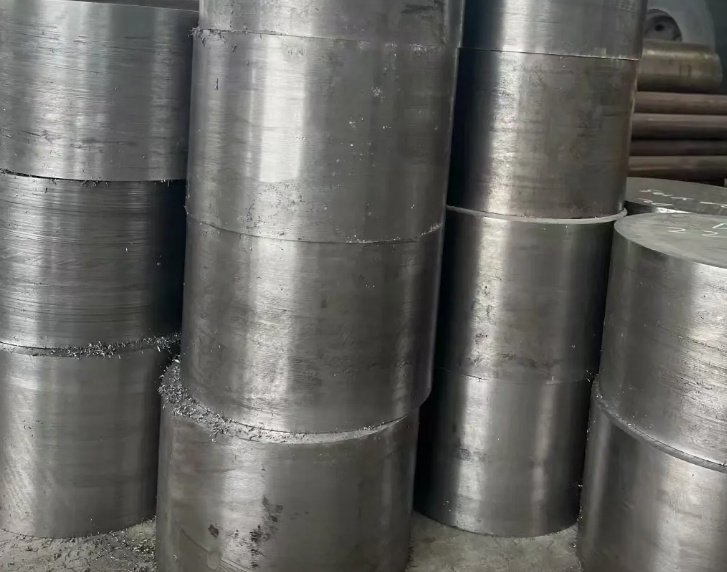
AISI 6150 alloy steel, also known as SAE 6150 or UNS G61500, is a chromium-vanadium spring steel used where high strength, good toughness, wear resistance and fatigue performance are required. It is commonly specified for leaf springs, coil springs, torsion bars, shafts, gears, hand tools, agricultural components and other parts exposed to repeated loading.
Compared with plain carbon spring steels, AISI 6150 offers better hardenability and strength retention after heat treatment. Compared with chromium-molybdenum steels such as AISI 4140, it is often selected when the design priority is elastic strength under cyclic stress rather than general-purpose structural strength.
What Is AISI 6150 Alloy Steel?
AISI 6150 is a medium-carbon, chromium-vanadium alloy steel. Its carbon content is typically around 0.48–0.53%, giving it the ability to reach high hardness after quenching and tempering. Chromium improves hardenability and wear resistance, while vanadium refines grain size and contributes to strength, toughness and fatigue resistance.
The material is supplied in several forms, including hot rolled bar, cold drawn bar, forged bar, plate, strip and wire. Depending on the final application, it may be delivered annealed, normalized, quenched and tempered, or spheroidized annealed for forming and machining.
AISI 6150 Chemical Composition
The exact chemical limits can vary slightly by producer, product form and applicable standard. The following ranges reflect common SAE/AISI composition expectations for 6150 alloy steel.
| Element | Typical Range, wt% | Function in 6150 Steel |
|---|---|---|
| Carbon, C | 0.48–0.53 | Provides hardness, tensile strength and spring properties after heat treatment |
| Manganese, Mn | 0.70–0.90 | Improves hardenability and strength |
| Silicon, Si | 0.15–0.35 | Contributes to strength and deoxidation |
| Chromium, Cr | 0.80–1.10 | Improves hardenability, wear resistance and tempering response |
| Vanadium, V | 0.15 min, commonly 0.15–0.25 | Refines grain size and improves fatigue resistance |
| Phosphorus, P | 0.035 max | Controlled impurity; excess may reduce toughness |
| Sulfur, S | 0.040 max | Controlled impurity; may improve machinability but reduce ductility |
| Iron, Fe | Balance | Base metal |
Mechanical Properties of AISI 6150
Mechanical properties depend strongly on section size, heat treatment, quench severity and tempering temperature. In engineering procurement, AISI 6150 should not be purchased only by grade name; hardness range, tensile strength, microstructure and test standard should also be specified.
| Condition | Hardness | Tensile Strength | Yield Strength | Typical Use |
|---|---|---|---|---|
| Annealed | Approx. 197–229 HB | Lower strength, improved machinability | Lower yield strength | Machining, forming, pre-heat-treatment stock |
| Normalized | Approx. 250–320 HB | Moderate to high strength | Moderate yield strength | General components, pre-hardening condition |
| Quenched and tempered | Approx. 40–55 HRC | Approx. 1,300–1,900 MPa depending on temper | Approx. 1,100–1,600 MPa depending on temper | Springs, torsion bars, tools, highly stressed parts |
For many spring applications, the useful design value is not only ultimate tensile strength but also fatigue endurance after proper surface condition control. Shot peening, decarburization control and polished radii can significantly improve real service life.
Heat Treatment of AISI 6150 Alloy Steel
Heat treatment is the main reason AISI 6150 is selected. The grade can develop high hardness and elastic strength while maintaining better toughness than many simple high-carbon steels.
Annealing
Typical annealing is performed at about 800–850°C followed by slow furnace cooling. This produces a softer structure for machining or forming. Spheroidized annealing may be preferred for wire, strip or precision parts that require cold forming before hardening.
Normalizing
Normalizing is commonly performed around 870–925°C followed by air cooling. It refines grain structure and improves uniformity before final hardening, especially in forged or hot worked components.
Hardening
Austenitizing is commonly carried out around 830–870°C, followed by oil quenching for many sections. The correct quench medium depends on cross-section, distortion limits and required hardness. Overheating should be avoided because excessive grain growth can reduce toughness and fatigue performance.
Tempering
Tempering is normally performed after quenching, often in the range of 400–650°C depending on target hardness and strength. Lower tempering temperatures increase hardness but reduce ductility; higher temperatures improve toughness but lower tensile strength.
| Process Step | Common Temperature Range | Purpose |
|---|---|---|
| Annealing | 800–850°C | Softening for machining or forming |
| Normalizing | 870–925°C | Grain refinement and structure uniformity |
| Austenitizing | 830–870°C | Prepare steel for quenching |
| Quenching | Usually oil quench | Develop martensitic structure |
| Tempering | 400–650°C | Adjust hardness, strength and toughness |
AISI 6150 vs 4140, 5160 and 9260
Searches for AISI 6150 often involve material substitution. The correct choice depends on fatigue loading, hardenability, section size, cost, availability and heat treatment capability.
| Grade | Alloy System | Strengths | Limitations | Best-Fit Applications |
|---|---|---|---|---|
| AISI 6150 | Cr-V spring steel | High fatigue strength, good toughness, strong spring performance | Requires controlled heat treatment and surface decarburization control | Springs, torsion bars, shafts, high-stress tools |
| AISI 4140 | Cr-Mo alloy steel | Excellent general-purpose strength, toughness and hardenability | Not as spring-specific as 6150 for repeated elastic deflection | Shafts, gears, bolts, structural machine components |
| AISI 5160 | Cr spring steel | Good toughness and widely used for leaf springs | No intentional vanadium grain refinement in standard chemistry | Leaf springs, blades, simple spring components |
| AISI 9260 | Si-Mn spring steel | High elastic limit and good shock resistance | May be more sensitive to decarburization and processing variation | Coil springs, suspension springs, shock-loaded parts |
As a practical rule, select 6150 over 4140 when the component behaves like a spring and must return elastically after repeated deflection. Select 4140 over 6150 when the application is a general shaft, pin or structural component where machinability, weld repair options and broad availability are stronger purchasing factors.
Machining, Forming and Grinding Considerations
AISI 6150 is generally machined in the annealed condition. In hardened and tempered condition, machining becomes more difficult and is usually limited to grinding, hard turning or finishing operations.
- Annealed machinability: moderate; better than fully hardened material but not as free-cutting as resulfurized steels.
- Tooling: carbide tools are preferred for production machining; high-speed steel may be used for lower-speed operations.
- Cutting fluid: suitable coolant or oil reduces heat, tool wear and surface damage.
- Grinding: avoid overheating because grinding burns can reduce fatigue life.
- Surface finish: important for springs and torsion parts; scratches and sharp corners can initiate cracks.
For fatigue-critical parts, machining marks should be aligned to reduce stress concentration, and final grinding should be followed by inspection where appropriate. A small reduction in surface roughness can produce a measurable life improvement when the component operates near its endurance limit.
Machining notes for buyers and process engineers
If the part will be heavily machined before heat treatment, request annealed or spheroidized annealed stock. If dimensional tolerance after hardening is tight, discuss machining allowance, straightness, quench distortion and final grinding stock before placing the order.
- For shafts and bars, verify straightness tolerance before CNC turning.
- For flat spring stock, check decarburization depth and edge condition.
- For high-volume components, ask whether the supplier can provide consistent hardness bands after heat treatment.
Welding and Fabrication
AISI 6150 is not normally considered a welding-friendly steel because its carbon and alloy content create a risk of heat-affected-zone cracking. If welding cannot be avoided, preheating, controlled interpass temperature and post-weld heat treatment may be required.
In most designs, mechanical joining or redesigning the component as a one-piece forged, machined or heat-treated part is preferred. For production spring components, welding is generally avoided because it can create local hardness variation and reduce fatigue reliability.
Typical Applications of AISI 6150
AISI 6150 is chosen when a component needs high elastic limit, good resistance to permanent deformation and reliable performance under shock or cyclic loading.
- Automotive leaf springs, coil springs and stabilizer bars
- Torsion bars and suspension components
- Industrial shafts, spindles and stressed machine parts
- Hand tools, pry bars, punches and chisels
- Agricultural machinery components
- Wear-resistant bars, plates and forged parts
- Heavy-duty clips, clamps and retaining components
The grade is especially valuable where the component must combine high hardness with usable impact toughness. This balance is why 6150 remains common in transportation, tooling and heavy machinery supply chains.
Engineering Example: Reducing Spring Failure with 6150
Consider a medium-duty torsion spring originally produced from a plain carbon spring steel. The part operates at high cyclic stress and experiences premature cracking near the inside bend radius. A redesign using AISI 6150 with controlled quench and temper, improved radius polishing and shot peening can provide a practical life improvement.
| Design Factor | Original Part | Improved 6150 Part | Expected Engineering Benefit |
|---|---|---|---|
| Material | Plain carbon spring steel | AISI 6150 Cr-V alloy steel | Better hardenability and fatigue resistance |
| Hardness control | Wide variation, about 38–48 HRC | Narrower target, about 44–48 HRC | More consistent elastic response |
| Surface condition | Machining marks and unpolished bend area | Polished radius plus shot peening | Lower crack initiation risk |
| Heat treatment control | Limited decarburization inspection | Controlled atmosphere or verified decarb limit | Improved surface strength |
In fatigue-sensitive parts, material upgrade alone is rarely the full solution. The strongest result usually comes from combining the right alloy, controlled heat treatment, improved geometry and surface treatment.
Standards, Equivalents and Specifications
AISI 6150 may be referenced under several specification systems. Always confirm the applicable standard on the purchase order because chemical composition, testing requirements, delivery condition and tolerances can differ.
| Designation | System or Standard | Notes |
|---|---|---|
| AISI 6150 / SAE 6150 | North American steel grade designation | Common commercial name for Cr-V spring steel |
| UNS G61500 | Unified Numbering System | UNS identifier for 6150 alloy steel |
| ASTM A29/A29M | General requirements for steel bars | Often used for hot-wrought and cold-finished alloy steel bars |
| SAE J404 | Chemical compositions of SAE alloy steels | Common reference for chemistry ranges |
| EN equivalents | Approximate comparison only | 50CrV4 / 1.8159 is often compared but should not be assumed identical without specification review |
When substituting with 50CrV4, SUP10, 51CrV4 or another regional grade, verify chemistry, hardenability, heat treatment response and mechanical property requirements rather than relying on grade equivalence tables alone.
Procurement checklist for AISI 6150 steel
For reliable sourcing, specify more than the grade name. A complete purchase description reduces disputes and helps suppliers quote the correct material condition.
- Grade: AISI 6150, SAE 6150 or UNS G61500
- Product form: round bar, flat bar, plate, strip, wire or forging
- Delivery condition: annealed, normalized, quenched and tempered, or spheroidized annealed
- Size tolerance, straightness, surface finish and decarburization limits
- Required hardness or mechanical property range
- Inspection documents, heat number traceability and applicable standard
Advantages and Limitations
AISI 6150 is a strong choice for demanding spring and cyclic-load parts, but it is not automatically the best material for every high-strength application.
| Advantages | Limitations |
|---|---|
| High strength after quenching and tempering | Requires careful heat treatment control |
| Good fatigue resistance for spring applications | Surface defects and decarburization can reduce service life |
| Better hardenability than many plain carbon steels | Machinability is best in annealed condition, not hardened condition |
| Good toughness compared with many high-carbon steels at similar hardness | Welding is difficult and usually not recommended |
| Suitable for bars, forgings, strip and wire | Availability may vary by region and product size |
How to Specify AISI 6150 for Reliable Performance
For engineering use, the most important specification items are hardness, heat treatment condition, section size and surface quality. For fatigue applications, include decarburization limits, surface finish requirements and inspection expectations.
A well-defined order might state: AISI 6150 alloy steel bar to ASTM A29/A29M, annealed condition, heat traceable, ultrasonic tested if required, suitable for quench and temper to 44–48 HRC after machining. For spring strip or wire, the order should also include edge condition, surface quality and allowable decarburization depth.
When AISI 6150 may not be the best choice
AISI 6150 may be excessive for low-stress brackets, simple pins or components that do not require spring behavior. It may also be unsuitable where welding, corrosion resistance or extreme machinability is the main requirement.
- Choose 4140 or 4340 for many general high-strength shafts and structural parts.
- Choose stainless spring steels where corrosion resistance is critical.
- Choose free-machining steels where high-volume machining cost is more important than spring fatigue strength.
Summary
AISI 6150 alloy steel is a chromium-vanadium spring steel designed for strength, hardenability and cyclic-load performance. Its typical uses include springs, torsion bars, shafts, tools and heavy-duty machine components. The grade performs best when heat treatment, surface condition and decarburization are controlled together.
For buyers and engineers, the key is to specify AISI 6150 by grade, standard, delivery condition, hardness range, dimensional tolerance and inspection requirements. When compared with 4140, 5160 and 9260, 6150 is most attractive where fatigue-resistant spring performance is the central design requirement.