
Bronze CNC machining services
- Fast prototype & low MOQ support
- Tight tolerance up to +0.002mm
- Surface finishing available
- Engineering review before production
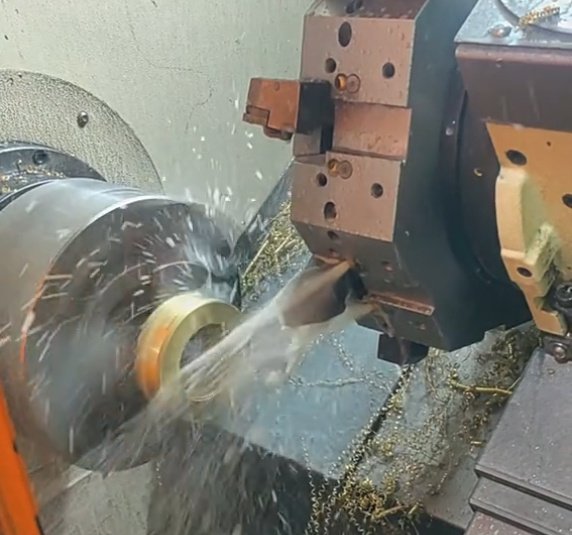
Bronze CNC Machining
Precision Milling
- Multi-axis CNC milling for complex geometries.
- Tight tolerances as tight as ±0.002mm and fine surface finishes.
- Suitable for prototypes and mass production.
CNC Turning
- High-speed turning for shafts, rods, and cylindrical parts.
- Thread cutting, grooving, and facing operations.
- Supports both small and large batch production.
Drilling, Tapping & Boring
- CNC drilling for holes of all sizes and depths.
- Threading and tapping for assemblies.
- High repeatability for precision alignment.
Multi-Axis Machining
- 4-axis and 5-axis machining for intricate parts.
- Reduced setups and improved accuracy.
- Ideal for aerospace, automotive, and medical components.
Materials Expertise
- Aluminum, stainless steel, titanium, brass, copper, and more.
- Specialized processes for hard-to-machine metals.
- Material selection advice for strength, weight, and cost.
CNC Prototyping
- Rapid CNC prototyping to test designs quickly.
- Small batch to full-scale production runs.
- Flexible workflow to meet tight deadlines.
Why Bronze Is Used for CNC Machined Parts
- Wear resistance: Suitable for bushings, bearings, guide plates and rotating shaft interfaces.
- Low friction: Helps reduce heat generation and scoring in sliding or oscillating motion.
- Corrosion resistance: Useful for marine, pump, valve and outdoor equipment components.
- Load carrying capacity: Aluminum bronze and manganese bronze are used where high strength is required.
- Machinability options: Leaded bearing bronzes machine efficiently, while tougher aluminum bronzes require more controlled tooling and parameters.
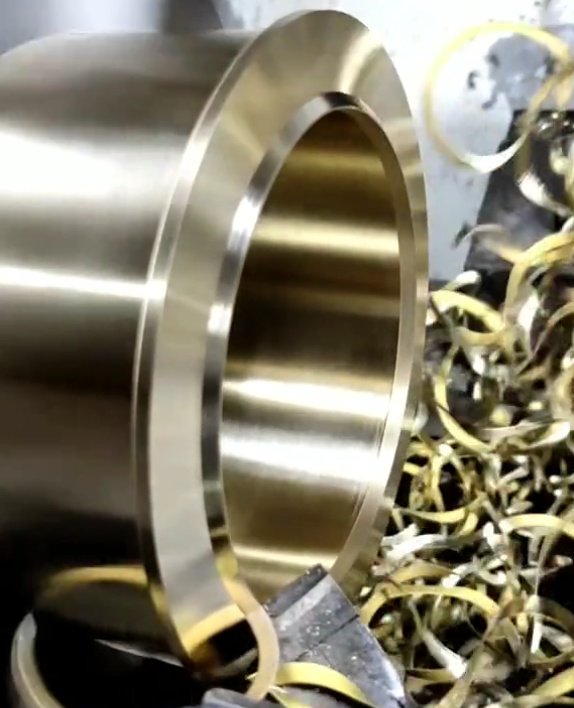
Engineering Challenges in Bronze CNC Machining
1
Heat, Tool Wear and Built-Up Edge
2
Thin-Wall Distortion
3
Burr Formation
Common Bronze Alloys for CNC Machining
| Bronze Alloy | Common Name | Key Properties | Typical CNC Machined Parts |
|---|---|---|---|
| C93200 | SAE 660 Bearing Bronze | Excellent machinability, good wear resistance, low friction | Bushings, bearings, thrust washers, sleeves |
| C95400 | Aluminum Bronze | High strength, corrosion resistance, good load capacity | Marine parts, pump components, valve parts, gears |
| C86300 | Manganese Bronze | Very high strength, good bearing performance under heavy load | Heavy-duty bushings, wear plates, industrial equipment parts |
| C54400 | Phosphor Bronze | Good fatigue resistance, spring properties, corrosion resistance | Electrical contacts, precision sleeves, clips, small turned parts |
| C65500 | Silicon Bronze | Good corrosion resistance and weldability | Marine fittings, fasteners, architectural hardware |
| C51000 | Phosphor Bronze | High fatigue strength, good formability and electrical performance | Connector parts, springs, thin precision components |
Alloy substitution caution
Substituting one bronze grade for another may change bearing life, shaft compatibility, corrosion performance and machining cost. For example, replacing C93200 with C95400 may increase strength, but it can also increase tool wear and alter friction behavior. Engineering approval is recommended before alloy substitution.
Achievable Tolerances and Surface Finishes
CNC machined bronze parts can achieve tight and repeatable tolerances when the alloy, feature geometry and inspection method are properly defined. Actual capability depends on part size, wall thickness, tolerance stack-up, tooling access and whether the component is cast, extruded or continuously cast bar stock.
| Feature Type | Typical Machining Capability | Engineering Notes |
|---|---|---|
| General milled or turned dimensions | ±0.005 in / ±0.13 mm commonly achievable | Suitable for many non-critical external features |
| Precision bores | ±0.001 in / ±0.025 mm or tighter with controlled process | Finish boring, reaming or honing may be used |
| Concentricity and runout | Application-dependent | Best controlled when critical diameters are machined in one setup |
| Surface finish | Ra 32 µin / 0.8 µm typical; finer possible | Bearing surfaces may require smoother finishes depending on shaft speed and lubrication |
| Threaded features | Class 2 or class 3 fit depending on requirement | Bronze can produce clean threads, but tool sharpness and chip control matter |
Bearing bores, press-fit diameters and sealing surfaces should be specified with clear tolerance, datum and surface finish requirements. Over-tolerancing non-functional features can increase machining time without improving product performance.
Applications of CNC Machined Bronze Parts
CNC machined bronze components are used in industries where sliding contact, corrosion resistance and dimensional stability are important. The material is especially common in machinery where lubrication may be limited or loads are high.
- Industrial machinery: bushings, bearings, wear plates, guide blocks, spacers and thrust washers.
- Marine equipment: propeller hardware, pump components, fittings, valve bodies and corrosion-resistant fastener parts.
- Oil and gas: valve seats, sealing rings, pump parts and non-sparking components where specified.
- Hydraulic and fluid systems: manifolds, sleeves, piston guides and precision valve components.
- Electrical and electronics: phosphor bronze contacts, connector parts and spring-like conductive components.
- Aerospace and defense equipment: high-reliability wear components, bushings and precision bronze hardware when material traceability is required.
In many assemblies, bronze bearing components protect more expensive shafts, housings and rotating equipment by acting as replaceable wear elements.
Design Guidelines for Machined Bronze Components
Design decisions affect machining cost, part life and inspection reliability. The following guidelines help improve manufacturability and reduce avoidable production risks.
- Define the bronze alloy by recognized standard, such as UNS C93200 or C95400, instead of using only a generic material name.
- Specify critical-to-function dimensions separately from general tolerances.
- Use realistic bore tolerances based on operating clearance, shaft tolerance and lubrication conditions.
- Avoid extremely thin walls unless necessary; thin bronze rings may deform during workholding.
- Include required surface finish on bearing, sealing and sliding faces.
- Clarify whether edges should be sharp, broken, chamfered or radiused.
- For press-fit bushings, consider that installation can reduce the final internal diameter.
- Provide datum references for concentricity, perpendicularity and true position requirements.
For sleeve bearings, a common engineering mistake is specifying only the free-state bore diameter. If the bushing is installed with interference, the operating bore after press-fit may be smaller. The drawing should reflect how the part will be inspected and how it will function in the final assembly.
Press-fit bushing note
A bronze bushing pressed into a housing can experience bore closure. The amount depends on interference, wall thickness, housing material and geometry. When final running clearance is critical, engineers may specify machining after installation or define an installed bore requirement.
Quality Control and Documentation
Precision bronze machining should include inspection planning that matches the application risk. Simple spacers may require standard dimensional inspection, while aerospace, marine, hydraulic or safety-related parts may require material certificates and advanced reporting.
- Material certification: confirms alloy grade, heat or lot traceability and chemical composition where required.
- Dimensional inspection: verifies critical dimensions using calipers, micrometers, bore gauges, CMMs, height gauges or thread gauges.
- Surface finish verification: important for bearing, sealing and sliding surfaces.
- First article inspection: useful for new production parts or components with tight tolerances.
- Process control: monitors tool wear, coolant condition, workholding and in-process measurements.
For production runs, in-process inspection is often more valuable than final inspection alone because bronze dimensions can shift as tools wear, parts heat up or thin walls relax after machining.
Cost Drivers in Bronze CNC Machining
The cost of bronze CNC machining is influenced by raw material price, alloy machinability, part complexity, tolerance requirements, surface finish, inspection level and order quantity. Bronze is often more expensive than aluminum or mild steel, so efficient material utilization can significantly affect total part cost.
| Cost Driver | Impact on Machining | Cost Reduction Opportunity |
|---|---|---|
| Alloy selection | Harder bronzes increase tool wear and cycle time | Select the grade based on function, not only strength |
| Tight tolerances | Require slower finishing, more inspection and possible secondary operations | Apply tight tolerances only to functional features |
| Deep bores | Increase risk of chatter, taper and tool deflection | Use practical length-to-diameter ratios where possible |
| Thin walls | Require careful workholding and staged machining | Increase wall thickness or allow finish machining after roughing |
| Small batch quantity | Setup time becomes a larger portion of unit cost | Combine releases or standardize similar parts when feasible |
Information Needed for Accurate Bronze CNC Machining Review
A complete technical package helps determine the correct machining process, tooling plan and inspection method. Useful information includes the 2D drawing, 3D CAD model, alloy grade, quantity, tolerance requirements, surface finish requirements and any applicable industry standards.
- Material grade, such as C93200, C95400, C86300, C54400 or C65500.
- Drawing format with dimensions, tolerances, datums and notes.
- CAD file format, such as STEP, IGES, Parasolid or native model.
- Required quantity for prototype, low-volume or production machining.
- Critical features, including bearing bores, sealing faces, threads and press-fit diameters.
- Inspection requirements, such as material certificates, first article inspection or full dimensional report.
- Finishing requirements, including deburring, polishing, passivation where applicable, oil impregnation or special packaging.
With the correct alloy selection, controlled machining strategy and appropriate inspection plan, bronze CNC machining services can deliver durable, accurate and production-ready parts for demanding mechanical, marine, hydraulic and electrical applications.