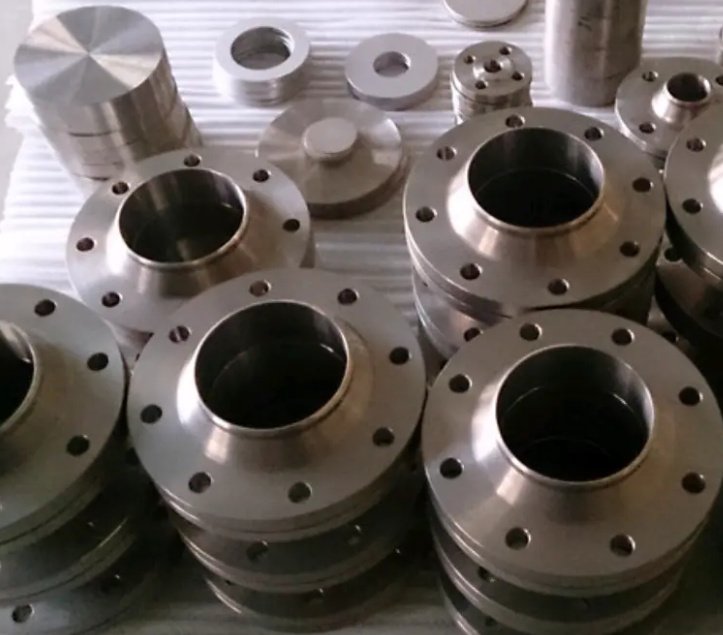
Titanium Flanges are engineered pipe connection components used where stainless steel, duplex steel or nickel alloys may suffer from chloride corrosion, seawater attack, oxidizing acids or weight limitations. Manufactured from commercially pure titanium and titanium alloys, these flanges provide a high strength-to-weight ratio, excellent corrosion resistance and reliable sealing performance in demanding industrial piping systems.
Our titanium flange range covers weld neck, slip-on, blind, lap joint, socket weld, threaded and custom machined flanges according to ASTM B381, ASME B16.5, ASME B16.47, EN 1092-1, DIN, JIS and customer drawings. Typical applications include desalination plants, chlor-alkali production, offshore platforms, heat exchangers, chemical processing, pulp bleaching systems, marine pipelines and aerospace fluid systems.
Product Overview: What Is a Titanium Flange?
A titanium flange is a forged or machined circular fitting used to connect titanium pipe, valves, pressure vessels, pumps and equipment nozzles. It is normally installed with bolts, nuts and a gasket to create a removable pressure-tight joint. Compared with carbon steel or stainless steel flanges, titanium flanges are selected when corrosion allowance, service life, contamination control and lifecycle cost are more important than initial material cost.
Titanium Flanges are especially valuable in chloride-rich environments because titanium naturally forms a dense and self-healing titanium dioxide film on its surface. In clean natural seawater at ambient temperature, commercially pure titanium commonly shows corrosion rates below 0.01 mm/year, making it a preferred material for seawater cooling lines, condenser connections and desalination brine systems.
| Item | Available Range |
|---|---|
| Product | Titanium pipe flange, titanium alloy flange, forged titanium flange, custom machined flange |
| Size | NPS 1/2 to NPS 48, or customized according to drawings |
| Pressure Class | Class 150, 300, 600, 900, 1500, 2500; PN6 to PN100 |
| Facing | Raised face, flat face, ring type joint, tongue and groove, male and female |
| Standards | ASTM B381, ASME B16.5, ASME B16.47, EN 1092-1, DIN, JIS, GB/T, custom drawings |
| Manufacturing | Forging, heat treatment, CNC machining, drilling, facing, inspection, marking and packing |
Available Titanium Grades and Material Selection
Selecting the correct titanium grade is essential for pressure integrity, corrosion resistance and weldability. The most common materials for titanium flanges are ASTM B381 Grade F2, F5, F7 and F12, corresponding to different service conditions and mechanical requirements.
| Grade | Common Name | Key Characteristics | Typical Use |
|---|---|---|---|
| Grade 1 / F1 | Commercially Pure Titanium | Highest ductility, excellent formability, lower strength | Low-pressure chemical and marine systems |
| Grade 2 / F2 | Commercially Pure Titanium | Balanced strength, weldability and corrosion resistance | Seawater, desalination, heat exchangers, chemical piping |
| Grade 5 / F5 | Ti-6Al-4V | High strength, good fatigue resistance, lower ductility than CP titanium | Aerospace, high-strength bolted connections, special equipment |
| Grade 7 / F7 | Ti-Pd Alloy | Enhanced resistance in reducing acid environments due to palladium addition | Acid processing, aggressive chemical systems |
| Grade 12 / F12 | Ti-Ni-Mo Alloy | Improved crevice corrosion resistance and higher strength than Grade 2 | Hot brine, heat exchanger piping, severe chloride service |
For most seawater and general chemical piping systems, Grade 2 titanium flanges offer the best balance between performance and cost. For high-strength applications, Grade 5 titanium flanges may be selected, while Grade 7 or Grade 12 should be considered when reducing acids, hot chlorides or crevice corrosion risks are present.
Types of Titanium Flanges
Titanium flanges can be supplied in standard and non-standard configurations. The type should be selected according to pipe connection method, pressure class, inspection requirements, welding accessibility and maintenance frequency.
Titanium Weld Neck Flange
A titanium weld neck flange has a long tapered hub and is butt-welded to the pipe. It is preferred for high-pressure, high-temperature or cyclic loading service because the hub helps reduce stress concentration. Weld neck titanium flanges are commonly used in chemical process lines, offshore seawater systems and pressure equipment nozzles.
Titanium Slip-On Flange
A titanium slip-on flange slides over the pipe and is fillet-welded on both sides. It is easier to align than a weld neck flange and is often used in low-to-medium pressure titanium piping systems. For corrosive media, welding quality and crevice control should be carefully reviewed.
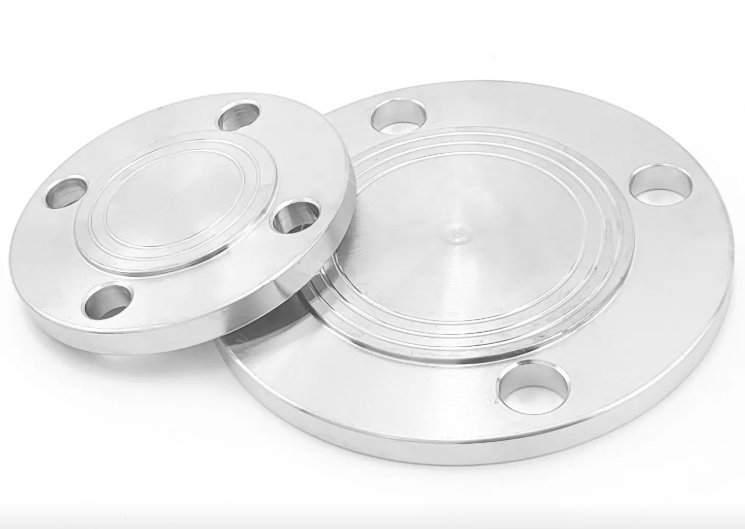
Titanium Blind Flange
A titanium blind flange is used to close the end of a pipeline, valve or pressure vessel opening. It allows future extension or inspection access while maintaining corrosion resistance. Blind flanges are often specified in seawater intake systems, titanium heat exchanger channels and chemical storage connections.
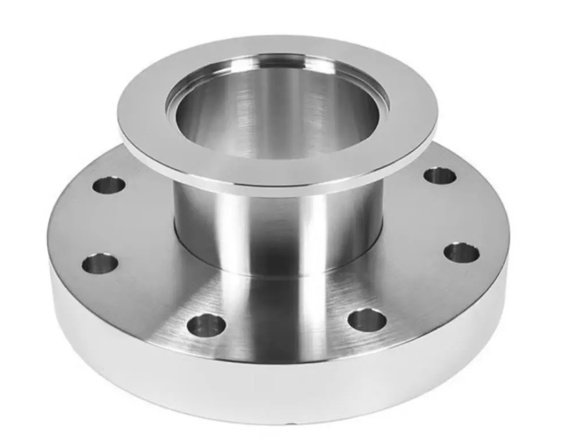
Titanium Lap Joint Flange
A titanium lap joint flange is used with a stub end. It is suitable when frequent dismantling is required or when bolt-hole alignment is critical. In some projects, a titanium stub end with a loose backing flange can reduce cost while maintaining corrosion resistance at the wetted surface.
Titanium Socket Weld and Threaded Flanges
Socket weld titanium flanges are used for small-bore high-integrity piping, while threaded titanium flanges are used where welding is not preferred. For corrosive or crevice-sensitive service, threaded designs should be evaluated carefully because thread roots may retain stagnant media.
When should a buyer choose a weld neck titanium flange instead of a slip-on flange?
Choose a weld neck flange when the system has high pressure, thermal cycling, vibration, hazardous media or strict fatigue requirements. Choose a slip-on flange when installation economy and alignment convenience are more important and the pressure class is moderate.
Standards, Dimensions and Pressure Ratings
Titanium flanges are commonly manufactured to the same dimensional standards used for steel flanges, while the material specification follows titanium forging standards. The most requested standard for forged titanium flanges is ASTM B381, which covers titanium and titanium alloy forgings for industrial applications.
| Standard | Scope | Engineering Relevance |
|---|---|---|
| ASTM B381 | Titanium and titanium alloy forgings | Defines grade, chemistry, mechanical properties and forging requirements |
| ASME B16.5 | Pipe flanges and flanged fittings up to NPS 24 | Defines dimensions, pressure classes, facing and bolt patterns |
| ASME B16.47 | Large diameter steel flanges | Often referenced for large titanium flanges above NPS 24 |
| EN 1092-1 | European circular flanges | Used for PN-rated systems in European and international projects |
| DIN / JIS / GB | Regional flange standards | Used for replacement projects and equipment exported to specific markets |
Critical dimensional items include outside diameter, flange thickness, bolt circle diameter, number of bolt holes, bolt hole diameter, bore size, hub diameter, hub length, raised face height and gasket contact surface finish. For gasket sealing, the machined facing finish should be matched with gasket type, pressure rating and process media.
Manufacturing and Machining Capabilities
Titanium flange production requires strict control of raw material, forging temperature, machining parameters and surface cleanliness. Titanium has low thermal conductivity and high chemical reactivity at elevated temperatures, so poor machining practice may cause work hardening, galling, tool wear or surface contamination.
Our production process includes titanium sponge or ingot control, billet cutting, heating, forging, heat treatment, rough machining, ultrasonic inspection when required, CNC finishing, bolt hole drilling, facing, deburring, cleaning, marking and protective packing. CNC machining enables tight control of bolt-hole position, sealing face flatness, bore concentricity and special drawing dimensions.
| Process | Control Point | Purpose |
|---|---|---|
| Forging | Controlled heating and deformation | Improves grain structure and mechanical consistency |
| Heat Treatment | Grade-specific temperature and cooling procedure | Stabilizes mechanical properties and relieves stress |
| CNC Turning | Controlled feed, coolant and tooling | Maintains flatness, thickness and sealing surface quality |
| Drilling | Bolt-hole spacing and perpendicularity | Ensures assembly compatibility with valves and mating flanges |
| Surface Cleaning | Removal of oil, iron particles and shop contamination | Protects titanium corrosion resistance and prevents galvanic contamination |
Why is iron contamination control important during titanium flange machining?
Embedded iron particles from carbon steel tools, grinding dust or mixed-material workshops can create local corrosion points on titanium surfaces. Dedicated tools, clean work areas and proper pickling or cleaning procedures help preserve the passive titanium oxide layer.
Engineering Performance in Corrosive Service
Titanium is frequently specified when piping systems face chloride stress corrosion cracking, pitting, crevice corrosion or rapid general corrosion in conventional alloys. In many seawater and brine systems, the material decision is driven by lifecycle cost rather than the initial flange price.
In a typical desalination plant, replacing stainless steel flanges that suffer from chloride pitting with Grade 2 titanium flanges can reduce unplanned shutdown risk and eliminate repeated flange replacement. While actual results depend on temperature, flow rate, oxygen content, crevice geometry and cleaning chemistry, titanium is widely used because its passive oxide film remains stable in oxidizing chloride environments.
| Problem | Risk in Conventional Materials | Titanium Flange Advantage |
|---|---|---|
| Seawater corrosion | Pitting, crevice corrosion and leakage at gasket areas | Excellent resistance in natural seawater and marine atmosphere |
| Chloride stress corrosion cracking | Austenitic stainless steels may crack under tensile stress | Titanium is highly resistant to chloride SCC in common service conditions |
| Weight limitation | Heavy flanges increase support load and installation difficulty | Titanium density is about 4.51 g/cm³, roughly 56% of stainless steel density |
| Metal contamination | Process media may be contaminated by corrosion products | Low corrosion rate helps maintain process purity |
| High lifecycle maintenance | Frequent replacement and shutdown costs | Long service life can offset higher initial procurement cost |
For engineers, the most important design checks include galvanic compatibility, gasket selection, bolt material, flange face finish, cathodic protection influence, maximum operating temperature, oxygen availability and whether the medium is oxidizing or reducing. In reducing acids such as hydrochloric acid, Grade 7 titanium or another alloyed titanium grade may be required instead of Grade 2.
Quality Control, Testing and Documentation
Titanium flange quality should be verified through both material traceability and dimensional inspection. Each batch can be supplied with mill test certificates, chemical composition reports, mechanical test results and dimensional inspection records. Additional testing may be specified for critical equipment, offshore projects or pressure-containing applications.
- Raw material verification and heat number traceability
- Chemical composition analysis according to the specified titanium grade
- Tensile strength, yield strength and elongation testing when required
- Ultrasonic testing for forged titanium flanges when specified
- Visual inspection for cracks, laps, folds, machining defects and surface contamination
- Dimensional inspection of OD, ID, bolt circle, thickness, hub and facing
- Surface roughness inspection for raised face, flat face or RTJ groove
- Positive material identification where project specifications require PMI
Material traceability is especially important for EPC projects, pressure equipment suppliers and maintenance buyers who must match flange materials with titanium pipe, titanium fittings, titanium valves and titanium heat exchanger components.
What documents are commonly requested with titanium flanges?
Common documents include MTC according to EN 10204 3.1, chemical analysis, mechanical test report, dimensional inspection report, heat treatment record, ultrasonic test report if applicable, PMI report, packing list and certificate of conformity.
Procurement Guidance for Buyers and Engineers
To purchase titanium flanges accurately, buyers should define not only size and pressure class but also grade, standard, flange type, facing, gasket requirement, inspection level and documentation requirement. Incomplete specifications may lead to mismatched bolt holes, incorrect gasket seating, unsuitable grade selection or delays during site installation.
A complete inquiry for titanium pipe flanges usually includes:
- Flange type: weld neck, slip-on, blind, lap joint, socket weld, threaded or custom
- Material grade: ASTM B381 F2, F5, F7, F12 or other titanium alloy
- Dimensional standard: ASME B16.5, ASME B16.47, EN 1092-1, DIN, JIS or drawing
- Size and pressure class: for example, NPS 6 Class 150 or DN150 PN16
- Facing type: RF, FF, RTJ or special facing
- Pipe schedule or bore requirement for weld neck and slip-on flanges
- Quantity, delivery schedule and packing requirement
- Required certificates, NDT, PMI or third-party inspection
From an engineering purchasing perspective, the lowest unit price is not always the lowest installed cost. Correct grade selection, accurate flange machining, complete certificates and clean packaging can reduce welding rework, assembly problems and corrosion-related maintenance. For seawater and aggressive chemical piping, titanium flanges should be evaluated as part of the full system, including titanium pipe, titanium fittings, gasket material and bolting strategy.
Typical Applications of Titanium Flanges
Titanium flanges are used across industries where corrosion resistance, low weight and long-term reliability are required. Their performance is particularly valuable in piping systems that operate continuously and where leakage or shutdown would be expensive.
- Seawater cooling systems and offshore platforms
- Desalination plants, evaporators and brine pipelines
- Chlor-alkali and chlorine dioxide production
- Chemical reactors, acid transfer lines and process equipment
- Plate heat exchangers, shell-and-tube heat exchangers and condenser connections
- Marine engineering, shipbuilding and ballast water systems
- Pulp and paper bleaching equipment
- Power plant cooling water and auxiliary systems
- Aerospace hydraulic, fuel and specialty fluid systems
Whether the requirement is a standard ASME titanium weld neck flange or a drawing-based custom titanium flange, the final specification should balance corrosion resistance, mechanical load, flange standard, welding procedure and inspection requirements. Properly specified and manufactured titanium flanges deliver durable sealing performance in some of the most corrosive industrial environments.