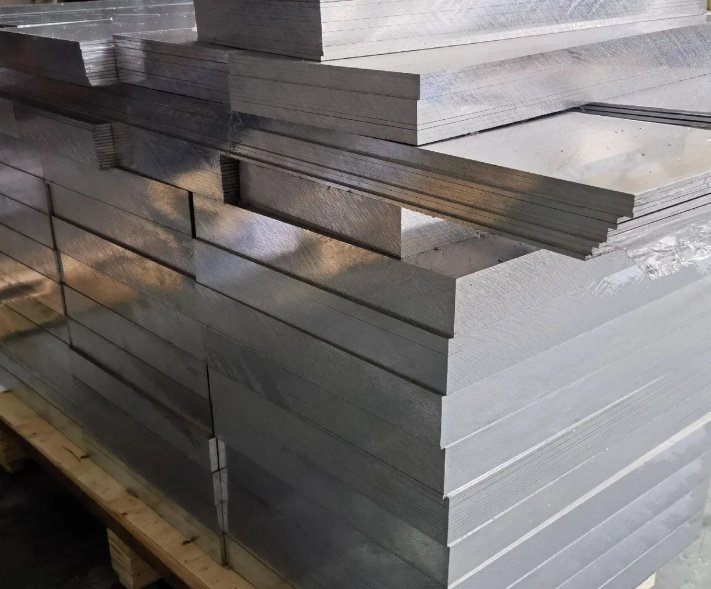
5052 aluminum is a non-heat-treatable aluminum-magnesium alloy widely specified for sheet, plate and coil applications that need strong corrosion resistance, good formability and moderate-to-high strength. In engineering documents, it may appear as AA 5052, UNS A95052, EN AW-5052 or AlMg2.5. Buyers often search for Al 5052, al alloy 5052 or Aluminum 5052 when comparing marine-grade sheet, tank plate, formed enclosures, vehicle panels and welded assemblies.
The key advantage of 5052 is its balance: it is stronger than common 3003 aluminum, easier to form than many 5xxx marine alloys and more corrosion resistant in saltwater atmospheres than 6061 in many sheet-metal applications. It is not the highest-strength aluminum alloy, and it is not strengthened by heat treatment, but it is one of the most practical choices when forming, welding and environmental durability matter more than maximum machinability.
What Is 5052 Aluminum?
5052 aluminum is a wrought aluminum alloy from the 5xxx series, where magnesium is the main alloying element. Chromium is also added to help control grain structure and improve resistance to stress corrosion in appropriate service conditions. Because it is non-heat-treatable, its mechanical strength is increased mainly through strain hardening, also called work hardening, rather than solution heat treatment and aging.
This makes 5052 especially useful for formed sheet and plate parts. Manufacturers can specify a temper such as O, H32 or H34 to match the required balance of elongation, yield strength and bend performance.
5052 Aluminum Chemical Composition
The exact composition limits depend on the standard and producer certification, but the following ranges are commonly associated with 5052 aluminum sheet and plate under ASTM B209/B209M and similar wrought aluminum specifications.
| Element | Typical Range or Maximum | Engineering Role |
|---|---|---|
| Aluminum, Al | Balance | Base metal, lightweight structure |
| Magnesium, Mg | 2.2% - 2.8% | Increases strength and corrosion resistance |
| Chromium, Cr | 0.15% - 0.35% | Improves grain control and corrosion behavior |
| Iron, Fe | 0.40% max | Impurity control; affects ductility and finish |
| Silicon, Si | 0.25% max | Impurity control |
| Copper, Cu | 0.10% max | Kept low to preserve corrosion resistance |
| Manganese, Mn | 0.10% max | Minor addition or residual |
| Zinc, Zn | 0.10% max | Minor residual |
The relatively low copper content is one reason 5052 performs well in moisture, marine atmosphere and many industrial environments compared with copper-bearing aluminum alloys.
Key Mechanical and Physical Properties
The mechanical values of 5052 vary significantly by temper, product thickness and test direction. The following table provides useful reference ranges for common sheet and plate tempers. Always verify certified mill test reports for final design.
| Property | 5052-O | 5052-H32 | 5052-H34 | Engineering Meaning |
|---|---|---|---|---|
| Ultimate tensile strength | Approx. 170 - 215 MPa | Approx. 210 - 260 MPa | Approx. 235 - 290 MPa | Maximum stress before fracture |
| Yield strength | Approx. 65 - 95 MPa | Approx. 160 - 195 MPa | Approx. 180 - 215 MPa | Stress level where permanent deformation begins |
| Elongation | Approx. 18% - 28% | Approx. 8% - 15% | Approx. 6% - 12% | Higher values generally improve forming and bending |
| Density | Approx. 2.68 g/cm³ | About one-third the density of carbon steel | ||
| Elastic modulus | Approx. 70 GPa | Similar stiffness to most aluminum alloys | ||
| Thermal conductivity | Approx. 138 W/m·K | Useful for enclosures and heat-spreading panels | ||
| Electrical conductivity | Approx. 35% IACS | Moderate conductivity, not a primary electrical conductor alloy | ||
For structural calculations, engineers should not use generic internet values alone. Certified yield strength, thickness tolerance, grain direction, minimum bend radius and applicable safety factors must be confirmed for the actual product form.
Common 5052 Tempers and How to Choose Them
Temper selection has a direct effect on forming behavior, springback, tensile strength and surface condition. The most common options for sheet-metal work are O, H32 and H34.
| Temper | Description | Best Used For | Important Trade-Off |
|---|---|---|---|
| 5052-O | Annealed, softest condition | Deep drawing, severe forming, tight bends | Lowest strength among common tempers |
| 5052-H32 | Strain hardened and stabilized to quarter-hard level | General sheet fabrication, marine panels, tanks, covers | Moderate springback and moderate formability |
| 5052-H34 | Strain hardened and stabilized to half-hard level | Parts needing higher strength with moderate bending | Less ductile than H32 and O |
| 5052-H112 | Strain-hardened condition often associated with plate | Plate applications with moderate forming and welding | Properties depend strongly on product and thickness |
In practical purchasing, 5052-H32 is often the default choice for balanced sheet fabrication. For parts with severe bends, drawn corners or cosmetic cracking risk, 5052-O may reduce scrap. For flatter panels where added strength is useful and bend severity is lower, 5052-H34 may be preferred.
Buyer and engineer note: choosing a temper for formed sheet parts
If a part fails at the bend line, switching from H34 to H32 or O may solve the issue faster than changing alloy. If the part passes forming but deforms in service, moving from O to H32 may improve yield strength without changing the material family. For high-volume procurement, ask suppliers to quote by alloy, temper, thickness tolerance, surface finish, PVC film requirement, grain direction and applicable standard rather than by alloy name alone.
Corrosion Resistance: Why 5052 Is Used in Marine and Outdoor Environments
The 5xxx aluminum-magnesium family is valued for resistance to atmospheric corrosion, salt spray and many freshwater environments. 5052 is commonly used in boat components, dock hardware, fuel tanks, truck panels, outdoor cabinets and chemical equipment covers because it forms a stable aluminum oxide film and avoids the higher copper levels found in some aerospace alloys.
A major engineering benefit is that 5052 can retain good surface durability after forming and welding when correct fabrication practices are used. For marine service, chloride exposure, crevice geometry, dissimilar-metal contact and coating quality often control real-world performance more than the alloy name alone.
Galvanic Corrosion Considerations
When 5052 is connected to stainless steel, carbon steel, brass or copper in wet service, galvanic corrosion may occur if the joint is not isolated. Use compatible fasteners, sealing washers, non-conductive barriers, drainage paths and appropriate coating systems. Avoid water-trapping lap joints where possible.
Surface Finishes for 5052
- Mill finish: economical and common for internal or non-cosmetic parts.
- Brushed finish: used for panels, cabinets and visible sheet-metal products.
- Anodized finish: possible on 5052, often with good corrosion protection, though color uniformity should be verified for appearance-critical work.
- Powder coating or painting: common for outdoor enclosures and vehicle components after proper cleaning and pretreatment.
5052 Aluminum vs 6061, 3003, 5083 and 5754
Searchers often compare 5052 with 6061 because both are common aluminum alloys, but they solve different problems. 6061 is heat treatable and often better for machined structural components. 5052 is usually better for sheet forming, marine atmosphere and welded sheet assemblies where high machinability is not the main requirement.
| Alloy | Main Strength | Formability | Corrosion Resistance | Weldability | Typical Use Case |
|---|---|---|---|---|---|
| 5052 | Medium | Excellent to good, depending on temper | Very good, especially in marine atmosphere | Very good | Marine sheet, tanks, enclosures, formed panels |
| 6061-T6 | Higher than 5052-H32 | Moderate; less suited to tight bends in T6 | Good, but often less marine-oriented than 5052 | Good, but heat-affected zone loses strength | Machined parts, frames, structural extrusions |
| 3003 | Lower than 5052 | Excellent | Good | Good | General sheet, ducts, cookware, light tanks |
| 5083 | Higher than 5052 | Good, but less forgiving than 5052 in some forming | Excellent in marine environments | Excellent | Marine plate, pressure vessels, heavy transport |
| 5754 | Similar to moderately higher, depending on temper | Very good | Very good | Very good | Automotive panels, flooring, welded structures |
5052 vs 6061
Choose 5052 when the part is mainly a formed sheet component, corrosion resistance is important, or welding and bending are frequent. Choose 6061 when the part is a machined block, structural extrusion, bracket or component that benefits from T6 strength and better chip formation.
5052 vs 3003
Choose 5052 when strength and saltwater resistance need to be better than general-purpose sheet. Choose 3003 when maximum formability, lower cost and lighter-duty service are more important than strength.
5052 vs 5083
Choose 5052 for formed sheet and moderate marine service. Choose 5083 for heavier marine plate, welded structures and higher-strength applications where the additional cost and forming constraints are justified.
Procurement note: when a cheaper substitute may create hidden cost
Replacing 5052-H32 with 3003-H14 may reduce material cost, but it can increase denting, deformation or warranty risk in outdoor panels and tanks. Replacing 5052 with 6061-T6 can increase cracking risk in tight bends. A lower material price is not always a lower installed cost if scrap, rework, coating failure or field corrosion increases.
Forming, Bending and Fabrication Guidelines
5052 is one of the most fabrication-friendly aluminum alloys for sheet-metal shops. It can be sheared, punched, laser cut, waterjet cut, bent, roll formed, spun and drawn, provided the temper and bend radius are correctly selected.
A practical rule is simple: softer tempers tolerate tighter bends, while harder tempers provide higher strength but need larger radii. The bend should also consider grain direction. Bending perpendicular to the rolling direction usually performs better than bending parallel to the grain.
| Fabrication Operation | 5052 Performance | Engineering Notes |
|---|---|---|
| Air bending | Very good | Expect more springback than mild steel; adjust tooling angle and process controls. |
| Deep drawing | Good in O temper | Use proper lubrication and blank-holder pressure to reduce tearing and wrinkling. |
| Punching | Good | Use suitable die clearance to minimize burrs and edge cracking. |
| Laser cutting | Good | Reflectivity and thermal conductivity require correct machine settings. |
| Roll forming | Good | H32 is commonly used for balanced profile strength and formability. |
For critical bends, prototype using the exact production thickness, temper and supplier source. Small differences in actual yield strength or surface condition can affect cracking and springback in high-volume production.
Machining 5052 Aluminum: What to Expect
5052 is machinable, but it is not normally selected as a first-choice machining aluminum alloy. Compared with 6061-T6 or 6082-T6, 5052 is softer and more ductile, so chips may be longer and more likely to adhere to cutting tools. It can still be milled, drilled, countersunk and tapped successfully with sharp tooling and correct parameters.
For CNC machining, sharp carbide tools, polished flutes, adequate coolant or mist lubrication and high chip evacuation are recommended. Avoid rubbing, because heat buildup can worsen built-up edge and surface smearing.
| Process | Common Issue | Practical Solution |
|---|---|---|
| Drilling | Long chips and burr formation | Use sharp drills, proper point geometry, peck cycles and backing support. |
| Milling | Built-up edge and gummy chips | Use high rake tools, coolant and chip-clearing toolpaths. |
| Tapping | Thread galling or tearing | Use forming taps only after testing; cutting taps and lubricant may be safer. |
| Countersinking | Chatter and cosmetic marks | Use controlled speed, sharp tools and stable fixturing. |
If a component is mostly machined from billet and has limited forming requirements, 6061-T6 is usually more economical to machine. If the component is cut, bent, welded and only lightly machined, 5052 remains a strong candidate.
Manufacturing note: example of a real shop-floor problem
A fabricated enclosure originally specified in 6061-T6 developed cracks on 90-degree bends around cable cutouts. After switching to 5052-H32 and increasing the inside bend radius from approximately 1.0t to 1.5t, pilot production reduced bend-related scrap from about 7% to below 1% while maintaining sufficient panel rigidity. This type of result depends on tooling, thickness, grain direction and inspection criteria, but it illustrates why alloy selection should match the manufacturing process rather than only the strength target.
Welding and Joining Performance
5052 has very good weldability using common arc welding processes, including GTAW/TIG and GMAW/MIG. It is frequently welded in tanks, marine components, cabinets and sheet-metal structures. Suitable filler metals commonly include 5356 and, in some cases, 5554 or other fillers selected according to design code, anodizing needs, strength requirements and service temperature.
Because 5052 gains strength through strain hardening, welding locally softens the heat-affected zone. This means the welded area may not retain the same strength as the original H32 or H34 base metal. Design calculations should account for weld efficiency and reduced heat-affected-zone properties where relevant.
- Clean oxide, oil and marking fluids before welding.
- Use stainless steel brushes dedicated to aluminum only.
- Control heat input to reduce distortion in thin sheet.
- Avoid joint designs that trap moisture in corrosive environments.
- Verify filler selection if the welded part will be anodized for appearance.
Typical Applications of 5052 Aluminum
5052 is selected where formed geometry, low weight, weldability and corrosion resistance need to work together. Common applications include:
- Marine panels, boat parts, hull interior structures and dock components
- Fuel tanks, hydraulic tanks and non-pressure liquid containers
- Truck and trailer body panels, tread plates and toolboxes
- Electrical enclosures, outdoor cabinets and control boxes
- Aircraft and transportation sheet-metal parts where applicable specifications allow
- Kitchen, appliance and architectural panels
- Chemical equipment covers and splash guards
- Battery trays, brackets and protective housings
It is especially useful for medium-duty sheet parts exposed to water, road salt or outdoor weather. For pressure vessels, load-bearing structures, food contact or regulated transport applications, the governing code and material certification should be checked before final selection.
Product Forms, Standards and Ordering Information
5052 is most commonly purchased as sheet, coil, strip, tread plate and plate. It is less commonly selected for complex extrusions than 6xxx alloys. Relevant standards may include ASTM B209/B209M for aluminum and aluminum-alloy sheet and plate, EN 485 for aluminum sheet, strip and plate in European supply chains, and customer-specific automotive, marine or industrial specifications.
| Ordering Field | Why It Matters | Example |
|---|---|---|
| Alloy and temper | Controls strength and formability | 5052-H32 or 5052-O |
| Thickness | Affects weight, bending, stiffness and cost | 1.5 mm, 2.0 mm, 3.0 mm, 6.0 mm |
| Width and length | Determines nesting yield and cutting efficiency | 1220 x 2440 mm, 1500 x 3000 mm, coil width |
| Surface finish | Important for cosmetic, anodized or painted parts | Mill finish, brushed, PVC-coated |
| Tolerance standard | Prevents disputes over thickness, flatness and width | ASTM B209/B209M or EN 485 |
| Certification | Needed for traceability and engineering approval | Mill test certificate, heat number, RoHS/REACH if required |
Buyer note: questions to resolve before placing a production order
- Will the part be bent, drawn, welded, machined, anodized or painted?
- Is the drawing based on minimum strength, typical strength or supplier data?
- Is grain direction critical for bends or visible surface grain?
- Does the application involve salt spray, road salt, chemicals or dissimilar metals?
- Is flatness or surface scratch control more important than lowest price?
- Are test certificates, lot traceability and compliance documents required?
Design Example: Weight and Stiffness Considerations
Aluminum selection is often driven by weight reduction. A 1 m² panel made from 3.0 mm thick 5052 aluminum has an approximate mass:
Mass = area × thickness × density = 1 m² × 0.003 m × 2680 kg/m³ = approximately 8.04 kg.
A similar 3.0 mm carbon steel panel would weigh roughly 23.6 kg using a density of 7850 kg/m³. This gives a weight reduction of about 66%. However, aluminum has about one-third the elastic modulus of steel, so a direct thickness substitution may reduce stiffness. Engineers often add beads, flanges, ribs or a slightly thicker gauge to improve panel rigidity without losing the weight advantage.
For formed enclosures, this is one reason 5052 works well: flanges and bends can increase stiffness efficiently while preserving corrosion resistance and manufacturability.
Advantages and Limitations of 5052 Aluminum
| Advantages | Limitations |
|---|---|
| Very good corrosion resistance in marine and outdoor atmospheres | Not heat treatable, so strength cannot be increased by T6 aging |
| Excellent formability, especially in O and H32 tempers | Lower machinability than 6061-T6 for complex CNC parts |
| Good weldability with common aluminum welding processes | Welded zones may soften compared with strain-hardened base metal |
| Better strength than 3003 in many sheet applications | Not as strong as 5083 or 6061-T6 in many structural comparisons |
| Good surface finishing options, including painting and anodizing | Surface appearance can vary by mill source and processing route |
When 5052 Aluminum Is the Right Choice
5052 aluminum is a strong candidate when the part must be bent or formed, exposed to moisture or salt-containing environments, welded into an assembly, and produced with consistent sheet-metal quality. It is often the right alloy for marine panels, outdoor enclosures, tanks, transportation panels and medium-strength fabricated components.
It may not be the best choice for heavily machined parts, high-temperature service, maximum-strength structures or applications where a heat-treatable alloy is required. In those cases, compare 6061, 6082, 5083, 7075 or stainless steel according to the design load, corrosion environment, manufacturing route and cost target.
In short, 5052 is best understood as a practical engineering alloy: corrosion resistant, weldable, formable and strong enough for many real-world sheet and plate applications. Correct temper selection, bend design, joining method and supplier certification are the factors that turn the material specification into a reliable finished product.