
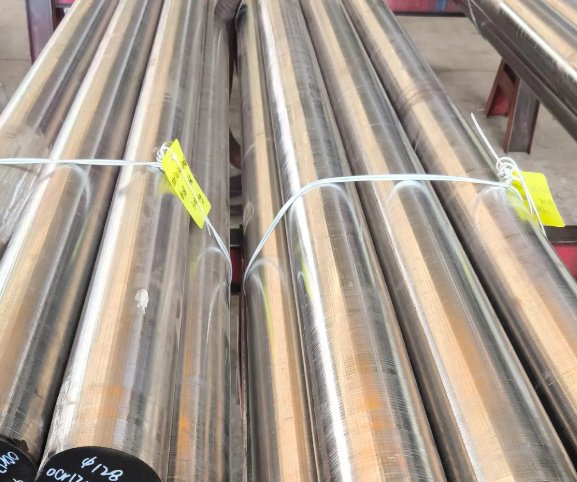
17-4PH alloy steel is more accurately known as 17-4 PH precipitation-hardening stainless steel. It is widely specified as UNS S17400, AISI 630, Type 630 stainless steel and EN 1.4542. The alloy combines high strength, good corrosion resistance and practical machinability, making it a common choice for shafts, valve parts, pump components, aerospace fittings, marine hardware, food-processing parts and precision mechanical components.
The “17-4” name refers broadly to its chromium and nickel content, while “PH” means precipitation hardening. The material is typically supplied in solution-annealed Condition A and then aged to conditions such as H900, H1025, H1075, H1100 or H1150 to obtain the required strength, hardness and toughness balance.
What Is 17-4PH Alloy Steel?
17-4PH is a martensitic precipitation-hardening stainless steel strengthened by copper-rich precipitates during aging. Compared with conventional martensitic stainless steels, it offers a more stable combination of high tensile strength, dimensional control after heat treatment and corrosion resistance close to 304 stainless steel in many mild environments.
In engineering documents, buyers may see several equivalent names:
- UNS: S17400
- AISI / SAE: 630 stainless steel
- EN / Werkstoff: 1.4542, X5CrNiCuNb16-4
- Common name: 17-4 PH, 17-4PH, Type 630
- Material family: precipitation-hardening martensitic stainless steel
17-4PH Chemical Composition and Relevant Specifications
The alloy chemistry is designed to balance corrosion resistance, hardenability, strength and aging response. Chromium supports stainless corrosion resistance, nickel improves toughness, copper enables precipitation hardening, and niobium/columbium contributes to strengthening and grain stability.
| Element | Typical Range | Function in 17-4PH |
|---|---|---|
| Chromium, Cr | 15.0–17.5% | Stainless corrosion resistance and oxidation resistance |
| Nickel, Ni | 3.0–5.0% | Toughness and phase stability |
| Copper, Cu | 3.0–5.0% | Precipitation hardening response |
| Niobium + Tantalum, Nb + Ta | 0.15–0.45% | Strengthening and microstructural control |
| Carbon, C | ≤ 0.07% | Controls hardness and weldability risk |
| Manganese, Mn | ≤ 1.00% | Steelmaking control |
| Silicon, Si | ≤ 1.00% | Deoxidation and oxidation behavior |
| Phosphorus, P | ≤ 0.04% | Residual impurity control |
| Sulfur, S | ≤ 0.03% | Residual impurity; affects machinability and toughness |
| Iron, Fe | Balance | Base metal |
Common procurement and engineering standards include ASTM A564 for bars and shapes, ASTM A693 for plate, sheet and strip, ASTM A705 for forgings, AMS 5643 for bars and forgings, AMS 5604 for sheet and strip, and ASTM A484 general requirements for stainless bars. Final acceptance should be based on the applicable standard, drawing revision and mill test certificate.
Heat Treatment Conditions: H900, H1025, H1075, H1100 and H1150
17-4PH is usually solution treated at approximately 1900°F / 1040°C and air cooled to Condition A. Aging then develops the final mechanical properties. Lower aging temperatures usually produce higher strength and hardness, while higher aging temperatures improve toughness, ductility and resistance to stress-corrosion cracking.
| Condition | Typical Aging Cycle | General Result | Typical Use Case |
|---|---|---|---|
| H900 | 900°F / 482°C for about 1 hour, air cool | Maximum strength and hardness | High-load precision parts where toughness demand is moderate |
| H1025 | 1025°F / 552°C for about 4 hours, air cool | High strength with improved toughness | Shafts, fittings and structural components |
| H1075 | 1075°F / 580°C for about 4 hours, air cool | Balanced strength and ductility | General mechanical service |
| H1100 | 1100°F / 593°C for about 4 hours, air cool | Lower hardness, better toughness | Parts requiring reduced brittleness and better impact behavior |
| H1150 | 1150°F / 621°C for about 4 hours, air cool | Best toughness among common single-aging conditions | Marine, pressure and fatigue-sensitive applications |
For high-reliability components, heat treatment should be defined by both condition and acceptance criteria. A drawing that states only “17-4PH” is incomplete if strength, hardness, corrosion resistance or dimensional stability is critical.
Mechanical Properties by Condition
Mechanical properties vary significantly by product form, section size, heat treatment and specification. The following values are typical engineering reference ranges and should be verified against ASTM, AMS or project-specific acceptance limits.
| Condition | Tensile Strength | Yield Strength, 0.2% | Elongation | Hardness |
|---|---|---|---|---|
| Condition A | Approximately 150 ksi / 1030 MPa | Approximately 110 ksi / 760 MPa | Approx. 10–15% | Approx. 32–38 HRC |
| H900 | Approx. 190–200 ksi / 1310–1380 MPa | Approx. 170–185 ksi / 1170–1275 MPa | Approx. 8–10% | Approx. 40–45 HRC |
| H1025 | Approx. 155–170 ksi / 1070–1170 MPa | Approx. 145–160 ksi / 1000–1100 MPa | Approx. 10–12% | Approx. 35–42 HRC |
| H1075 | Approx. 145–160 ksi / 1000–1100 MPa | Approx. 125–145 ksi / 860–1000 MPa | Approx. 11–13% | Approx. 32–38 HRC |
| H1150 | Approx. 135–145 ksi / 930–1000 MPa | Approx. 105–125 ksi / 725–860 MPa | Approx. 14–17% | Approx. 28–35 HRC |
A practical selection rule is simple: choose H900 when maximum strength is the priority, choose H1025 or H1075 for balanced load-bearing performance, and choose H1100 or H1150 where toughness, fatigue tolerance or stress-corrosion resistance is more important than peak hardness.
17-4PH vs 304, 316, 410 and 15-5PH Stainless Steel
Engineers often compare 17-4PH with austenitic stainless steels, martensitic grades and other precipitation-hardening alloys. The best choice depends on strength requirement, corrosion environment, welding demand, machining route and cost.
| Material | Strength | Corrosion Resistance | Machinability | Best Fit |
|---|---|---|---|---|
| 17-4PH / UNS S17400 | Very high after aging | Good in many mild to moderate environments | Good, especially in Condition A or overaged conditions | High-strength stainless components |
| 304 stainless steel | Moderate | Good general corrosion resistance | Moderate; work hardens | General fabrication, food equipment, non-high-strength parts |
| 316 stainless steel | Moderate | Better chloride resistance than 304 and 17-4PH in many cases | Moderate; work hardens | Marine, chemical and chloride-bearing environments |
| 410 stainless steel | High when hardened | Lower than 17-4PH | Good | Wear parts, cutlery, lower-cost hardened stainless applications |
| 15-5PH / UNS S15500 | Similar to 17-4PH | Similar, often slightly better transverse toughness | Good | Aerospace and forged components requiring improved toughness |
The key trade-off is that 17-4PH delivers much higher strength than 304 or 316, but it is not a direct substitute for 316 in aggressive chloride exposure. For seawater immersion, chemical service or high-chloride cleaning environments, corrosion testing and material qualification are recommended.
Machining 17-4PH Alloy Steel
17-4PH is generally considered more machinable than many austenitic stainless steels because it does not work-harden as severely as 304 or 316. However, its strength and hardness increase substantially after aging, so machining strategy should be matched to heat-treatment condition.
For most precision components, the preferred route is rough machining in Condition A, stress relief or stabilization if required, aging to the specified H condition, and finish machining or grinding to final tolerance. This sequence reduces tool wear while controlling distortion.
| Operation | Recommended Practice | Engineering Reason |
|---|---|---|
| Turning | Use rigid setup, carbide tooling, positive rake geometry and consistent feed | Reduces chatter and prevents edge rubbing |
| Milling | Use sharp carbide inserts, climb milling where appropriate and stable chip load | Improves surface finish and tool life |
| Drilling | Use coolant, peck cycles for deep holes and high-quality cobalt or carbide drills | Controls heat and chip packing |
| Threading | Thread before final aging when possible; consider thread rolling for fatigue-critical parts | Improves tool life and fatigue performance |
| Grinding | Use controlled wheel pressure and coolant | Minimizes thermal damage and surface tensile stress |
Real production experience often shows a measurable cost difference between machining before and after aging. For example, a shaft machined mostly in H900 may require lower cutting speeds, more frequent insert changes and additional inspection for surface integrity. Moving roughing operations to Condition A can reduce machining time and tool consumption while preserving final H900 strength after aging.
Engineering note: controlling distortion after aging
17-4PH has relatively good dimensional stability compared with quench-and-temper alloy steels, but distortion is still possible in thin walls, asymmetric parts and heavily machined blanks. A practical workflow is to leave machining stock after roughing, age the part in a supported fixture when geometry requires it, then finish machine critical diameters, sealing surfaces and bearing journals.
Welding, Forming and Surface Finishing
17-4PH can be welded by common fusion welding methods, but weld procedure qualification is important for critical service. Components are often welded in Condition A and then aged. For maximum toughness and corrosion performance, post-weld heat treatment should be evaluated according to the governing specification and part geometry.
Formability is limited compared with austenitic stainless steels. Moderate forming is more feasible in solution-annealed condition, while aged conditions are stronger and less ductile. For severe forming, another stainless grade may be more suitable.
Surface treatments may include passivation, electropolishing, mechanical polishing, pickling after heat treatment scale, and controlled blasting. Passivation is commonly specified to remove free iron contamination and improve stainless surface performance, but it does not make the alloy immune to chloride pitting or crevice corrosion.
Corrosion Resistance and Service Limits
17-4PH offers good corrosion resistance in atmospheric conditions, fresh water, many food-processing environments and some petroleum or chemical applications. It generally performs better than 400-series martensitic stainless steels such as 410, but it is usually not as resistant as 316 stainless steel in chloride-rich environments.
Important corrosion considerations include:
- Risk of pitting and crevice corrosion in stagnant chloride solutions
- Potential stress-corrosion cracking under high stress and aggressive environments
- Improved toughness and SCC resistance in higher aging conditions such as H1150 compared with H900
- Need for compatible fasteners, weld filler, surface finish and passivation process
- Verification testing for marine immersion, sour service, high temperature or chemical exposure
17-4PH is not normally selected for continuous high-temperature strength above approximately 600°F / 315°C when retention of peak mechanical properties is required. Long exposure at elevated temperature can overage the material and reduce strength.
Applications of 17-4PH Alloy Steel
Because it combines high strength and stainless behavior, 17-4PH is used where carbon steel lacks corrosion resistance and 304 or 316 stainless steel lacks strength. Typical applications include:
- Aerospace fittings, bushings, brackets, fasteners and landing gear components
- Pump shafts, valve stems, valve bodies and compressor components
- Marine hardware, propeller shafts and deck equipment in selected environments
- Food-processing shafts, mixing components and high-strength stainless tooling
- Oil and gas equipment, sensor housings and instrumentation parts
- Mold tooling, plastic processing components and wear-resistant mechanical parts
- Medical and laboratory equipment where high strength and cleanability are required
In a common engineering case, replacing 304 stainless with 17-4PH H1025 for a loaded shaft can significantly reduce shaft diameter while maintaining yield capacity. The result may be lower rotating mass, improved stiffness-to-size ratio and better resistance to permanent deformation, provided the corrosion environment is suitable.
Buyer note: information to include on a 17-4PH purchase order
A complete purchase order should specify material name, UNS S17400 or equivalent grade, product form, standard such as ASTM A564 or AMS 5643, heat-treatment condition, dimensions, tolerance, surface finish, ultrasonic or nondestructive testing if required, passivation requirement, country-of-origin requirement if applicable, and mill test report requirements. Stating only “17-4PH steel” may lead to the wrong condition, wrong certification or unsuitable hardness.
Product Forms, Tolerances and Supply Considerations
17-4PH is available as round bar, flat bar, plate, sheet, strip, forged billet, wire, precision ground bar and custom machined parts. For engineering procurement, the product form matters because property requirements and applicable standards can differ.
| Product Form | Typical Specification | Procurement Consideration |
|---|---|---|
| Round bar | ASTM A564, AMS 5643 | Check diameter tolerance, straightness, condition and ultrasonic testing needs |
| Plate | ASTM A693 or project-specific standard | Confirm thickness tolerance, flatness and heat-treatment capability |
| Sheet and strip | AMS 5604, ASTM A693 | Confirm temper, surface finish and forming requirements |
| Forging | ASTM A705, AMS 5643 | Confirm grain flow, mechanical testing orientation and inspection level |
| Precision machined part | Drawing-controlled | Define final condition, hardness range, passivation and dimensional inspection plan |
For safety-critical components, require heat-lot traceability and certified mechanical testing. A valid material test report should identify chemistry, heat number, specification, heat-treatment condition, mechanical properties and any supplementary testing.
Engineer and buyer checklist for avoiding specification errors
- Do not treat 17-4PH, 304 and 316 as interchangeable stainless steels.
- Specify the exact aging condition, not only the alloy grade.
- Confirm whether machining occurs before or after aging.
- Check that hardness requirements match tensile and yield expectations.
- Evaluate chloride exposure before replacing 316 with 17-4PH.
- Confirm ASTM or AMS standard compatibility with the required product form.
- Require MTRs when strength, corrosion resistance or regulatory compliance matters.
When to Choose 17-4PH—and When Not To
Choose 17-4PH when the design requires high strength with stainless corrosion resistance, good machinability, stable heat-treatment response and a wide range of certified product forms. It is especially effective for shafts, valve components, fittings and structural stainless parts where yield strength is a primary design driver.
Consider alternatives when the application requires maximum chloride corrosion resistance, extreme cryogenic toughness, severe forming, very high temperature stability or the lowest possible material cost. In those cases, 316 stainless steel, duplex stainless steel, 15-5PH, 410 stainless steel, nickel alloys or carbon/alloy steels with coatings may be more appropriate.
The best-performing 17-4PH component is not defined by alloy name alone. It is defined by the correct standard, heat-treatment condition, machining route, surface finish, inspection method and environment-specific validation.