
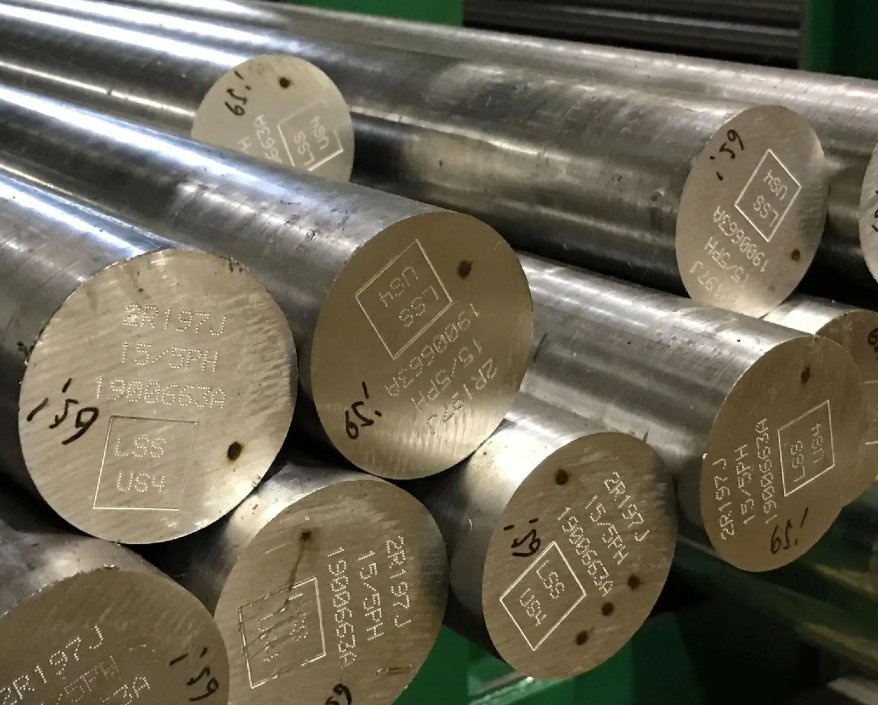
15-5PH alloy steel is a common search term for UNS S15500, a martensitic precipitation-hardening stainless steel engineered for high strength, good toughness and better transverse ductility than many conventional PH stainless grades. In technical specifications, it is usually called 15-5PH stainless steel, 15-5 PH, XM-12 or UNS S15500.
15-5PH is selected when high strength, moderate corrosion resistance and better transverse toughness than 17-4PH are required. It is widely used in aerospace components, shafts, valve parts, gears, fasteners, fittings, pump components, nuclear hardware and precision machined structural parts.
- Material family: martensitic precipitation-hardening stainless steel
- Primary strengthening mechanism: copper precipitation during aging
- Typical standards: ASTM A564, ASTM A705, AMS 5659, AMS 5862
- Typical supply forms: round bar, forged bar, plate, sheet, strip, billet and forgings
- Common heat-treated conditions: H900, H1025, H1075, H1100, H1150 and H1150M
What Is 15-5PH Alloy Steel?
15-5PH is a chromium-nickel-copper stainless steel containing niobium/columbium for precipitation hardening. It was developed as a cleaner, tougher refinement of 17-4PH stainless steel. The grade is produced with tight control of chemistry and melting practice to reduce delta ferrite, which improves transverse mechanical properties and consistency in critical parts.
The “15-5” name refers approximately to its chromium and nickel content: about 15% chromium and 5% nickel. The “PH” means precipitation hardening. After solution treatment, the alloy can be aged at different temperatures to produce a range of strength, hardness and toughness combinations.
Standards, Forms and Equivalent Designations
| Category | Common References | Notes for Engineering or Procurement |
|---|---|---|
| UNS number | S15500 | Primary identification used on material certificates and drawings. |
| Common names | 15-5PH, 15-5 PH, XM-12 | Names may vary by mill, distributor or legacy drawing. |
| Bar and forging standards | ASTM A564, ASTM A705, AMS 5659 | Confirm condition, size range, test orientation and certification level. |
| Sheet, strip and plate | AMS 5862 and related aerospace specifications | Flat products may have different test requirements from bar. |
| European comparison | No exact one-to-one EN equivalent | Use chemistry, mechanical properties and heat treatment requirements rather than name matching only. |
Chemical Composition of 15-5PH Stainless Steel
The nominal composition of 15-5PH is designed to balance corrosion resistance, hardenability, toughness and precipitation response. Exact limits depend on the governing specification, so the purchase order should always reference the required standard and revision.
| Element | Typical Range or Maximum, wt.% | Function in the Alloy |
|---|---|---|
| Carbon | 0.07 max | Controls hardness and weldability; kept low for toughness. |
| Chromium | 14.00–15.50 | Provides stainless corrosion resistance and oxidation resistance. |
| Nickel | 3.50–5.50 | Improves toughness and stabilizes the martensitic structure. |
| Copper | 2.50–4.50 | Forms strengthening precipitates during aging. |
| Niobium + Tantalum | 0.15–0.45 | Assists precipitation hardening and grain structure control. |
| Manganese | 1.00 max | Steelmaking and deoxidation control. |
| Silicon | 1.00 max | Deoxidation and processing control. |
| Phosphorus | 0.040 max | Restricted impurity for toughness and quality. |
| Sulfur | 0.030 max | Restricted impurity unless machinability modifications are specified. |
| Iron | Balance | Base metal. |
Typical Mechanical Properties by Heat-Treated Condition
15-5PH gains strength through solution treatment followed by aging. Condition H900 delivers the highest strength, while H1025 to H1150 improve ductility, toughness and stress-corrosion resistance. The values below are representative for engineering comparison; certified values must come from the applicable material specification and mill test report.
| Condition | Aging Temperature | Tensile Strength | Yield Strength | Elongation | Hardness | Best Use Case |
|---|---|---|---|---|---|---|
| H900 | 900°F / 482°C | Approx. 190 ksi / 1310 MPa | Approx. 170 ksi / 1170 MPa | Approx. 10% | Approx. HRC 38–42 | Maximum strength and wear resistance. |
| H1025 | 1025°F / 552°C | Approx. 155 ksi / 1070 MPa | Approx. 145 ksi / 1000 MPa | Approx. 12% | Approx. HRC 34–38 | High strength with improved toughness. |
| H1075 | 1075°F / 579°C | Approx. 145 ksi / 1000 MPa | Approx. 125 ksi / 860 MPa | Approx. 13% | Approx. HRC 32–36 | Balanced mechanical performance. |
| H1100 | 1100°F / 593°C | Approx. 140 ksi / 965 MPa | Approx. 115 ksi / 795 MPa | Approx. 14% | Approx. HRC 30–34 | Better ductility and lower residual stress. |
| H1150 | 1150°F / 621°C | Approx. 135 ksi / 930 MPa | Approx. 105 ksi / 725 MPa | Approx. 16% | Approx. HRC 28–32 | Toughness, dimensional stability and corrosion-related risk reduction. |
Typical physical properties include density around 7.8 g/cm³, elastic modulus near 196–200 GPa and thermal conductivity lower than carbon steel. These values matter for shaft deflection, thermal growth, heat dissipation and machining heat control.
15-5PH vs 17-4PH, 13-8Mo and 316 Stainless Steel
Buyers often compare 15-5PH with 17-4PH because both grades are copper-strengthened PH stainless steels. The key difference is consistency and toughness: 15-5PH is typically preferred where transverse properties, aerospace qualification or fracture-sensitive designs are important.
| Grade | Strength Level | Corrosion Resistance | Toughness | Machinability | Typical Reason to Select |
|---|---|---|---|---|---|
| 15-5PH / UNS S15500 | Very high after aging | Good for a martensitic PH stainless | Better transverse toughness than 17-4PH in many applications | Good with correct tooling and heat condition | Aerospace shafts, fittings, high-strength machined parts. |
| 17-4PH / UNS S17400 | Very high after aging | Good | Good, but generally less consistent in transverse direction than 15-5PH | Good | Cost-effective high-strength PH stainless components. |
| 13-8Mo / UNS S13800 | Very high | Good to very good | Excellent for demanding aerospace use | Moderate | Premium aerospace parts requiring high fracture toughness. |
| 316 / UNS S31600 | Low to moderate | Very good, especially with molybdenum in chloride environments | Excellent ductility | Moderate, work-hardens readily | Corrosion-driven parts where high strength is not required. |
The practical selection rule is simple: choose 15-5PH when the part needs high yield strength and better toughness than 17-4PH; choose 316 when corrosion resistance in wet chloride service is more important than strength; choose 13-8Mo when premium aerospace toughness justifies higher material and processing cost.
Heat Treatment and Aging Response
15-5PH is normally supplied in solution-treated Condition A or in a specified aged condition. Always specify the heat-treated condition on drawings, purchase orders and inspection documents because mechanical properties change significantly with aging temperature.
- Solution treatment is commonly performed around 1900°F / 1038°C, followed by cooling according to the specification.
- Aging is performed at a selected temperature such as 900°F, 1025°F, 1075°F, 1100°F or 1150°F.
- Lower aging temperatures generally produce higher strength and hardness.
- Higher aging temperatures generally improve ductility, toughness and dimensional stability.
- Double-aging practices such as H1150M may be used when toughness and stress-corrosion resistance are more important than maximum hardness.
Engineering note: choosing H900 or H1150 for a loaded pin
For a 25 mm diameter 15-5PH pin carrying a 40 kN single-shear design load, the nominal shear stress is roughly 81 MPa before stress concentration factors. This is far below the tensile yield strength of both H900 and H1150 conditions, so the final condition may be governed by impact toughness, galling risk, corrosion exposure, dimensional stability after machining and inspection requirements rather than static strength alone.
Machining, Grinding and Fabrication Guidance
15-5PH machines best when the process is planned around hardness, thermal conductivity and work hardening. Condition A is generally easier to machine than peak-aged H900, although final aging after rough machining can cause dimensional change that must be allowed for in precision parts.
Machine in Condition A when possible, leave controlled stock for finish machining, then age to the required condition if the drawing permits. For close-tolerance aerospace components, many shops rough machine, heat treat, stress relieve if applicable and finish grind or finish turn to final dimensions.
Practical machining recommendations
- Use rigid fixturing to reduce vibration on shafts, thin walls and long components.
- Use sharp carbide tooling with positive geometry for turning and milling.
- Maintain consistent feed to avoid rubbing and work-hardened surfaces.
- Apply high-quality coolant to manage heat and improve tool life.
- Use lower surface speeds than free-machining stainless steels, especially in aged conditions.
- Plan chip control carefully because stainless chips can be tough and stringy.
- For grinding, control heat input to avoid tensile residual stress, surface burning or dimensional distortion.
Welding and joining considerations
15-5PH can be welded using suitable stainless filler metals and qualified procedures, but welding may reduce local properties and corrosion performance if heat treatment is not controlled. For critical aerospace or pressure-containing parts, weld procedure qualification, post-weld heat treatment and inspection should be defined before production.
Manufacturing note: distortion after aging
Precision parts can move during precipitation aging because residual stresses from machining are relieved and the microstructure changes. A common control method is to rough machine with balanced stock removal, age to the specified condition, then finish machine or grind critical diameters, bearing seats, threads and sealing surfaces.
Corrosion Resistance and Service Limitations
15-5PH provides good corrosion resistance compared with many high-strength alloy steels, but it is not as corrosion resistant as austenitic grades such as 316 stainless steel. Its corrosion behavior is similar to 17-4PH and depends strongly on heat-treated condition, surface finish, passivation, chloride concentration, stress level and temperature.
For marine splash zones, stagnant chloride solutions, sour environments or continuous wet service, avoid using 15-5PH as a direct substitute for 316 in chloride-rich wet service without corrosion testing. If the component is highly stressed, review stress-corrosion cracking risk and consider overaged conditions such as H1150 or alternative alloys.
Applications of 15-5PH Alloy Steel
15-5PH is used where designers need a high strength-to-weight ratio, reliable toughness and corrosion resistance better than low-alloy steel. Its combination of machinability and heat-treatable strength makes it common in precision components with demanding inspection requirements.
- Aerospace structural fittings, actuator parts and landing gear support components
- Shafts, pins, couplings, gears and splined components
- Valve stems, pump shafts and pressure-control hardware
- Fasteners, bushings and high-strength threaded parts
- Nuclear, defense and instrumentation components
- Medical and food equipment parts where high strength and stainless behavior are required, subject to corrosion validation
Procurement Checklist for Engineers and Buyers
15-5PH purchasing errors usually come from incomplete specifications rather than material availability. Mill test reports should show specification, heat number, heat-treated condition, chemical composition and mechanical test results. For regulated industries, also confirm country of origin, melt practice, ultrasonic inspection, grain flow direction and any customer-specific testing.
| Requirement | Why It Matters |
|---|---|
| Grade and UNS number | Prevents confusion with 17-4PH or other PH stainless grades. |
| Governing specification | Defines chemistry, testing, tolerances and certification requirements. |
| Heat-treated condition | Controls strength, hardness, toughness and machinability. |
| Product form and size | Bar, plate, sheet and forging standards may not be interchangeable. |
| Test orientation | Important for transverse ductility, fracture-critical parts and aerospace designs. |
| Surface condition | Ground, peeled, turned, polished or passivated surfaces affect final processing. |
| Inspection level | May include ultrasonic testing, hardness testing, tensile testing or microstructure review. |
Buyer note: when price comparison is misleading
A lower quote may exclude aging, ultrasonic inspection, aerospace certification, domestic melt requirements or special straightness tolerances. When comparing 15-5PH suppliers, evaluate the full delivered condition, not only the price per kilogram or price per pound.
Technical Summary
15-5PH alloy steel, more accurately 15-5PH precipitation-hardening stainless steel, is a high-strength UNS S15500 material used when mechanical performance and reliability are more important than lowest raw material cost. Compared with 17-4PH, it offers improved toughness consistency due to cleaner chemistry control and reduced delta ferrite. Compared with 316 stainless steel, it provides much higher strength but lower chloride corrosion resistance.
For engineering use, the most important decisions are the specification, heat-treated condition, test orientation and machining route. When these are defined correctly, 15-5PH is a proven choice for aerospace, defense, energy, valve, pump and precision industrial components requiring high strength, stainless corrosion behavior and dependable dimensional control.