
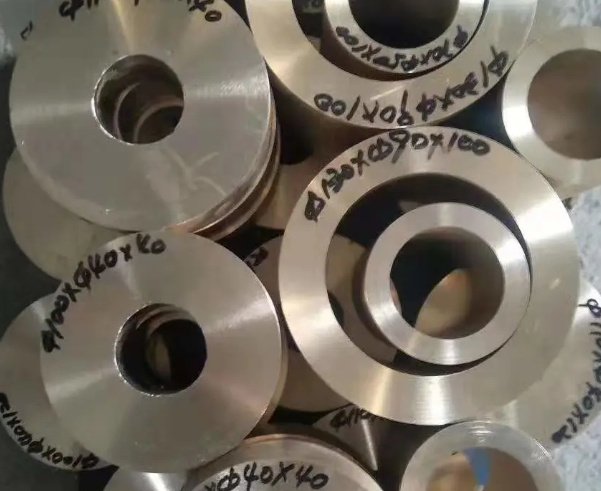
UNS C37700, commonly referred to as forging brass or leaded forging brass, is a copper-zinc-lead alloy specifically engineered for high-speed machining and hot forging operations. With a nominal composition of approximately 58-61% copper, 38-42% zinc, and 1.5-2.5% lead, C37700 bronze delivers unmatched machinability while maintaining the ductility required for complex forming processes.
Unlike general-purpose yellow brasses, C37700 is optimized for the production of valve bodies, fittings, and plumbing hardware where rapid machining and reliable hot working behavior are essential. Its classification as a forging brass distinguishes it from free-machining rod brasses like C36000, making it the material of choice for heavy-section components produced via upset forging and pressing.
C37700 vs. C37000 vs. C36000: Material Comparison
Selecting between related copper alloys requires understanding their distinct performance profiles. While C37700, C37000, and C36000 share similar base compositions, their mechanical behavior and optimal use cases diverge significantly.
| Property | C37700 | C37000 | C36000 |
|---|---|---|---|
| Common Name | Forging Brass | Free-Cutting Muntz Metal | Free-Cutting Brass |
| Lead Content (%) | 1.5 - 2.5 | 0.5 - 1.5 | 2.5 - 3.0 |
| Copper Content (%) | 58.0 - 61.0 | 59.0 - 62.0 | 60.0 - 63.0 |
| Machinability Rating | 80% | 70% | 100% (Standard) |
| Hot Forgeability | Excellent | Good | Fair |
| Typical Form | Extruded rod, forgings | Rod, bar, shapes | Rod, bar, wire |
| Primary Application | Valve bodies, fittings | Hardware, couplings | Precision screw machine parts |
The elevated lead content in C36000 provides the highest machinability rating but limits its suitability for heavy-section hot forging. Conversely, C37700 bronze offers the optimal balance of lead for chip breaking during machining while retaining the structural integrity and plasticity required for hot deformation processes. C37000 occupies a middle ground but lacks the forgeability consistency demanded by complex asymmetrical forgings.
Chemical Composition of C37700
The performance characteristics of C37700 forging brass are directly attributable to its tightly controlled chemical specification. Deviations in lead or zinc content can alter machinability rates and hot working temperatures, impacting tool life and forging yield.
- Copper (Cu): 58.0% - 61.0%
- Lead (Pb): 1.5% - 2.5%
- Iron (Fe): 0.30% max
- Zinc (Zn): Remainder
The lead phase in C37700 exists as discrete particles rather than a solid solution. This microstructural arrangement is critical: during machining, the lead smears at the tool-chip interface, acting as an internal lubricant that reduces cutting forces and extends insert life. In forging applications, the lead simultaneously improves grain flow and reduces die wear compared to unleaded alloys.
Mechanical and Physical Properties
C37700 bronze exhibits mechanical properties that align with the requirements of medium-strength, high-fabricability components. Its properties remain stable across typical service temperatures encountered in plumbing and fluid control systems.
| Property | Value (Typical) |
|---|---|
| Tensile Strength | 50,000 - 70,000 psi |
| Yield Strength | 20,000 - 30,000 psi |
| Elongation in 2 inches | 20% - 40% |
| Hardness (Rockwell B) | 55 - 75 |
| Density | 0.306 lb/in³ (8.47 g/cm³) |
| Melting Point (Liquidus) | 1,650°F (899°C) |
| Electrical Conductivity | 26% IACS at 68°F |
| Thermal Conductivity | 67 Btu·ft/(hr·ft²·°F) |
The moderate electrical conductivity of C37700 (26% IACS) precludes its use in high-current electrical bus applications but is sufficient for grounding hardware and low-current contacts. Its thermal conductivity supports applications requiring rapid heat dissipation during brazing or soldering assembly.
Machinability and Processing Characteristics
C37700 is specifically formulated for environments where machining and forging occur sequentially. Understanding its processing envelope prevents costly defects such as forging cracks or poor surface finish.
Machining Performance
With a machinability rating of approximately 80% relative to free-cutting brass (C36000), C37700 produces manageable chip forms across drilling, turning, and threading operations. Optimal cutting speeds range between 300 and 500 surface feet per minute (SFM) for turning operations, with carbide tooling recommended for volume production. Lead segregation is minimal under standard processing, reducing the risk of out-of-specification parts.
Hot Forging
The defining advantage of C37700 over C36000 is its superior hot plasticity. Hot forging is typically performed between 1,200°F and 1,500°F (649°C - 816°C). Within this range, the alloy exhibits low flow stress, enabling complex shape realization with reduced forging load. Post-forge cooling must be controlled to prevent residual stress accumulation, particularly in components with significant cross-sectional variation.
Joining and Surface Treatment
C37700 bronze responds well to soldering and brazing using standard silver-bearing filler metals. Oxyacetylene welding is possible but not recommended for structural joints due to lead vaporization, which can produce porous welds. For surface finishing, the alloy accepts chrome plating and nickel plating readily, making it suitable for decorative and wear-resistant hardware applications.
Applications and Industry Usage
The combination of excellent forgeability and good machinability positions C37700 bronze as a primary material in fluid conveyance and control hardware. Typical applications include:
- Brass valve bodies and bonnets for plumbing and HVAC systems
- Fire hose and air brake couplings
- Pressure regulators and gauge hardware
- Pump components and impeller hubs
- Decorative and architectural hardware requiring post-forge machining
In potable water systems, compliance with lead-content regulations (such as NSF/ANSI 61 and the U.S. Safe Drinking Water Act) has historically impacted the use of high-lead alloys like C37700. Engineers specifying C37700 for modern water applications must verify current lead-free compliance thresholds, typically requiring substitution with bismuth or silicon-modified brasses for direct potable water contact. However, C37700 remains prevalent in industrial fluid handling, pneumatic systems, and non-potable infrastructure.
Engineering Perspective: Solving Machining and Forging Defects
From a manufacturing engineering standpoint, C37700 presents specific challenges that require process tuning. During high-speed machining, lead softening can generate a built-up edge (BUE) on carbide tools if speeds drop below 250 SFM, resulting in poor surface roughness (Ra values exceeding 63 microinches). Maintaining positive rake angles and employing high-pressure coolant delivery mitigates this issue.
In forging, C37700 is susceptible to internal shear cracking when initial billet temperatures exceed 1,550°F due to excessive grain growth. Finite Element Analysis (FEA) of forging sequences should incorporate a flow stress model valid between 1,200°F and 1,500°F. Reducing ram speed in the final forging stages improves cavity fill and reduces flash line thickness by approximately 15% compared to constant-velocity pressing.
Procurement and Buyer Guide: Specifying C37700 Stock
When sourcing C37700 bronze, buyers should specify ASTM B124 for forged rod and ASTM B453 for screw machine stock. Mill test reports (MTRs) must certify lead content within the 1.5-2.5% range, as sub-specification lead reduces machinability and increases tool cost per part by up to 20%.
Extruded rod diameters are commonly available from 0.5 inch to 6 inches. For upset forging applications, specify a maximum grain size of 0.050 mm to ensure uniform deformation. Clarify temper requirements: as-forged (M30) or annealed (O60) tempers impact subsequent machining allowances by ±0.005 inch. Lead times for standard hex and round bar stock typically range from 4 to 8 weeks for non-standard sizes.
Standards Compliance and Specifications
C37700 forging brass is standardized under multiple nomenclature systems:
- UNS Designation: C37700
- ASTM Specifications: B124, B283
- CDA Alloy: 377
- EN/DIN Equivalent: CuZn39Pb3 (approximate)
ASTM B124 covers copper and copper-alloy forging rod, bar, and shapes. For components requiring pressure retention, ultrasonic testing per ASTM B594 may be specified to detect internal discontinuities exceeding 1/8 inch. Chemistry verification via spectrographic analysis is recommended for critical valve applications to confirm arsenic levels remain below 0.05%, preventing stress corrosion cracking in ammonia-bearing environments.
Corrosion Resistance and Service Environment
C37700 bronze provides adequate corrosion resistance in neutral freshwater, seawater, and atmospheric environments. Its performance is comparable to other alpha-beta brasses containing 58-62% copper. However, the alloy is vulnerable to dezincification in the presence of stagnant chloride-rich waters or under deposits where oxygen concentration cells form.
Mitigation strategies include protective nickel plating, the application of corrosion inhibitors in closed-loop systems, or specifying arsenic-treated variants where permitted by regulation. In marine environments, C37700 should not be coupled directly to aluminum or stainless steel without dielectric isolation to prevent galvanic corrosion acceleration.
Sustainability and Recyclability
As a copper alloy, C37700 is fully recyclable without degradation of mechanical properties. Scrap generated during machining and forging operations retains high value in secondary metal markets. Foundries and brass mills routinely incorporate C37700 turnings and forgings scrap into charge recipes for new billet production, contributing to a closed-loop material cycle with substantial energy savings compared to primary copper extraction.