
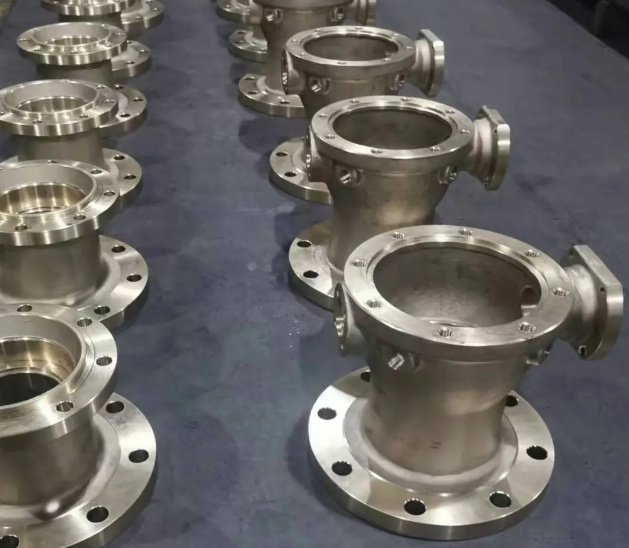
C95800 is a high-strength, corrosion-resistant nickel aluminum bronze cast alloy governed by ASTM B148. With a nominal composition of 9% aluminum, 4.5% iron, and 4.5% nickel, this alloy outperforms standard tin bronzes and lower-grade aluminum bronzes in seawater, chemical processing, and heavy-load industrial environments. Engineers specify C95800 bronze for propellers, valve bodies, and pump components where cavitation erosion and galvanic corrosion are primary failure modes.
What Is C95800 Bronze?
UNS C95800 is a cast copper alloy commonly referred to as NAB (nickel-aluminum bronze) or 9D bronze. Unlike manganese bronze or silicon bronze, C95800 derives its strength from an alpha-beta copper-aluminum matrix reinforced by iron-nickel intermetallic (kappa) phases. The alloy is available in sand castings, centrifugal castings, and permanent mold castings, offering a density of 0.275 lb/in³ and a melting range near 1900-1950°F. Its metallurgical stability under both ambient and subzero temperatures makes it suitable for arctic marine and cryogenic service.
C95800 Chemical Composition per ASTM B148
The table below defines the UNS composition limits. Tight control of iron and nickel is essential to form the kappa phase, which inhibits dealuminification and improves erosion resistance.
| Element | Min % | Max % |
|---|---|---|
| Copper (Cu) | 79.0 | Balance |
| Aluminum (Al) | 8.5 | 9.5 |
| Iron (Fe) | 3.5 | 4.5 |
| Nickel (Ni) | 4.0 | 5.0 |
| Manganese (Mn) | 0.8 | 1.5 |
| Silicon (Si) | - | 0.05 |
| Lead (Pb) | - | 0.03 |
The combined iron plus nickel content typically ranges from 7.5% to 9.5%, producing a refined as-cast grain structure that achieves tensile strengths above 85 ksi without requiring additional heat treatment.
Mechanical Properties & Performance Data
Design values for C95800 bronze castings depend on section size and casting method. The following data represent conservative sand-cast values per ASTM B148 test bars.
| Property | Value (Sand Cast) | Unit |
|---|---|---|
| Ultimate Tensile Strength | 85 – 105 | ksi |
| Yield Strength (0.2% offset) | 35 – 45 | ksi |
| Elongation in 2 in. | 15 – 25 | % |
| Brinell Hardness | 170 – 200 | HBW |
| Shear Strength | 60 | ksi (typ.) |
| Modulus of Elasticity | 16.0 | 10^6 psi |
Charpy V-notch impact testing demonstrates that C95800 retains exceptional toughness at low temperatures, with values exceeding 25 ft-lbs at -60°F. This characteristic is critical for offshore platforms operating in polar regions and for LNG terminal valve components.
C95800 vs C95400 vs C95500: Alloy Comparison
Material selection between these three aluminum bronze grades depends on electrochemical environment, loading cycles, and budget constraints. The table below provides a side-by-side engineering comparison.
| Property | C95800 | C95400 | C95500 |
|---|---|---|---|
| ASTM Reference | B148 | B148 | B148 |
| Nickel Content | 4.0 – 5.0% | < 0.5% | 3.0 – 5.5% |
| Typical UTS | 95 ksi | 85 ksi | 100 ksi |
| Seawater Corrosion | Superior | Good | Excellent |
| Cavitation Resistance | High | Moderate | High |
| Relative Cost | Premium | Low | Moderate |
| Common Applications | Propellers, valves | Bearings, gears | Wear guides, bushings |
C95800 occupies the optimal position between ductility and cavitation resistance. While C95500 can achieve marginally higher tensile strength, C95800's higher iron content relative to aluminum promotes a more stable microstructure that resists selective phase attack (dealuminification) in stagnant or low-pH chloride environments.
Corrosion Resistance & Field-Proven Engineering Data
In a 36-month North Sea offshore study, bare C95800 pump impellers exhibited a general corrosion rate of 0.025 mm/year, compared to 0.18 mm/year recorded on C95200-modified castings under identical seawater exposure. The alloy maintains a stable passive film at flow velocities exceeding 12 ft/s and resists biofouling better than duplex stainless steels in macrofouling assessments.
Documented engineering challenges include:
- Galvanic coupling with ferrous alloys: When bolted directly to 316 stainless steel flanges in seawater pipelines, C95800 becomes the cathode. Engineers must specify dielectric isolation gaskets and bolt sleeves to prevent accelerated steel wastage.
- Stress corrosion cracking: Residual tensile stresses from welding or casting can trigger SCC in ammonia-contaminated industrial atmospheres. A stress-relief treatment at 675°F (357°C) for four hours reduces residual stress by approximately 70% without diminishing tensile properties.
- Dealuminification: Although rare in properly composed C95800, heat-affected zones from improper repair welding can suffer selective aluminum depletion. Post-weld annealing at 1250°F followed by air cooling restores phase equilibrium.
Machinability, Welding & Fabrication Guidelines
C95800 is rated at approximately 30–40% machinability relative to C36000 free-machining brass. Its hard kappa phase is abrasive to uncoated tooling. Production machining of large-diameter ring castings requires coated carbide or PCD inserts, positive rake geometries, and high-volume coolant to manage heat at the cutting edge.
Fabrication best practices include:
- Welding repair: Use ERCuAl-A2 filler metal or matching C95800 consumables. Preheat thick sections to 300–500°F. Avoid steel-based fillers, which create brittle iron-aluminide intermetallics and crack-sensitive fusion boundaries.
- Post-weld heat treatment: A full anneal at 1200–1250°F followed by controlled cooling improves weld ductility from roughly 8% elongation (as-welded) to over 18%.
- Grinding: Use open-structure aluminum-oxide wheels to prevent loading. Typical turning operations with proper parameters achieve surface finishes of Ra 32 µin.
- Casting design: Minimum wall thickness should not fall below 0.25 inch in sand castings to ensure complete kappa phase formation and avoid hydrogen porosity.
Primary Applications Across Industries
C95800 bronze castings serve critical functions where material failure incurs high shutdown or safety costs:
- Marine Propulsion: Fixed and controllable-pitch propeller hubs, blade roots, strut bushings, and stern tube liners for vessels operating in brackish and open-ocean water.
- Oil & Gas Subsea: ROV-operated valve actuators, subsea Christmas tree components, and manifold connectors rated for 10,000 psi working pressure in chloride-rich environments.
- Power Generation: Cooling water intake gate seats, circulating pump wear rings, and condenser tube sheets in once-through and closed-loop cooling systems.
- Desalination: Brine recycle pump casings and multi-stage flash (MSF) plant components exposed to 45°C saline at pH 8.1.
Procurement & Buyer Guidelines: MTRs, Standards & Stock Forms
When sourcing UNS C95800 for new builds or MRO projects, buyers should specify ASTM B148 with full chemical and mechanical certification. Mill test reports (MTRs) must verify composition by optical emission spectroscopy (OES) and confirm Brinell hardness meets the 170–200 HBW window.
Critical procurement considerations:
- Do not accept C95400 as a direct substitute on Navy or ABS-classified contracts; the absence of 4% nickel voids corrosion-performance warranties.
- Marine propeller castings require third-party inspection by ABS, DNV, or Lloyd’s Register with magnetic particle inspection (MPI) per ASTM E1444.
- Centrifugal cast rings offer a 30–40% fatigue-life improvement over sand-cast equivalents due to finer grain structure; specify the casting method explicitly on purchase orders.
- Standard rough-machined tubular bar stock is common for valve-body blanks, while sand castings dominate large propeller hubs. Lead times for specialized castings typically span 8 to 14 weeks.
Engineering Design Checklist: Stress, Tolerances & Thermal Analysis
Design engineers should cross-reference SAE J461 and ASTM B271 for allowable stress and casting tolerances. Because C95800 has a modulus of elasticity of 16 x 10^6 psi—roughly 17% below carbon steel—beam and flange deflection calculations require adjusted section properties.
Recommended design practices:
- Provide 0.125 inch minimum machining stock on diameters exceeding 6 inches to accommodate scale, parting lines, and solidification shrinkage.
- Maintain uniform wall-thickness ratios near 3:1 to prevent hot tearing in complex cored castings.
- Specify ASME B46.1 surface finish standards for sealing faces; as-cast surfaces typically measure 500–1000 µin Ra and require at least 0.060 inch stock removal to achieve pressure-tight seats.
- Account for a coefficient of thermal expansion of 9.0 x 10⁻⁶ /°F when calculating bolt preloads in systems cycling between ambient and 400°F.