
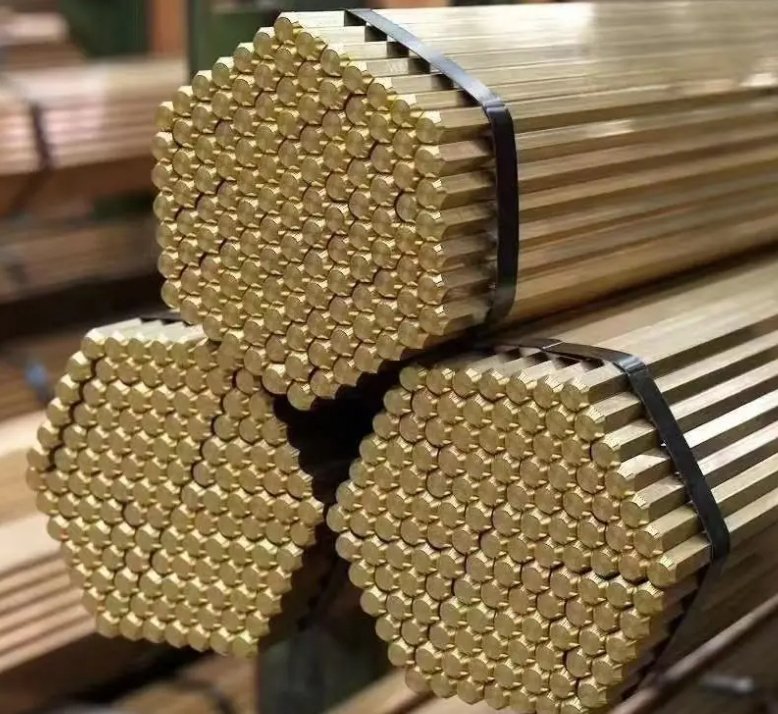
UNS C95400 is a high-strength aluminum bronze alloy widely specified for heavy-load bushings, wear plates, and corrosion-resistant components. With nominal 11% aluminum content and iron additions up to 4%, C95400 bronze delivers a tensile strength above 85 ksi and excellent cavitation resistance in seawater environments. Engineers select this grade when C93200 bearing bronze lacks sufficient load capacity or when stainless steel poses galling risks against mating steel surfaces.
Chemical Composition and Material Grade Equivalents
C95400 conforms to ASTM B505 for continuous and centrifugal cast products. Its chemistry creates a stable beta-phase matrix that resists deformation under impact.
| Element | Min % | Max % |
|---|---|---|
| Copper | 83.0 | - |
| Aluminum | 10.0 | 11.5 |
| Iron | 3.0 | 5.0 |
| Nickel | - | 1.5 |
| Manganese | - | 0.5 |
Equivalent designations include CuAl11Fe4 under EN standards and CDADB according to older SAE classifications. Procurement teams should verify aluminum and iron percentages because slight variations shift yield strength by 5–8 ksi in cast bar stock.
Mechanical Properties and Validated Performance Data
Mechanical performance depends on casting method. The following data reflects continuous cast bar in the as-cast condition, the form most commonly supplied for CNC machining.
| Property | Value (Typical) | Test Standard |
|---|---|---|
| Tensile Strength | 85–105 ksi | ASTM E8 |
| Yield Strength (0.2%) | 35–45 ksi | ASTM E8 |
| Elongation | 12–18% | ASTM E8 |
| Brinell Hardness | 170–210 HB | ASTM E10 |
| Modulus of Elasticity | 15,000 ksi | ASTM E111 |
| Charpy Impact | 10–14 ft-lbs | ASTM E23 |
In a documented seawater valve retrofit, C95400 stem bushings showed negligible wear after 18 months of continuous operation at 1,200 psi contact stress, whereas C93200 equivalents required replacement at 8 months. This correlates with the alloy’s high yield-to-tensile ratio and work-hardening capacity under sliding load.
Key Comparison: C95400 vs. C93200 and C95500
Selecting between aluminum bronze and bearing bronze requires matching alloy capability to duty cycle. Below is a direct engineering comparison.
| Characteristic | C95400 | C93200 (Bearing Bronze) | C95500 (Ni-Al Bronze) |
|---|---|---|---|
| Tensile Strength | 85–105 ksi | 35–45 ksi | 100–130 ksi |
| Hardness | 170–210 HB | 65–75 HB | 200–240 HB |
| Seawater Corrosion | Excellent | Good | Superior |
| Seizure Resistance vs Steel | High | Moderate | Very High |
| Relative Cost | Moderate | Lower | Higher |
| Typical Use | Heavy bushings, slides | Light bearings, thrust washers | Propellers, marine hardware |
C95400 occupies the middle ground: it outperforms C93200 in load and impact resistance without the nickel premium of C95500. For non-marine industrial machinery operating under boundary lubrication, C95400 offers the optimal strength-to-cost profile.
Machining, Welding and Processing Guidelines
Despite its hardness, C95400 is machinable with rigid setups and appropriate tooling. The material produces discontinuous chips and generates heat rapidly at the insert edge.
- Turning Speed: 200–350 SFM with coated carbide inserts; use 0.010–0.020 in/rev feed for roughing.
- Drilling: Split-point carbide or cobalt bits at 40–80 SFM; peck cycles every 1–1.5 diameters to avoid work hardening.
- Reaming: 0.004–0.008 in/rev feed; abundant sulfurized oil to prevent galling on the reamer margin.
Welding requires preheat to 300–500 °F and interpass control. Matching filler metals such as ERCuAl-A2 preserve corrosion resistance. Post-weld stress relief at 900 °F improves dimensional stability in large wear pads.
Engineering Applications and Field Performance
C95400 bronze solves specific failure modes that softer copper alloys cannot address. Representative applications include:
- Steel mill slipper bearings and screw-down nuts subject to shock loads exceeding 50 tons.
- Hydraulic cylinder clevis bushings in mining equipment, where abrasive contamination accelerates sleeve wear.
- Seawater-cooled heat exchanger tube sheets, leveraging the alloy’s resistance to impingement attack.
- Injection mold wear plates requiring low friction against hardened tool steel without lubrication.
A 2022 field study at a copper concentrator documented a 42% reduction in unplanned downtime after switching dragline bucket bushing material from C93200 to C95400. The harder matrix resisted embedding of silica particulate, preserving journal clearance over a 14-month interval versus historical 6-month changeouts.
Procurement and Material Selection Insights
Sourcing C95400 requires attention to casting integrity, certification traceability, and form factor. The following perspectives clarify common procurement decisions.
Buyer and Supply Chain Perspective
When purchasing C95400 cast bar or hollow bar, request mill test reports verifying aluminum content between 10.5% and 11.3%. Continuous cast material minimizes porosity compared to sand cast equivalents, reducing scrap rates in finish-machined components. Standard stock sizes range from 1-inch rounds to 12-inch hollow bar, with typical lead times of 2–4 weeks for domestic North American suppliers. International buyers should confirm ASTM B505 compliance rather than generic aluminum bronze grades to avoid tensile shortfalls.
Design Engineer Perspective
Specify C95400 when design loads exceed 3,000 psi bearing pressure or when operating temperatures surpass 400 °F. At elevated temperatures, C95400 retains strength better than tin bronzes due to aluminum oxide film stability. Maintain 0.001–0.002 in/in running clearance for press-fit bushings; thermal expansion is approximately 9.0 × 10⁻⁶ in/in/°F. Avoid pairing with aluminum mating surfaces to prevent galvanic coupling in wet environments.
Quality and Inspection Perspective
Incoming inspection should include Brinell hardness spot checks on saw-cut samples. Acceptable incoming hardness is 170–210 HB; values below 160 HB indicate insufficient aluminum or excessive porosity. Ultrasonic testing of continuous cast hollow bar detects internal shrink that may not be visible on the as-cast surface. Dye penetrant inspection is recommended for welded overlays prior to final assembly.
Standards, Forms and Availability
C95400 is commercially available as continuous cast bar, hollow bar, centrifugal cast rings, and rectangular plate. Flat wear plate is often supplied in oversize thicknesses to allow finish grinding to 0.005-inch parallelism.
- ASTM B505: Standard specification for copper alloy continuous castings.
- ASTM B271: Centrifugal cast specifications for larger diameter tube and ring requirements.
- QQ-C-390: Federal specification still referenced in legacy defense and infrastructure contracts.
Lead-free and compliant with REACH and RoHS directives, C95400 serves as a direct upgrade path from leaded bronzes in environmentally regulated applications. Suppliers typically ship stock lengths of 144 inches, with cut-to-size and rough-turning services available for high-volume contract manufacturing.