
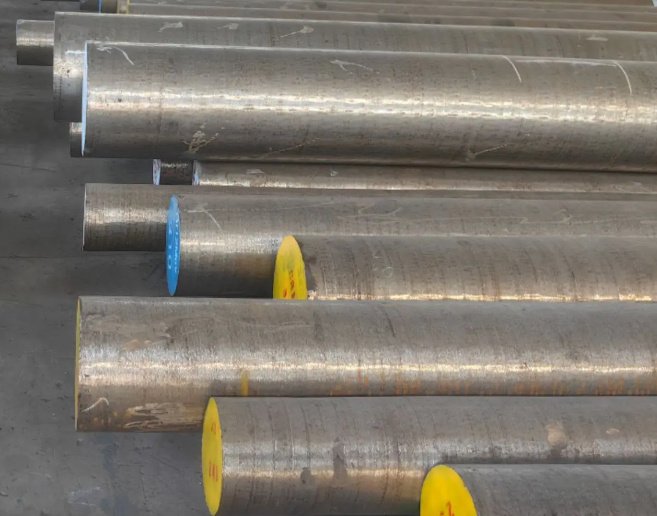
AISI 8620 alloy steel is a low-carbon nickel-chromium-molybdenum carburizing steel used when a component needs a hard, wear-resistant surface and a tough, ductile core. It is commonly specified for gears, pinions, shafts, bushings, camshafts, splined parts, clutch components and other transmission parts that operate under sliding contact, rolling contact or repeated impact.
Engineers search for AISI 8620 when they need to verify chemistry, mechanical properties, heat treatment response, machinability, case depth, equivalent grades or whether 8620 is the right alternative to steels such as 4140, 4320, 9310 or 1020. This page consolidates those specification and application questions in one technical reference.
What Is AISI 8620 Steel?
AISI 8620 is a carburizing-grade alloy steel in the SAE-AISI 86xx family. Its nominal carbon content is low, typically around 0.18% to 0.23%, which helps maintain core toughness after carburizing, quenching and tempering. Nickel improves toughness, chromium improves hardenability and wear resistance, while molybdenum supports hardenability and reduces temper embrittlement risk.
The main engineering value of 8620 is not high through-hardness. Instead, it is case hardening performance: after carburizing, the outer case can reach high surface hardness while the core remains relatively tough and impact-resistant. This makes it suitable for parts where tooth flank wear, pitting, scuffing and torsional shock are major failure modes.
AISI 8620 Standards, Forms and Equivalent Grades
AISI 8620 is supplied as round bar, flat bar, forged bar, plate, billet, tubing and forgings. It may be ordered in hot rolled, cold drawn, annealed, normalized, quenched and tempered, or carburized condition depending on downstream processing requirements.
| Category | Common reference | Notes |
|---|---|---|
| SAE/AISI | 8620 | Nickel-chromium-molybdenum low-carbon alloy steel |
| UNS | G86200 | Unified Numbering System designation |
| ASTM | Often supplied to ASTM A29/A29M | General requirements for steel bars, carbon and alloy, hot-wrought |
| EN approximate equivalent | 20NiCrMo2-2 / 1.6523 | Not a direct substitute without checking chemistry, hardenability and heat treatment |
| JIS approximate equivalent | SNCM220 | Use cross-reference only as a starting point |
Equivalent grades should be confirmed by reviewing the purchasing specification, product form, hardenability band, mechanical test requirements and final heat treatment. For safety-critical gears and shafts, equivalency based only on grade name is not sufficient.
Chemical Composition of AISI 8620
The composition ranges below are typical for AISI 8620 steel and may vary slightly by standard, mill practice and product form. Always verify the certified mill test report before approving material for production.
| Element | Typical range, % | Engineering function |
|---|---|---|
| Carbon, C | 0.18 - 0.23 | Controls core strength and carburizing response |
| Manganese, Mn | 0.70 - 0.90 | Improves hardenability and strength |
| Silicon, Si | 0.15 - 0.35 | Deoxidizer; contributes to strength |
| Nickel, Ni | 0.40 - 0.70 | Improves toughness and fatigue resistance |
| Chromium, Cr | 0.40 - 0.60 | Improves hardenability and wear resistance |
| Molybdenum, Mo | 0.15 - 0.25 | Improves hardenability and tempering response |
| Phosphorus, P | 0.035 max | Controlled impurity; excessive content can reduce toughness |
| Sulfur, S | 0.040 max | Controlled impurity; affects machinability and ductility |
Mechanical Properties and Hardness
Mechanical properties of AISI 8620 depend strongly on section size, processing route and heat treatment. Annealed or normalized 8620 is selected for machinability and forming before final carburizing. Carburized and quenched 8620 is selected for the final combination of surface hardness, wear resistance and core toughness.
| Condition | Typical tensile strength | Typical hardness | Use case |
|---|---|---|---|
| Annealed | Approximately 530 - 650 MPa | Approximately 149 - 197 HB | Machining, forming, pre-heat-treatment stock |
| Normalized | Approximately 620 - 760 MPa | Approximately 180 - 230 HB | Improved uniformity before machining or carburizing |
| Carburized, quenched and tempered | Core varies by section and process | Case commonly 58 - 62 HRC | Gears, splines, shafts, wear-loaded components |
For case-hardened components, surface hardness alone does not define performance. Engineers should also specify effective case depth, core hardness, retained austenite control, microstructure, grinding burn limits and dimensional tolerance after heat treatment.
Heat Treatment: Carburizing, Quenching and Tempering
The most common heat treatment for AISI 8620 is carburizing followed by quenching and low-temperature tempering. A typical carburizing temperature range is 900 - 955°C, followed by oil quenching or controlled quenching depending on size, geometry and distortion limits. Tempering is often performed around 150 - 205°C to reduce quench stress while maintaining high case hardness.
Typical engineering targets include an effective case depth of 0.4 - 1.5 mm for many gears and shafts, although heavy-duty parts may require deeper cases. A surface carbon level near 0.8% is often targeted, but the correct value depends on required hardness, retained austenite, carbide network risk and contact fatigue performance.
Effective case depth is commonly measured to a specified hardness limit, often around 50 HRC, but the definition should be stated on the drawing or heat treatment specification. Without a clear case depth definition, two suppliers may produce parts that pass surface hardness checks but perform differently in service.
Engineering note: controlling distortion during 8620 carburizing
Distortion is a common manufacturing issue for 8620 gears and thin-wall shafts. Practical controls include uniform stock allowance, stress-relief before carburizing, fixture design, controlled atmosphere carburizing, press quenching for gears, oil temperature control and consistent load spacing. In production gear programs, changing from random basket loading to controlled fixture loading can reduce pitch diameter variation and post-heat-treatment grinding stock requirements.
Machining, Forming and Welding Considerations
AISI 8620 has good machinability in annealed or normalized condition compared with many higher-carbon alloy steels. It can be turned, milled, drilled, broached, hobbed and ground before heat treatment. Machining after carburizing should be limited to grinding, honing, lapping or hard turning where the process is qualified.
For production machining, 8620 is often processed near 160 - 220 HB to balance tool life, chip control and dimensional stability. Carbide tools are commonly used for turning and milling, while gear cutting operations such as hobbing or shaping are typically completed before carburizing. Cutting data should be adjusted for bar condition, inclusion control, workholding rigidity and coolant delivery.
Machinability of 8620 is generally better than through-hardening steels such as 4140 in a harder quenched-and-tempered condition, but worse than free-machining grades when sulfur is intentionally raised. If tight tolerance bores, splines or gear teeth are required, the machining plan should include allowance for carburizing growth and quench distortion.
Welding is possible but not usually preferred for critical carburized components. If welding is unavoidable, preheating, low-hydrogen filler, controlled interpass temperature and post-weld heat treatment may be required to reduce hydrogen cracking and hardness variation in the heat-affected zone.
AISI 8620 vs 4140, 9310, 4320 and 1020
Material selection often depends on whether the part needs surface wear resistance, through-section strength, high fatigue life, economy or weldability. The table below compares common alternatives.
| Grade | Best strength | Limitations | Typical decision point |
|---|---|---|---|
| AISI 8620 | Excellent carburizing response, tough core, good gear performance | Requires heat treatment control; not designed for maximum through-hardness | Choose for case-hardened gears, splines and shafts |
| AISI 4140 | High through-hardening strength and fatigue resistance | Lower carbon case-hardening efficiency than dedicated carburizing grades | Choose for through-hardened shafts, bolts and structural parts |
| AISI 9310 | Very high toughness and fatigue strength in carburized gears | Higher alloy cost than 8620 | Choose for aerospace or high-performance drivetrain gears |
| AISI 4320 | Higher nickel content and better toughness than 8620 | Higher cost and sometimes lower availability | Choose when impact toughness is more demanding |
| AISI 1020 | Low cost, good formability and weldability | Much lower hardenability and wear performance | Choose for non-critical carburized or structural parts |
In simple terms, 8620 vs 4140 is usually a case-hardening versus through-hardening decision. If a gear tooth needs a 60 HRC wear surface and a tough core, 8620 is normally more appropriate. If a shaft needs relatively uniform high strength through the section without carburizing, 4140 may be the better fit.
Buyer note: when AISI 8620 may not be the lowest-cost option
Although 8620 bar may be affordable, the final part cost includes carburizing cycle time, quenching fixtures, inspection, straightening, grinding stock and distortion scrap. For lightly loaded parts, a lower-cost steel or induction-hardened alternative may be sufficient. For high-duty gears, however, 8620 often reduces life-cycle cost because it improves wear life and contact fatigue resistance.
Applications of AISI 8620 Alloy Steel
AISI 8620 is widely used in automotive, agricultural, mining, industrial gearbox, oil and gas, defense and general machinery applications. It is especially valuable when the design requires repeated contact loading with a high hardness surface and a shock-resistant core.
- Transmission gears, differential gears and pinions
- Gear shafts, spline shafts and drive shafts
- Camshafts, crank components and clutch parts
- Bearings, bushings, sleeves and wear rings
- Worm gears, sprockets and ratchet components
- Tooling components requiring carburized wear surfaces
For gears, the major performance concerns are pitting, micropitting, scuffing, bending fatigue and tooth root cracking. Properly carburized 8620 can improve resistance to these failures when the case depth, surface hardness and residual compressive stress are matched to the gear geometry and loading.
Engineering Example: Gear Shaft Material Selection
Consider a medium-duty gearbox shaft with integral gear teeth operating under cyclic torque and boundary lubrication during startup. A plain carbon steel may machine easily, but the gear teeth can wear rapidly because the surface hardness is insufficient. A through-hardened 4140 shaft may provide good strength, but the tooth surface may not reach the same wear-resistant case condition as carburized 8620 without changing the process route.
When the shaft is redesigned in AISI 8620, carburized to an effective case depth of approximately 0.8 mm and tempered to a case hardness of 58 - 62 HRC, the expected benefits include higher flank wear resistance, improved pitting resistance and better tolerance of torsional shock due to the tougher low-carbon core. In practical production reviews, the measurable success criteria are not just hardness; they include gear tooth profile after heat treatment, runout, grinding stock, retained austenite, case depth distribution and field return rate.
Data-driven specification should define the acceptance criteria before sampling: chemistry range, grain size, cleanliness level if required, normalized or annealed condition, machining hardness, carburizing depth, surface hardness, core hardness, distortion allowance and final inspection method.
Purchasing and Specification Checklist
When sourcing AISI 8620 alloy steel, buyers and engineers should align the mill supply condition with the manufacturing route. A bar ordered only by grade may not provide enough control for a critical carburized part.
- Confirm standard: SAE, ASTM, AMS, EN, JIS or customer-specific specification.
- Request a mill test certificate with heat number, chemistry and product condition.
- Define bar size tolerance, straightness, surface condition and decarburization limits.
- Specify annealed, normalized, cold drawn or hot rolled condition based on machining needs.
- Define hardenability requirements if section size and heat treatment response are critical.
- Confirm ultrasonic testing, grain size or cleanliness requirements for demanding service.
- Coordinate machining allowance with carburizing, quenching and grinding operations.
Engineer and procurement perspective: what to ask before approving a supplier
Ask whether the supplier can provide consistent heat-to-heat chemistry, bar straightness data, hardness range in supplied condition, traceability, prior case-hardening performance and dimensional capability after heat treatment. For gear programs, also confirm whether the heat treater can meet the specified case depth on tooth flanks and roots, not only on simple coupon samples.
Key Takeaways for AISI 8620 Alloy Steel
AISI 8620 alloy steel is best understood as a carburizing steel for parts that need a hard surface and tough core. It is widely used because it balances cost, machinability, toughness, hardenability and wear performance. For high-quality results, specifications should go beyond the grade name and define chemistry, supply condition, heat treatment, effective case depth, hardness profile, inspection requirements and dimensional control after carburizing.
Use AISI 8620 when the component is exposed to sliding or rolling contact, impact, cyclic loading and wear. Consider alternatives such as 4140, 9310, 4320 or 1020 when through-hardness, very high aerospace-grade fatigue performance, extra toughness or lower cost is the dominant design requirement.