
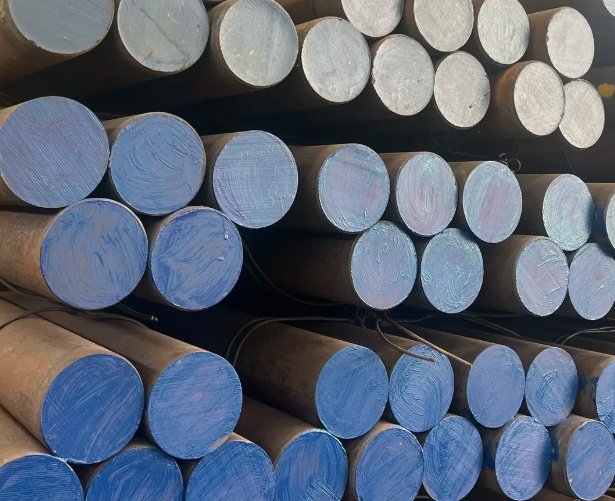
1045 alloy steel is a commonly searched term for AISI 1045 medium-carbon steel, a widely used engineering material known for its higher strength than low-carbon steels, good machinability, and excellent response to induction hardening. Strictly speaking, 1045 is not a chromium-molybdenum alloy steel like 4140; it is a plain carbon steel with approximately 0.43% to 0.50% carbon.
For buyers, machinists and design engineers, 1045 is often selected for shafts, axles, studs, bolts, pins, hydraulic components, crankshafts, machine parts and wear-resistant surfaces where a balance of strength, hardness and cost is required.
What Is 1045 Steel?
AISI/SAE 1045 is a medium-carbon steel grade commonly supplied as hot rolled, cold drawn, normalized, turned-ground-polished, or quenched and tempered bar. It is valued for a balanced shaft and component performance: stronger than 1018, easier to machine than many alloy steels, and more economical than 4140 when deep hardenability is not required.
| Standard or Region | Equivalent or Related Grade | Notes |
|---|---|---|
| AISI / SAE | 1045 | Medium-carbon plain carbon steel |
| EN / DIN | C45 / 1.0503 | Common European equivalent |
| BS | EN8 | Frequently compared with 1045 |
| JIS | S45C | Japanese medium-carbon steel equivalent |
| GB / China | 45 Steel | Common Chinese engineering steel grade |
Buyer and engineer note: why the term “1045 alloy steel” can be confusing
Many purchasing teams use “1045 alloy steel” as a broad search term, but material certificates usually identify it as AISI 1045, SAE 1045, C45, EN8 or S45C. If a drawing requires alloy steel hardenability, fatigue strength or through-hardening in larger sections, confirm whether the intended grade is actually 4140, 4340 or another alloy steel rather than 1045.
1045 Steel Chemical Composition
The defining feature of 1045 is its carbon range. The carbon content provides improved tensile strength and hardness compared with mild steel, while manganese supports strength and machinability.
| Element | Typical Range | Function in Steel |
|---|---|---|
| Carbon, C | 0.43% - 0.50% | Increases hardness, tensile strength and wear resistance |
| Manganese, Mn | 0.60% - 0.90% | Improves strength, hardenability and machinability |
| Phosphorus, P | 0.040% max | Controlled impurity; excessive levels reduce toughness |
| Sulfur, S | 0.050% max | Controlled impurity; may improve machinability in resulfurized variants |
| Iron, Fe | Balance | Base metal |
Mechanical Properties of 1045 Steel
Mechanical properties depend heavily on product form, diameter, heat treatment, test orientation and standard. The values below are typical reference ranges for engineering selection, not a substitute for certified mill test reports.
| Condition | Tensile Strength | Yield Strength | Hardness | Typical Use |
|---|---|---|---|---|
| Hot rolled | 570 - 700 MPa | 310 - 450 MPa | 170 - 220 HB | General machined components, brackets, pins |
| Normalized | 620 - 760 MPa | 340 - 500 MPa | 180 - 240 HB | Shafts, axles, machine parts needing uniform structure |
| Cold drawn | 650 - 850 MPa | 530 - 700 MPa | 190 - 260 HB | Precision bars, turned parts, threaded components |
| Quenched and tempered | 700 - 900 MPa | 450 - 650 MPa | 220 - 300 HB | Higher-strength shafts, gears and mechanical parts |
| Induction hardened surface | Core dependent | Core dependent | 50 - 58 HRC surface possible | Wear surfaces, bearing journals, splines |
In shafting applications, the practical advantage of 1045 is that it can deliver higher load capacity than 1018 while still remaining cost-effective. For wear-loaded surfaces, localized induction hardening can create a hard case while keeping a tougher core.
1045 Steel Heat Treatment
1045 responds well to normalizing, quenching and tempering, flame hardening and induction hardening. Because it is a medium-carbon plain carbon steel, hardenability is moderate; larger cross sections may not through-harden as effectively as alloy steels.
| Process | Typical Temperature Range | Result |
|---|---|---|
| Annealing | 790 - 870°C followed by slow cooling | Softens material for forming or machining |
| Normalizing | 840 - 900°C followed by air cooling | Refines grain structure and improves property uniformity |
| Hardening | 820 - 860°C followed by water or oil quench | Increases hardness; risk of distortion depends on geometry |
| Tempering | 400 - 650°C depending on target hardness | Reduces brittleness and adjusts strength-toughness balance |
| Induction hardening | Localized rapid heating and quenching | Hard wear-resistant surface with ductile core |
For wear-resistant shafts, induction hardening is often more efficient than through hardening because only bearing seats, spline teeth, journals or contact tracks need high surface hardness.
Engineering note: realistic result from induction hardening 1045 shafting
In a common production scenario, a 45 mm diameter normalized 1045 shaft with a bearing journal may be induction hardened to approximately 52 - 56 HRC at a 2 - 4 mm effective case depth. Compared with an untreated 180 - 220 HB surface, this can substantially reduce adhesive wear and fretting at the contact zone, while the core retains better toughness than a fully hardened brittle section.
Machining 1045 Steel
1045 is widely used for turned, milled, drilled, bored, threaded and ground parts. Its machinability is generally rated around 55% to 65% compared with free-cutting 1212 steel at 100%, depending on condition and sulfur level. The best machining stability is usually achieved in the normalized, cold drawn, or annealed condition.
From a production standpoint, machining parameters must account for carbon content and hardness. Higher hardness improves final strength but increases tool wear, cutting force and heat generation.
| Operation | Recommended Consideration | Common Issue |
|---|---|---|
| Turning | Use coated carbide inserts for production; maintain rigid setup | Built-up edge at low speed, chatter on long shafts |
| Drilling | Use adequate coolant and peck cycles for deeper holes | Work hardening near hole entrance, poor chip evacuation |
| Milling | Prefer stable clamping and climb milling when appropriate | Edge chipping if interrupted cuts are aggressive |
| Threading | Use sharp tools and controlled feed; consider rolling for high-volume parts | Torn thread surface in hot rolled stock |
| Grinding | Control heat input after hardening | Grinding burn, residual stress and surface cracking |
Machining Tips for Better Dimensional Stability
- Use normalized material when dimensional consistency is more important than minimum raw material cost.
- Rough machine before heat treatment, then finish machine or grind after hardening.
- For long shafts, use steady rests, tailstock support and balanced stock removal to reduce bending.
- Specify straightness tolerance for turned-ground-polished bars when bearing alignment matters.
- Control decarburization if parts will be surface hardened after machining.
Buyer note: machining cost is not only material price
A lower-cost hot rolled 1045 bar may increase machining time if scale, straightness variation or inconsistent hardness causes additional passes. For precision shafts, cold drawn or turned-ground-polished 1045 can reduce cycle time, scrap rate and final grinding allowance even when the purchase price per kilogram is higher.
1045 Steel vs 1018, 4140, 1040 and 1050
Material selection often depends on whether the application prioritizes cost, machinability, weldability, wear resistance, fatigue strength or through-hardening capability. 1045 sits between low-carbon mild steel and alloy steel in both performance and cost.
| Material | Carbon / Alloy Type | Strength | Machinability | Heat Treatment Response | Best Fit |
|---|---|---|---|---|---|
| 1018 | Low-carbon steel | Lower than 1045 | Good | Limited hardening except carburizing | Welded parts, low-stress machined components |
| 1040 | Medium-carbon steel | Slightly lower than 1045 | Similar or slightly easier | Good but slightly less hardening potential | General shafts and forgings |
| 1045 | Medium-carbon steel | Moderate to high | Good for carbon steel | Good surface hardening, moderate through hardening | Shafts, pins, axles, machine parts |
| 1050 | Higher-carbon steel | Higher hardness potential | Lower than 1045 | Better hardness but less forgiving | Wear parts, blades, springs in selected cases |
| 4140 | Chromium-molybdenum alloy steel | Higher and more reliable in larger sections | Moderate | Excellent through hardening | High-load shafts, gears, tooling, fatigue-critical parts |
If a component needs higher core strength, impact toughness or hardenability in thick sections, 4140 is often the safer engineering choice. If cost control and surface hardening are more important than deep hardening, 1045 can be more economical.
Common Applications of 1045 Steel
1045 is frequently chosen for components that need more strength and wear resistance than mild steel but do not justify the cost of alloy steel. It is especially common in rotating and sliding mechanical parts.
- Shafts, pump shafts, motor shafts and transmission shafts
- Axles, spindles, studs, pins and dowel components
- Hydraulic cylinder rods and tie rods
- Gears, sprockets, couplings and hubs in moderate-duty service
- Bolts, fasteners, threaded rods and mechanical connectors
- Machine tool components, fixtures and general industrial parts
- Induction hardened bearing journals, spline areas and wear tracks
Engineering problem example: replacing 1018 with 1045 for a shaft
A lightly loaded 1018 shaft may be adequate for static strength but develop wear at bearing contact surfaces. Switching to normalized 1045 can increase typical tensile strength from roughly 440 MPa for 1018 to around 620 - 760 MPa for normalized 1045. If the bearing journal is induction hardened to above 50 HRC, the surface wear resistance can improve significantly without changing to a more expensive alloy steel. The tradeoff is reduced weldability and potentially higher machining force.
Weldability, Formability and Limitations
1045 can be welded, but it is less weldable than low-carbon steels because its higher carbon content increases the risk of hard, brittle heat-affected zones and cracking. Preheating, controlled interpass temperature, low-hydrogen electrodes and post-weld stress relief may be necessary for critical weldments.
1045 also has limited cold formability compared with 1018. It can be forged and hot formed, but severe cold bending is not recommended unless the material condition and bend radius are carefully controlled.
It is not a chromium-molybdenum alloy steel, so it should not be selected when high through-hardening capability, high fatigue strength in large diameters, or severe impact resistance is required.
Specification Checklist for Purchasing 1045 Steel
To avoid material mismatch, drawings and purchase orders should define more than just “1045 steel.” The final performance depends on the standard, form, condition, heat treatment, dimensions, tolerance and certification requirements.
- Grade designation: AISI 1045, SAE 1045, C45, EN8, S45C or 45 steel
- Product form: round bar, flat bar, plate, forged billet, tube, shafting or TGP bar
- Condition: hot rolled, cold drawn, normalized, annealed, quenched and tempered, induction hardened
- Mechanical requirements: tensile strength, yield strength, elongation, hardness or impact value
- Dimensional tolerance: diameter, straightness, roundness, surface finish and machining allowance
- Heat treatment requirement: through hardening, surface hardness, case depth and tempering range
- Certification: mill test certificate, chemical analysis, hardness report or third-party inspection
For precision or safety-related components, confirm heat-treatment condition and certified mechanical properties before machining or assembly. Two bars both labeled “1045” can perform very differently if one is hot rolled and the other is cold drawn, normalized, or quenched and tempered.
Key Takeaways
- 1045 is a medium-carbon steel, often searched as 1045 alloy steel, but technically it is a plain carbon steel.
- It offers better strength and hardening response than 1018 while remaining more economical than 4140.
- It is suitable for shafts, pins, axles, gears, studs, hydraulic parts and many machined components.
- Induction hardening can produce a hard wear surface while preserving a tougher core.
- Machining is generally good, but tooling, coolant, material condition and heat treatment strongly affect productivity.
- Weldability is limited compared with low-carbon steel and may require preheat or post-weld treatment.
- For purchasing, specify grade, standard, condition, tolerance, hardness and certification requirements clearly.