
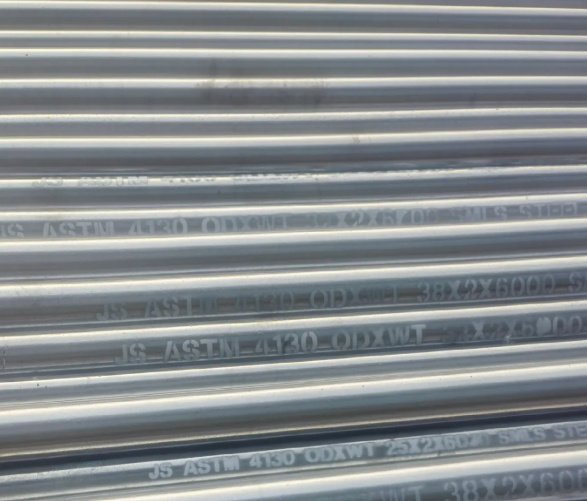
AISI 4130 alloy steel, also called SAE 4130, UNS G41300 or chromoly steel, is a low-alloy chromium-molybdenum steel known for its strength-to-weight ratio, weldability, toughness and response to heat treatment. It is widely used for aircraft tubing, motorsport roll cages, pressure components, shafts, fasteners, tooling, structural parts and energy-sector equipment.
Searchers evaluating 4130 usually need more than a definition. They need composition limits, mechanical properties by condition, whether 4130 is better than 4140 or 4340, how it machines, how it welds, and what to specify when buying bar, plate, sheet, seamless tube or forgings. This page is written for engineers, purchasers and manufacturing teams who need practical data before selecting or quoting 4130 material.
What Is 4130 Alloy Steel?
4130 is a chromium-molybdenum low-alloy steel with about 0.30% carbon. The “41” series indicates chromium and molybdenum alloying, while “30” indicates nominal carbon content near 0.30%. Compared with plain carbon steels, 4130 offers better hardenability, higher tensile strength after heat treatment, and improved fatigue performance when designed and processed correctly.
The key point is that 4130 is not a single-strength material. Its final strength depends heavily on product form, section size, heat-treatment condition and applicable specification. Annealed 4130 is easier to machine and form; normalized 4130 offers a balanced strength and toughness level; quenched-and-tempered 4130 can reach substantially higher strength.
4130 Chemical Composition and Common Standards
The following chemistry represents typical AISI/SAE 4130 composition ranges. Exact limits may vary by ASTM, AMS, EN, customer drawing or mill specification.
| Element | Typical Range, wt% | Function in 4130 |
|---|---|---|
| Carbon, C | 0.28–0.33 | Controls strength, hardenability and heat-treatment response |
| Manganese, Mn | 0.40–0.60 | Improves hardenability and supports deoxidation |
| Phosphorus, P | 0.035 max | Impurity; excessive levels reduce toughness |
| Sulfur, S | 0.040 max | Impurity; affects machinability and transverse ductility |
| Silicon, Si | 0.15–0.35 | Deoxidizer and minor strength contributor |
| Chromium, Cr | 0.80–1.10 | Improves hardenability, wear resistance and oxidation resistance |
| Molybdenum, Mo | 0.15–0.25 | Improves hardenability, high-temperature strength and temper resistance |
| Iron, Fe | Balance | Base metal |
Common material references include AISI 4130, SAE 4130, UNS G41300, ASTM A29, ASTM A322, ASTM A519 tubing, ASTM A331 cold-finished bar, ASTM A505 sheet and strip, AMS 6345, AMS 6346, AMS 6370 and other aerospace or industrial variants. For controlled hardenability, buyers may specify 4130H, which has restricted hardenability bands.
Buyer note: why the standard matters
“4130” alone is often not enough for procurement. A quote should define the product form, governing standard, heat condition, dimensions, tolerance, testing requirements, certification level and whether domestic melt, aircraft-quality, vacuum-degassed or ultrasonic-tested material is required. Two suppliers may both offer 4130, but one may quote commercial annealed bar while another quotes AMS-certified normalized tubing.
Mechanical and Physical Properties of 4130 Steel
The mechanical properties below are typical reference values, not guaranteed design allowables. Always verify values against the mill test report, material specification, heat-treatment certificate and engineering drawing.
| Condition | Tensile Strength | Yield Strength | Elongation | Hardness | Typical Use |
|---|---|---|---|---|---|
| Annealed | Approx. 560 MPa / 81 ksi | Approx. 360–435 MPa / 52–63 ksi | Approx. 25–28% | Approx. 156–197 HB | Machining, forming, parts to be heat treated later |
| Normalized | Approx. 560–670 MPa / 81–97 ksi | Approx. 435–460 MPa / 63–67 ksi | Approx. 20–25% | Approx. 180–220 HB | Aircraft tubing, welded structures, general high-strength parts |
| Quenched and tempered | Approx. 850–1,100 MPa / 123–160 ksi | Approx. 690–930 MPa / 100–135 ksi | Approx. 12–18% | Approx. 260–330 HB, depending on temper | Shafts, pins, high-load components, tooling supports |
| Property | Typical Value |
|---|---|
| Density | 7.85 g/cm³ / 0.284 lb/in³ |
| Elastic Modulus | About 205 GPa / 29,700 ksi |
| Poisson’s Ratio | About 0.29 |
| Thermal Conductivity | About 42 W/m·K at room temperature |
| Coefficient of Thermal Expansion | About 12.0–12.5 µm/m·°C |
| Electrical Resistivity | About 0.22 µΩ·m |
4130 vs 4140, 4340, 8620 and Mild Steel
Material selection often comes down to whether 4130 offers enough strength and hardenability without adding unnecessary cost, weight or welding risk. The comparisons below summarize common engineering trade-offs.
| Material | Main Difference | Advantages Compared with 4130 | When 4130 Is Preferable |
|---|---|---|---|
| 4130 vs 4140 | 4140 has higher carbon, typically about 0.40% | 4140 can achieve higher hardness, strength and wear resistance | 4130 is usually the better welding choice and is easier to form in tubing and thin sections |
| 4130 vs 4340 | 4340 adds nickel and has higher hardenability | 4340 performs better in large sections and very high toughness applications | 4130 is lower cost, easier to weld and adequate for many medium-strength components |
| 4130 vs 8620 | 8620 is commonly carburized for hard case and tough core | 8620 is excellent for case-hardened gears and wear surfaces | 4130 is better when through-strength, weldability and tubular structures are priorities |
| 4130 vs Mild Steel | Mild steel has lower alloy content and lower hardenability | Mild steel is cheaper, easier to form and more forgiving to weld | 4130 offers higher strength-to-weight potential and better fatigue performance when processed correctly |
For a welded aircraft frame, normalized 4130 tubing is often more practical than 4140 because carbon content is lower and welding procedures are better established. For a large shaft requiring very high through-hardness, 4340 may outperform 4130 because of its nickel-chromium-molybdenum alloy system and deeper hardenability.
Heat Treatment of 4130 Steel
Heat treatment is central to 4130 performance. A part that is annealed, normalized, stress relieved, quenched and tempered, or welded without post-weld processing can show very different strength, hardness and toughness.
| Process | Typical Temperature Range | Cooling Method | Purpose |
|---|---|---|---|
| Annealing | 830–860°C / 1525–1580°F | Furnace cool | Softens material for machining or forming |
| Normalizing | 870–900°C / 1600–1650°F | Air cool | Refines grain structure and improves uniformity |
| Hardening | 845–870°C / 1550–1600°F | Oil quench, depending on section and specification | Develops martensitic structure for high strength |
| Tempering | 400–650°C / 750–1200°F | Air cool after soak | Balances hardness, strength and toughness |
| Stress Relieving | 540–650°C / 1000–1200°F | Air cool or controlled cool | Reduces residual stress after machining or welding |
Always specify condition when ordering 4130: annealed, normalized, normalized and tempered, quenched and tempered, cold drawn, hot rolled, seamless, welded, or aircraft-quality tubing. If only “4130 steel” is written on a purchase order, the delivered material may not match the mechanical assumptions used in design.
Engineer note: heat treatment and section size
4130 has useful hardenability, but it is not unlimited. Thin wall tubing, small pins and moderate cross sections respond well to quench and temper. Large sections may not reach the same core hardness as the surface. For critical parts, specify hardness location, tensile coupon orientation, impact testing, microstructure requirements or hardenability banding.
Machining, Welding and Fabrication of 4130
Machining 4130 Steel
4130 is considered readily machinable in the annealed or normalized condition compared with higher-carbon alloy steels. Its machinability is commonly referenced around 70% of free-machining AISI 1212 steel, though actual tool life depends on hardness, sulfur level, microstructure, coolant, machine rigidity and cutting tool geometry.
- Best condition for general machining: annealed or normalized, typically under about 220 HB.
- Tooling: coated carbide is preferred for production turning, milling and drilling; high-speed steel can be used for lower-speed work.
- Coolant: use flood coolant or high-pressure coolant to reduce heat and improve chip control.
- Workholding: use rigid fixturing because 4130 can work harden locally if tools rub instead of cut.
- Post-machining: consider stress relief for tight-tolerance parts, long shafts or parts with heavy stock removal.
Typical starting points for annealed 4130 include carbide turning speeds around 120–220 m/min and high-speed steel turning speeds around 25–45 m/min, with feed and depth of cut adjusted for tool nose radius, machine horsepower and surface finish requirement. Hardened 4130 requires lower speeds, more rigid setups and often CBN, ceramic or premium carbide tooling depending on hardness.
Welding 4130 Steel
4130 can be welded by TIG, MIG, resistance welding and other controlled processes. TIG welding is common for aircraft and motorsport tubing. ER80S-D2 filler is frequently used because it provides compatible strength and deoxidizers, although filler selection must follow the applicable code, drawing or welding procedure specification.
- Preheat is often used for thicker sections, high-restraint joints or cold shop conditions; common ranges are about 150–260°C / 300–500°F depending on thickness and procedure.
- Thin normalized aircraft tubing is often welded with controlled heat input and may not require the same preheat as heavy plate or restrained weldments.
- Post-weld stress relief may be required for pressure equipment, thick sections, fatigue-critical parts or highly restrained assemblies.
- Avoid welding fully hardened 4130 unless a qualified procedure addresses hardness, cracking risk and post-weld heat treatment.
Fabrication note: common causes of 4130 weld problems
Cracking is usually linked to excessive restraint, hydrogen, rapid cooling, high hardness in the heat-affected zone or inappropriate filler. Practical controls include clean material, dry consumables, suitable preheat, controlled interpass temperature, moderate heat input and verified post-weld heat treatment when required.
Common Applications of 4130 Alloy Steel
4130 is selected where engineers need a combination of weldability, toughness, fatigue strength and heat-treatable strength. It is especially popular in tubular and weight-sensitive structures.
- Aircraft fuselage frames, engine mounts, landing gear components and structural tubing
- Motorsport roll cages, chassis members, suspension links and driveline components
- Oil and gas parts, including valve bodies, wellhead components and high-strength fittings
- Industrial shafts, pins, gears, fasteners, couplings and machinery components
- Pressure vessels, gas bottles and tubing where applicable standards permit its use
- Defense, robotics, bicycles, tooling fixtures and high-strength welded assemblies
In fatigue-sensitive applications, material strength alone is not enough. Surface finish, weld toe profile, residual stress, heat-affected zone hardness, corrosion protection and inspection quality often determine service life more than the nominal tensile strength.
Engineering Example: Replacing Mild Steel with 4130
Consider a welded bracket originally designed in A36 mild steel with a nominal yield strength of 250 MPa. If the same bracket is redesigned using normalized 4130 with a typical yield strength near 435 MPa, the yield-strength ratio is approximately 435 / 250 = 1.74. In a simple yield-governed member, this suggests up to about 42% theoretical cross-sectional area reduction for the same yield margin.
In real structures, the practical weight reduction is usually lower because buckling, weld strength, fatigue, stiffness, impact loading and manufacturing tolerances also control design. A realistic engineering outcome may be a 10–25% mass reduction after finite element analysis, weld procedure qualification and fatigue review. This is why 4130 is valuable: it gives the designer more strength per unit weight, but it does not remove the need for structural validation.
For tubular structures, stiffness often remains the limiting factor because steel grades have nearly the same elastic modulus. Switching from mild steel to 4130 increases yield and fatigue potential, but it does not significantly increase elastic stiffness. Tube diameter, wall thickness and geometry still dominate deflection performance.
Purchasing and Specification Checklist for 4130 Steel
For purchasing teams, the most common 4130 supply issue is incomplete specification. A buyer may request “4130 round bar” and receive technically correct material that is still unsuitable for aerospace, pressure equipment or heat-treated production parts.
- Material designation: AISI 4130, SAE 4130, UNS G41300 or required equivalent
- Product form: round bar, flat bar, plate, sheet, seamless tube, welded tube, forging or billet
- Governing standard: ASTM, AMS, SAE, customer specification or drawing requirement
- Condition: annealed, normalized, cold drawn, hot rolled, quenched and tempered, or stress relieved
- Mechanical requirements: tensile strength, yield strength, elongation, reduction of area, hardness or impact test
- Inspection: mill test certificate, heat number traceability, ultrasonic testing, magnetic particle testing or hardness mapping
- Dimensional controls: OD, ID, wall thickness, straightness, tolerance class, surface finish and cut length
- Processing restrictions: weldability, heat-treatment response, decarburization limits or grain size requirements
For buyers, the safest purchase order includes the standard, size, condition, certification requirement and intended processing route. For engineers, the safest drawing includes final mechanical requirements and whether values apply before or after machining, welding and heat treatment.
Limitations and Design Considerations
4130 is versatile, but it is not the best steel for every case. It is not stainless, so corrosion protection is often needed through paint, plating, phosphate coating, oiling or other surface treatment. It is not as deeply hardenable as 4340 for large cross sections. It is not as wear-resistant as carburized 8620 for gear teeth. It is not as inexpensive or as forgiving as mild steel for low-stress fabrication.
Critical 4130 parts should be evaluated for heat-treatment distortion, decarburization, weld heat-affected-zone hardness, hydrogen embrittlement from plating, notch sensitivity, fatigue detail design and inspection accessibility. When 4130 is used in aerospace, motorsport, pressure or lifting equipment, follow the governing code and qualified procedures rather than relying only on general property tables.
In short, 4130 alloy steel is best chosen when the project needs a proven chromium-molybdenum steel with good weldability, medium-to-high strength capability, excellent availability in tubing and bar, and a strong record in structural and mechanical applications. For accurate performance, specify the exact condition, verify certification and match heat treatment to the final service requirement.