
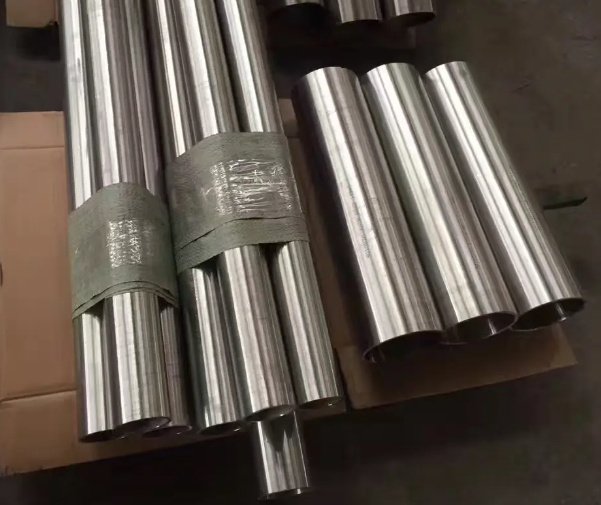
4340 alloy steel is a nickel-chromium-molybdenum low-alloy steel used where high tensile strength, toughness, fatigue resistance and through-hardening capability are required. It is commonly specified for aircraft landing gear, power transmission shafts, gears, oil and gas components, connecting rods, high-load fasteners, tooling and heavy-duty machine parts.
In engineering documents, 4340 may also appear as AISI 4340, SAE 4340 or UNS G43400. It is valued because 4340 alloy steel combines deep hardenability with good toughness after quenching and tempering, making it more suitable than plain carbon steels or 4140 steel for larger cross sections and severe cyclic loading.
What Is 4340 Alloy Steel?
4340 is a heat-treatable alloy steel containing nickel, chromium and molybdenum. Nickel improves toughness and impact resistance; chromium contributes hardenability and wear resistance; molybdenum improves strength retention and resistance to temper embrittlement. The alloy is normally supplied as hot rolled, annealed, normalized, quenched and tempered, cold drawn or forged product depending on the application.
| Element | Typical Range, % by Weight | Engineering Role |
|---|---|---|
| Carbon, C | 0.38 - 0.43 | Strength, hardness and heat-treatment response |
| Manganese, Mn | 0.60 - 0.80 | Hardenability and deoxidation |
| Silicon, Si | 0.15 - 0.35 | Deoxidation and strength |
| Nickel, Ni | 1.65 - 2.00 | Toughness and impact resistance |
| Chromium, Cr | 0.70 - 0.90 | Hardenability and wear resistance |
| Molybdenum, Mo | 0.20 - 0.30 | Deep hardening and tempering resistance |
| Phosphorus, P | 0.035 max | Controlled impurity |
| Sulfur, S | 0.040 max | Controlled impurity; affects machinability and toughness |
Composition limits vary slightly by standard, product form and mill specification. For critical aerospace, defense, motorsport or pressure-related components, purchase orders should reference the required material standard, heat treatment condition and test requirements rather than relying on a generic grade name alone.
4340 Steel Mechanical Properties
The mechanical properties of 4340 depend heavily on heat treatment, section size, reduction ratio, cleanliness, grain size and testing direction. The following values are typical engineering ranges and should be confirmed against certified mill test reports, applicable specifications and final part qualification tests.
| Condition | Tensile Strength | Yield Strength | Elongation | Hardness | Typical Use |
|---|---|---|---|---|---|
| Annealed | 650 - 800 MPa | 400 - 550 MPa | 18 - 25% | 197 - 235 HB | Machining before final heat treatment |
| Normalized | 850 - 1000 MPa | 600 - 750 MPa | 14 - 20% | 250 - 310 HB | Forgings, shafts, structural parts |
| Quenched and tempered | 1080 - 1550 MPa | 930 - 1350 MPa | 10 - 16% | 32 - 45 HRC | High-strength rotating and impact-loaded parts |
| High-strength Q&T | 1600 - 1900 MPa | 1400 - 1650 MPa | 7 - 12% | 45 - 53 HRC | Motorsport, aerospace and highly stressed components |
For many design teams, the main advantage is not just peak strength. The more important benefit is that 4340 can maintain useful core hardness in thicker sections, where shallower-hardening steels may show a significant drop from surface to center.
Heat Treatment of 4340 Alloy Steel
4340 is usually selected because it responds well to quenching and tempering. A common route is rough machining in the annealed or normalized condition, followed by austenitizing, oil quenching and tempering to the required hardness. Vacuum heat treatment, protective atmosphere processing or controlled decarburization limits may be required for precision or aerospace parts.
| Process | Typical Temperature Range | Purpose | Engineering Notes |
|---|---|---|---|
| Annealing | 810 - 850°C, slow cool | Softening for machining | Often targets about 197 - 235 HB |
| Normalizing | 870 - 900°C, air cool | Refining grain structure | Useful after forging or heavy hot working |
| Austenitizing | 830 - 870°C | Preparation for hardening | Soak time depends on section thickness and furnace loading |
| Quenching | Usually oil quench | Martensitic hardening | Control agitation and distortion; polymer quench may be used with qualification |
| Tempering | 200 - 650°C | Strength-toughness balance | Higher tempering temperatures reduce hardness but improve ductility and toughness |
Tempering is the key adjustment step. A lower tempering temperature can produce high hardness and strength, but reduced impact toughness. A higher tempering temperature generally improves toughness and dimensional stability but lowers tensile strength. For fatigue-critical components, final hardness alone is not enough; surface finish, residual stress, inclusion level and notch geometry also influence service life.
Engineering note: reducing distortion and cracking during 4340 heat treatment
Real production issues often occur when long shafts, thin-wall rings or asymmetric forgings are quenched without adequate fixturing or stress relief. A practical route is to rough machine with stock allowance, perform stress relieving before final hardening, use uniform section transitions, avoid sharp internal corners and specify controlled quench media. In one common shaft-manufacturing scenario, changing from direct hardening after aggressive rough turning to stress relief plus balanced stock removal can reduce post-heat-treatment runout and lower straightening scrap, especially on parts with high length-to-diameter ratios.
4340 Alloy Steel vs 4140, 300M, 8620 and 9310
Searchers often compare 4340 with other alloy steels because the correct choice depends on section size, toughness, hardenability, cost and whether the part needs through hardening or case hardening. The table below summarizes common engineering trade-offs.
| Grade | Type | Main Strength | Limitation | Best-Fit Applications |
|---|---|---|---|---|
| 4340 | Ni-Cr-Mo through-hardening alloy steel | High strength, toughness and deep hardenability | Higher cost than 4140; needs controlled heat treatment | Large shafts, aircraft parts, high-load gears, forged components |
| 4140 | Cr-Mo alloy steel | Good strength, availability and cost efficiency | Lower hardenability and toughness in larger sections | General shafts, machine components, tooling, bolts |
| 300M | Modified 4340 with silicon and vanadium | Very high strength and fatigue performance | More expensive; tighter processing control required | Aerospace landing gear, motorsport and defense parts |
| 8620 | Ni-Cr-Mo carburizing steel | Tough core with hard carburized case | Not used for high through-hardened strength like 4340 | Case-hardened gears, pinions, splines |
| 9310 | High-nickel carburizing steel | Excellent fatigue and gear performance after carburizing | Higher material and processing cost | Aerospace gears, high-performance transmission components |
Choose 4340 over 4140 when the component is larger, more highly stressed, impact loaded or fatigue critical. Choose 4140 when moderate strength, machinability and cost control are more important than maximum toughness. Choose 8620 or 9310 when the design requires a hard wear-resistant case with a tough low-carbon core, especially for carburized gears.
Machining 4340 Steel
4340 is machinable, but machining performance depends strongly on hardness and microstructure. It is normally easier to machine in the annealed condition than after quenching and tempering. As hardness increases above about 32 HRC, tool wear, cutting forces and heat generation rise quickly. For production machining, process planning should consider stock condition, cutter grade, coolant delivery, rigidity and whether final finishing occurs before or after heat treatment.
| Operation | Recommended Approach | Risk if Poorly Controlled |
|---|---|---|
| Turning | Use rigid workholding, coated carbide, positive chip control and adequate coolant | Chatter, built-up edge, thermal cracking or poor finish |
| Milling | Use stable fixturing, climb milling where suitable and avoid interrupted cuts at high hardness | Edge chipping and dimensional variation |
| Drilling | Use through-coolant drills for deep holes and peck cycles where necessary | Work hardening, drill wandering and hole oversize |
| Grinding | Use appropriate wheel selection and coolant flow; avoid excessive infeed | Grinding burn, tensile residual stress and microcracking |
| Threading | Machine before final hardening when possible; consider thread rolling after heat treatment if specified | Root notches, fatigue reduction and tool breakage |
In many shops, the best cost-to-quality route is rough machining in the annealed state, leaving allowance for distortion, then heat treating and finish machining or grinding. If the part must be machined after heat treatment, ceramic, cermet, PCBN or high-performance carbide tooling may be justified depending on hardness, volume and tolerance.
Buyer and machinist note: ordering 4340 for CNC machining
For machined components, specify more than the grade name. Useful purchasing details include bar diameter or plate thickness tolerance, annealed hardness range, ultrasonic testing requirement, grain flow direction for forgings, decarburization limits, straightness, surface condition and whether the supplier must provide mill test certificates. This reduces disputes between purchasing, machining and quality teams when tool life or dimensional stability becomes an issue.
Applications of 4340 Alloy Steel
4340 steel is used in applications where failure can be expensive, dangerous or operationally disruptive. Its combination of strength, toughness and fatigue resistance makes it suitable for parts exposed to torque, bending, impact and cyclic stress.
- Aircraft landing gear components, structural pins and high-strength fittings
- Crankshafts, connecting rods and motorsport drivetrain parts
- Oil and gas shafts, collars, tool joints and high-load mechanical components
- Heavy-duty gears, pinions, spindles, axles and transmission shafts
- Military vehicle components, fasteners and forged load-bearing parts
- High-strength tooling, mandrels, dies and machine elements
For rotating components, 4340 is often selected because the material can be heat treated to a high strength level while still retaining enough toughness to resist sudden brittle fracture. However, design teams must evaluate stress concentration, surface finish, shot peening, fillet radius and inspection requirements, not just nominal material strength.
Standards, Equivalent Grades and Product Forms
4340 alloy steel is supplied under several standards and product forms. The exact requirements differ by region and end-use industry, so equivalent grades should be treated as comparable rather than automatically interchangeable.
| Designation or Standard | Notes |
|---|---|
| AISI 4340 / SAE 4340 | Common North American grade designation |
| UNS G43400 | Unified Numbering System designation |
| AMS 6414, AMS 6415 and related AMS specifications | Often used for aerospace-quality bars, forgings or heat-treated forms; confirm exact revision |
| ASTM A29 / A29M | General requirements for hot-wrought steel bars |
| EN 34CrNiMo6 / 36CrNiMo4 | Commonly compared European Ni-Cr-Mo steels; verify chemistry and mechanical requirements before substitution |
| JIS SNCM439 | Japanese Ni-Cr-Mo alloy steel often considered in cross-reference discussions |
Available product forms commonly include round bar, flat bar, plate, forged bar, rings, billet, seamless mechanical tubing and custom forgings. Critical components may require vacuum degassing, aircraft quality cleanliness, ultrasonic inspection, macroetch testing or fracture toughness testing.
Welding, Forming and Surface Treatment
4340 can be welded, but it is not considered an easy-to-weld steel because its carbon and alloy content create a risk of heat-affected-zone cracking. Welding is usually avoided on highly stressed 4340 parts unless the procedure is qualified. When welding is unavoidable, preheating, low-hydrogen consumables, controlled interpass temperature and post-weld heat treatment are typically required.
Cold forming is limited compared with low-carbon steels, especially in hardened conditions. Hot forging is common, but forging temperature, cooling rate and subsequent normalizing or annealing must be controlled to refine grain structure and prepare the steel for machining or final hardening.
4340 can also be nitrided, induction hardened, shot peened, black oxide coated, phosphated, plated or coated for corrosion control and fatigue enhancement. Since 4340 is not stainless steel, corrosion protection should be specified for humid, marine or outdoor service. Plating operations on high-strength 4340 must consider hydrogen embrittlement risk and appropriate baking procedures.
Engineering problem: hydrogen embrittlement in plated high-strength 4340
When 4340 is heat treated above roughly 40 HRC and then electroplated, absorbed hydrogen can cause delayed cracking under sustained load. Aerospace and high-reliability applications often control this risk through approved plating procedures, surface preparation limits, post-plate baking and inspection. If corrosion protection is needed, engineers may evaluate alternatives such as mechanical plating, electroless nickel with qualified processing, thermal spray coatings or non-electrolytic coating systems depending on the design requirement.
How to Specify and Purchase 4340 Alloy Steel
A clear 4340 steel purchase specification helps prevent mismatches between engineering intent and delivered material. The grade alone does not define hardness, cleanliness, inspection level, heat treatment or dimensional tolerance.
- State the grade and standard, such as AISI 4340, SAE 4340, UNS G43400 or the applicable AMS/ASTM specification.
- Define the product form: round bar, plate, forged bar, ring, tubing or custom forging.
- Specify condition: annealed, normalized, quenched and tempered, pre-hardened or aircraft quality.
- List required mechanical properties, hardness range, impact testing or fracture toughness where needed.
- Define inspection requirements such as ultrasonic testing, magnetic particle inspection or macroetch evaluation.
- Require material test reports with heat number, chemistry, mechanical test results and heat treatment record.
- Clarify machining allowance, straightness, surface finish, decarburization limits and delivery tolerance.
For buyers, 4340 is rarely the lowest-cost alloy steel option. Its value comes from reducing risk in demanding applications where insufficient hardenability, poor toughness or unpredictable heat-treatment response could lead to rework, field failure or oversizing of the component.
Procurement note: when paying more for 4340 is justified
4340 is usually justified when a component has a combination of high load, large section thickness, fatigue cycling and impact exposure. If a small component only needs moderate strength, 4140 may be more economical. If a gear needs a very hard case and tough core, 8620 or 9310 may be more appropriate. If the application requires extreme aerospace strength and fatigue performance, 300M may outperform standard 4340 but at higher material and processing cost.
Key Takeaways for Engineers and Buyers
4340 alloy steel is a high-performance Ni-Cr-Mo steel for demanding mechanical components. Its strongest advantages are high hardenability, excellent strength after quenching and tempering, and better toughness than many lower-alloy steels at comparable strength levels. It is especially useful for large shafts, aircraft-grade parts, forged components and fatigue-loaded systems.
To use 4340 successfully, engineering and purchasing teams should control heat treatment, hardness, cleanliness, machining sequence and inspection requirements. The best results come from specifying the complete material condition and performance requirements, not just the words “4340 alloy steel.”