
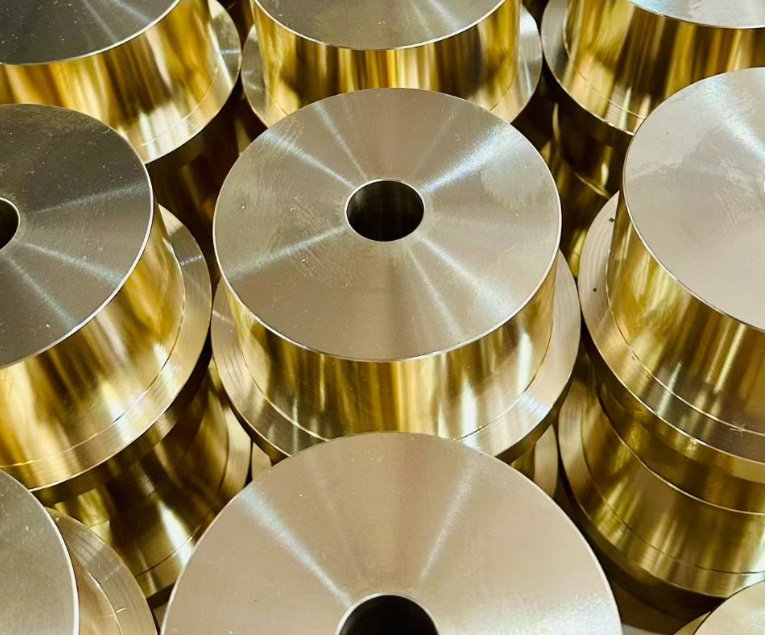
C26000 brass, also known as cartridge brass, 70/30 brass, CDA 260 or UNS C26000, is one of the most widely specified copper-zinc alloys for sheet, strip, plate, tube and drawn components. It combines high ductility, good corrosion resistance, excellent cold formability and a clean yellow appearance, making it a common choice for deep-drawn parts, terminals, radiator components, ammunition cases, decorative hardware and precision stamped products.
This page is written for engineers, buyers and product designers who need practical C26000 brass data: chemical composition, mechanical properties, forming behavior, machining guidance, comparison with other brass grades, procurement notes and common engineering risks.
What Is C26000 Brass?
C26000 is an alpha brass containing approximately 70% copper and 30% zinc. Because its microstructure is primarily single-phase alpha brass at room temperature, it has better ductility than many higher-zinc brasses and is especially suitable for cold working operations such as blanking, bending, spinning, rolling and deep drawing.
In industry, C26000 may be described by several equivalent or near-equivalent names:
- UNS designation: C26000
- Common name: Cartridge brass
- Copper Development Association name: CDA 260
- Nominal composition: 70Cu-30Zn brass
- European reference: CuZn30, often associated with CW505L depending on product form and standard
- Typical standards: ASTM B36/B36M for brass plate, sheet, strip and rolled bar; ASTM B135/B135M for seamless brass tube; ASTM B927/B927M for brass rod, bar and shapes where applicable
C26000 Brass Chemical Composition
The defining feature of C26000 brass is its controlled copper-zinc balance. The following values are typical for UNS C26000 and should be confirmed against the applicable ASTM, EN, JIS or customer specification before purchasing.
| Element | Typical Range or Limit | Function in the Alloy |
|---|---|---|
| Copper, Cu | 68.5% to 71.5% | Provides ductility, corrosion resistance, thermal and electrical conductivity |
| Zinc, Zn | Balance | Increases strength and reduces cost compared with pure copper |
| Lead, Pb | 0.07% max | Kept low to preserve formability and avoid lead-related compliance issues |
| Iron, Fe | 0.05% max | Controlled impurity; excessive iron can affect surface and forming behavior |
Compared with free-cutting brass such as C36000, C26000 has very low lead content. This makes it preferable for formed parts and for applications where lead restrictions, surface finishing consistency or cold work performance are more important than maximum machinability.
Key Physical and Mechanical Properties
C26000 brass properties vary significantly with product form, thickness, temper, grain size and processing route. The values below are representative engineering ranges, not a substitute for a certified mill test report.
| Property | Typical Value or Range | Engineering Relevance |
|---|---|---|
| Density | 8.53 g/cm³ | Used for weight and cost calculations |
| Modulus of elasticity | 105 to 110 GPa | Important for springback and stiffness prediction |
| Electrical conductivity | About 28% IACS | Suitable for many terminals and connectors, but lower than pure copper |
| Thermal conductivity | About 120 W/m·K | Useful for heat exchanger and radiator-related parts |
| Melting range | Approximately 915°C to 955°C | Relevant for brazing, annealing and thermal exposure limits |
| Annealed tensile strength | Approximately 300 to 380 MPa | High ductility for deep drawing and severe forming |
| Half-hard tensile strength | Approximately 410 to 520 MPa | Common balance for stamped parts needing strength and bendability |
| Hard temper tensile strength | Approximately 520 to 620 MPa | Used where higher strength is required and forming is less severe |
| Annealed elongation | Often 45% to 60% | Excellent for drawing, flanging and complex deformation |
For stamping or drawing projects, the most important specification items are usually temper, grain size, thickness tolerance, flatness, edge condition, surface finish and burr control. Specifying only “C260 brass” is rarely enough for repeatable production.
C26000 Brass Tempers and Product Forms
C26000 is commonly supplied as sheet, strip, coil, plate, tube, rod and wire. For formed components, strip and coil are often ordered in carefully controlled tempers to manage ductility and springback.
| Temper | Relative Strength | Relative Formability | Typical Use |
|---|---|---|---|
| O, annealed | Low | Very high | Deep drawing, spinning, severe forming, cartridge cases |
| Quarter-hard | Low to medium | High | Light stamping, decorative trim, shallow drawn parts |
| Half-hard | Medium | Medium | Connectors, electrical terminals, clips, general stamped parts |
| Hard | High | Lower | Flat spring-like parts, rigid stampings, components requiring higher yield strength |
| Spring temper | Very high | Limited | Selected spring contacts and parts with minimal forming after slitting |
When tight dimensional repeatability is required, temper selection should be validated by bend testing, pilot stamping trials and inspection of springback after forming. Two coils with the same alloy designation can behave differently if grain size, tensile range or prior cold reduction differs.
C26000 Brass vs Other Brass and Copper Alloys
Many users compare C26000 with C26800, C27000, C28000, C36000 and pure copper. The right selection depends on whether the priority is forming, strength, machinability, conductivity, corrosion resistance or cost.
| Material | Nominal Type | Main Advantage | Main Limitation | Best Fit |
|---|---|---|---|---|
| C26000 | 70/30 cartridge brass | Excellent cold formability and deep drawability | Not as machinable as leaded brass | Drawn shells, stamped terminals, decorative and formed parts |
| C26800 | Yellow brass, higher zinc than C260 | Good formability with often lower material cost | Slightly less severe-forming capability than C260 | General stamping, decorative sheet, hardware |
| C27000 | 65/35 brass | Good strength and moderate formability | Less ductile than C260 in demanding draw operations | General-purpose brass sheet and strip |
| C28000 | Muntz metal, 60/40 brass | Higher strength, good hot working | Lower cold formability; beta phase may be present | Architectural plate, marine hardware, hot-worked parts |
| C36000 | Free-cutting leaded brass | Excellent machinability, short chips | Poorer cold forming and contains lead | Machined fittings, valve parts, screw machine components |
| C11000 copper | Electrolytic tough pitch copper | Very high electrical and thermal conductivity | Lower strength and higher material cost than brass | Bus bars, high-conductivity electrical parts |
If the part is deeply drawn or severely bent, C26000 is often a safer starting point than higher-zinc brasses. If the part is mainly turned, drilled or threaded, C36000 is usually more economical from a machining productivity standpoint. If electrical conductivity dominates the design, copper or copper alloys with higher IACS conductivity may be required.
Forming, Stamping and Deep Drawing Performance
C26000 brass is selected for demanding forming because it work-hardens predictably and maintains good ductility in annealed and lightly cold-worked tempers. It performs well in blanking, embossing, coining, flanging, roll forming, spinning and deep drawing when tooling and lubrication are controlled.
For deep drawing, important variables include blank diameter, draw ratio, punch radius, die radius, lubrication, blank holder pressure and annealing schedule. A typical first draw ratio for well-lubricated annealed C26000 sheet may be around 1.8 to 2.1, but the safe value depends on thickness, grain size, anisotropy and tooling geometry.
Common Forming Recommendations
- Use annealed or quarter-hard temper for severe draw operations.
- Control grain size to reduce orange peel and uneven surface texture after stretching.
- Avoid sharp inside bend radii in hard tempers; increase bend radius as temper hardness increases.
- Deburr blanks before secondary forming to reduce edge cracking.
- Use compatible lubricants for drawing and clean thoroughly before plating or soldering.
- Validate springback with prototype tooling instead of relying only on handbook values.
A real production issue often seen in C26000 brass stamping is edge cracking after a successful blanking operation. In many cases, the root cause is not alloy chemistry but the combination of excessive burr height, hard temper, tight bend radius and unfavorable bend orientation relative to rolling direction.
Engineering note: reducing cracking in formed C26000 brass parts
In a terminal stamping application using 0.40 mm C26000 half-hard strip, a manufacturer observed intermittent cracks at 90-degree bends. The process review found burrs above 8% of strip thickness and a bend radius close to 0.3t. After sharpening the punch, reducing burr height to below 4% of thickness, changing bend radius to 0.7t and aligning critical bends more favorably to the rolling direction, visible crack rejects dropped from about 3.2% to below 0.4% over the next production lot. This type of result is typical when material specification and tooling condition are controlled together.
Machining, Cutting, Joining and Surface Finishing
C26000 can be machined, drilled, milled, sawn and tapped, but it is not a free-machining brass. Its machinability is commonly rated much lower than C36000, because the low lead content produces longer, more ductile chips. For parts with heavy machining content, consider whether the formability benefit of C26000 justifies the reduced tool productivity.
Machining Guidance for C26000 Brass
- Use sharp carbide or high-speed steel tools with positive rake geometry.
- Maintain adequate chip evacuation, especially in drilling and deep slotting.
- Use appropriate cutting fluid when surface finish, tool life or burr control is critical.
- Expect more stringy chips than C36000; chip breakers or adjusted feeds may be needed.
- Control clamping pressure on thin strip or sheet parts to avoid distortion.
- For high-volume turned parts, compare total cost against C36000 or other machinable brass grades.
C26000 brass is also suitable for soldering, brazing, mechanical fastening and many plating systems. It can be polished to an attractive finish and is commonly plated with nickel, tin, silver, gold or other coatings depending on corrosion, electrical contact and decorative requirements.
During brazing or heat treatment, avoid overheating because zinc can volatilize at elevated temperatures and cause surface degradation, fumes or dimensional change. Proper ventilation and process control are required in all thermal operations involving brass.
Corrosion Resistance and Service Environment
C26000 brass has good resistance to atmospheric corrosion, fresh water exposure, many neutral or mildly alkaline environments and indoor service conditions. It develops a natural oxide film and can age to a darker patina if left uncoated.
However, brass selection should consider dezincification, stress corrosion cracking and galvanic compatibility. C26000 is not the preferred alloy for every aggressive fluid environment, especially where ammonia, amines, chlorides, acidic conditions or tensile residual stress are present.
Environmental Considerations
- Indoor decorative use: good performance; lacquer or clear coating can preserve bright color.
- Fresh water: generally acceptable in many applications, subject to water chemistry.
- Marine atmosphere: usable for some non-critical exposed parts, but more specialized naval brasses or copper-nickel alloys may perform better.
- Ammonia exposure: risk of stress corrosion cracking increases, especially in cold-worked parts.
- Electrical contacts: surface oxidation and contact resistance may require tin, silver or gold plating.
For safety-critical or long-life fluid handling applications, corrosion testing under representative temperature, chemistry and stress conditions is recommended before final alloy approval.
Applications of C26000 Brass
The most common C26000 brass applications take advantage of its balance of ductility, strength, conductivity, appearance and corrosion resistance.
- Ammunition cartridge cases and primer cups
- Deep-drawn shells, eyelets, caps and ferrules
- Electrical terminals, connectors and contact components
- Automotive radiator and heat exchanger components
- Decorative trim, nameplates, badges and architectural details
- Locks, hinges, hardware and stamped fittings
- Musical instrument parts and formed acoustic components
- Consumer appliance trim and control panels
- Precision stamped components requiring good bendability
In many of these applications, the reason for choosing C26000 is not simply “brass appearance.” The material is often specified because it can survive multiple forming stages while holding surface quality and dimensional repeatability.
Specification and Purchasing Checklist
To purchase C26000 brass successfully, the buyer should define more than alloy name and thickness. For strip, sheet and coil orders, the most common quality disputes involve flatness, hardness range, edge condition, surface defects, coil set, grain size, thickness tolerance and plating readiness.
Buyer checklist for C26000 brass sheet, strip or coil
- Specify standard: ASTM B36/B36M, EN, JIS or customer-controlled specification.
- Define alloy designation: UNS C26000, CDA 260, CuZn30 or approved equivalent.
- State product form: sheet, strip, coil, plate, tube, rod or wire.
- Specify temper: annealed, quarter-hard, half-hard, hard or custom tensile range.
- Define thickness, width, length, coil ID, coil OD and weight limits.
- Clarify edge type: slit edge, deburred edge, rounded edge or special edge conditioning.
- Specify surface: mill finish, polished, brushed, degreased, plating quality or protective film.
- Request mill test report with chemical composition and mechanical properties.
- Confirm RoHS, REACH or other regulatory requirements if applicable.
- For stamping, request sample coils for pilot production before approving mass supply.
For engineers, it is useful to include the forming operation in the purchase specification. For example, “C26000, annealed, fine grain, deep drawing quality” communicates more useful manufacturing intent than simply “C260 brass sheet.”
Typical Problems and Practical Solutions
Most C26000 brass failures in production are related to specification mismatch, forming process variation or finishing assumptions rather than the alloy being unsuitable. The table below connects common symptoms with likely causes and corrective actions.
| Problem | Likely Cause | Practical Solution |
|---|---|---|
| Cracking during bending | Temper too hard, bend radius too small, burr on tensile side | Use softer temper, increase radius, deburr, review rolling direction |
| Orange peel surface after forming | Grain size too coarse for visible formed surface | Specify finer grain material and validate surface after forming |
| Excessive springback | High strength temper or inconsistent mechanical properties | Control tensile range, adjust tool compensation, run coil-to-coil trials |
| Poor machined finish | Dull tool, unsuitable rake angle, chip control issue | Use sharper tooling, positive rake, optimized feeds and coolant |
| Plating defects | Residual lubricant, oxide, embedded burrs or surface contamination | Improve cleaning, specify plating-quality surface, control handling |
| Stress corrosion cracking | Cold work plus exposure to ammonia or aggressive environment | Stress relieve if allowed, reduce residual stress, change environment or alloy |
Engineer perspective: when not to choose C26000 brass
C26000 is not the best choice when the part requires maximum electrical conductivity, very high-speed screw machining, long-term service in aggressive chloride or ammonia environments, or high-temperature strength. In those cases, consider C11000 copper, C36000 free-cutting brass, dezincification-resistant brass, bronze, copper-nickel, stainless steel or a plated alternative depending on the design priority.
Standards, Testing and Documentation
For traceable engineering use, C26000 brass should be ordered with documentation that matches the risk level of the application. A mill test report typically includes heat or lot number, chemical composition, mechanical test results, dimensional data and reference standard.
Common tests and inspections include tensile testing, hardness testing, bend testing, grain size evaluation, thickness measurement, width measurement, surface inspection and conductivity checks where relevant. For critical parts, the production control plan may also include incoming coil verification and first-article inspection after stamping.
The most relevant published references for C26000 brass specification include ASTM product standards, Copper Development Association alloy data, EN copper alloy standards and manufacturer mill data sheets. Because values differ by product form and temper, certified material data should always override generic handbook ranges for final design release.
Summary
C26000 brass is a high-utility 70/30 copper-zinc alloy valued for excellent cold formability, good corrosion resistance, moderate conductivity, attractive appearance and reliable performance in stamped and drawn components. It is often the preferred brass grade for deep-drawn shells, cartridge cases, terminals, decorative hardware and precision formed parts.
For the best results, specify C26000 by alloy, standard, temper, product form, thickness tolerance, grain size, surface condition and edge quality. Compare it carefully with C26800, C27000, C28000, C36000 and copper when the design priority shifts from formability to cost, strength, machinability or conductivity.