
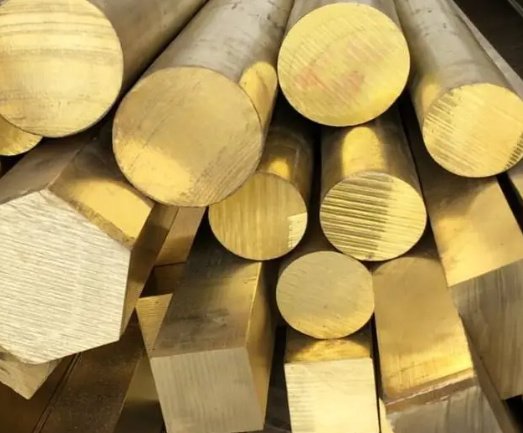
C28000 brass, widely known as Muntz Metal, is a high-zinc copper alloy used when buyers and engineers need a practical balance of strength, hot workability, corrosion resistance and material economy. It is commonly supplied as C28000 brass sheet, plate, strip, rolled bar and, where specified, rod or profile forms.
This guide explains the UNS C28000 composition, mechanical and physical properties, fabrication behavior, corrosion limits, machining considerations and how it compares with C26000, C27000, C36000 and C46400 brass alloys.
- UNS designation: C28000
- Common name: Muntz Metal, 60/40 brass, high-zinc brass
- Typical European reference: CuZn40 / CW509L, subject to specification confirmation
- Main supply forms: sheet, plate, strip, rolled bar and custom-cut blanks
- Best-fit applications: hot-formed components, architectural metalwork, industrial plates, marine trim in controlled environments and cost-sensitive brass fabrications
What Is C28000 Brass?
C28000 is a copper-zinc alloy containing approximately 60% copper and 40% zinc. Because of this composition, it is often called 60/40 brass. Compared with alpha brasses such as C26000 cartridge brass, C28000 has a duplex alpha-beta structure. That structure improves hot workability and strength but reduces deep drawing capability and some cold-forming performance.
In practical terms, C28000 is often selected when the component will be hot formed, pressed with moderate deformation, machined after forming, or specified where a lower copper content helps control material cost.
| Element | Typical Limit by Weight | Engineering Meaning |
|---|---|---|
| Copper, Cu | 59.0% to 63.0% | Provides ductility, corrosion resistance and electrical/thermal conductivity |
| Zinc, Zn | Remainder | Increases strength and reduces copper content compared with 70/30 brass |
| Lead, Pb | 0.09% max | Not a free-machining leaded brass; chips may be tougher than C36000 |
| Iron, Fe | 0.07% max | Controlled impurity to maintain workability and finish |
Composition limits may vary slightly by governing standard, product form and mill practice. For procurement, the controlling document should be the purchase specification, not only the common alloy name.
Key C28000 Brass Properties
C28000 is valued for moderate-to-high strength, good hot forming response and acceptable corrosion resistance in many atmospheric, fresh water and general industrial environments. Property values depend strongly on temper, thickness, grain size and processing history.
| Property | Typical Range or Value | Notes for Engineering Use |
|---|---|---|
| Density | About 8.39 g/cm³ | Useful for weight estimates and cost-per-part calculations |
| Elastic modulus | About 100 to 110 GPa | Similar to many copper-zinc brasses |
| Thermal conductivity | About 110 to 125 W/m·K | Lower than pure copper, higher than most steels |
| Electrical conductivity | About 25% to 30% IACS | Not normally chosen as a primary electrical conductor |
| Melting range | Approximately 900°C to 940°C | Important for brazing, hot working and casting-related discussions |
| Tensile strength | About 330 to 620 MPa, depending on temper | Higher tempers provide strength but reduce elongation |
| Elongation | About 8% to 50%, depending on temper | Critical for bending, forming and drawing decisions |
For design allowables, use certified mill data, applicable ASTM or EN requirements, and test results for the exact thickness and temper. Published values are suitable for alloy screening but should not replace project-specific verification.
C28000 Brass vs C26000, C27000, C36000 and C46400
C28000 is not the best brass for every application. The most common selection mistake is treating it as a universal substitute for cartridge brass, free-cutting brass or naval brass. It is better understood as a hot-workable, economical, high-zinc brass.
| Alloy | Common Name | Typical Composition | Strengths | Limitations Compared with C28000 |
|---|---|---|---|---|
| C26000 | Cartridge brass | About 70% Cu / 30% Zn | Excellent cold forming, deep drawing and ductility | Higher copper content and usually higher material cost; lower hot-working advantage |
| C27000 | Yellow brass | About 65% Cu / 35% Zn | Good general-purpose sheet brass with better cold formability than C28000 | Less hot-work optimized than C28000 for severe hot forming |
| C28000 | Muntz Metal | About 60% Cu / 40% Zn | Good hot workability, moderate strength and lower copper content | Lower deep-drawing capability and higher dezincification concern than lower-zinc brasses |
| C36000 | Free-cutting brass | Cu-Zn-Pb brass | Excellent machinability for screw-machine parts | Contains significant lead; poorer forming behavior than sheet brasses |
| C46400 | Naval brass | Cu-Zn-Sn brass | Improved resistance to seawater-related corrosion due to tin addition | Usually more expensive; selected for harsher marine service rather than cost economy |
C28000 is not a direct substitute for C26000 when the part requires severe cold drawing, tight-radius forming without heat, or maximum ductility. It can be a better choice than C26000 when the design prioritizes hot forming, moderate strength and reduced copper content.
Applications of C28000 Muntz Metal
C28000 brass is used in applications where appearance, formability, strength and material economy must be balanced. It is especially relevant for fabricated parts that can be hot worked or formed with controlled strain.
- Architectural panels, decorative plates and trim
- Marine hardware and trim in non-critical or controlled exposure conditions
- Industrial nameplates, brackets and fabricated plates
- Heat exchanger and condenser-related components where the specification allows C28000
- Hot-formed shapes, stampings and rolled components
- Fastener, washer and hardware blanks where free-machining brass is not required
The alloy’s gold-like color is one reason it appears in architectural and decorative work, but its selection should still be based on corrosion exposure, forming method and mechanical requirements.
Buyer note: how to reduce quotation ambiguity for C28000 brass
A precise quotation should state UNS C28000, product form, governing standard, thickness or diameter, temper, tolerance class, surface condition, quantity, test certificate requirement and whether cutting, polishing, deburring or protective packaging is required.
For sheet and plate orders, thickness tolerance and flatness can affect usable yield more than nominal price per kilogram. For machined blanks, ask whether the supplier quotes gross plate weight or finished cut size weight.
Machining, Forming and Fabrication Guidelines
Machining C28000 brass is generally possible with conventional turning, milling, drilling and sawing methods, but it does not machine like leaded C36000 free-cutting brass. Because C28000 has very low lead, chips can be longer and cutting forces may be higher than with screw-machine brass.
Machining behavior
- Use sharp tools with positive rake geometry to reduce cutting pressure and built-up edge.
- Carbide tooling is preferred for production machining; high-speed steel can be used for lower-volume work.
- Typical starting surface speeds may be around 60 to 120 m/min for HSS and 150 to 300 m/min for carbide, depending on operation, rigidity and coolant.
- Chip control may require adjusted feed, sharper inserts or chipbreaker geometry because C28000 is not leaded.
- Deburring should be planned for drilled holes, milled edges and punched features.
Machinability ratings are often reported around 30 when C36000 brass is rated at 100. This does not mean C28000 is difficult to machine; it means cycle time, tool geometry and chip management should be planned differently from leaded brass.
Hot working and cold forming
C28000 performs well in hot working operations and is commonly processed by hot rolling, hot pressing and hot forming. Cold forming is possible for moderate deformation, but it is not the preferred alloy for severe drawing or very tight bends.
- Hot working is generally favorable in the approximate 600°C to 800°C range, subject to mill and process guidance.
- Annealing may be used to restore ductility after work hardening.
- For bending, verify minimum inside bend radius by thickness, temper and grain direction.
- For stamped parts, prototype trials should confirm springback, edge cracking and surface marking.
Joining and finishing
C28000 can generally be soldered and brazed with proper cleaning and flux selection. Mechanical joining, riveting and fastening are also common. Welding is less frequently used and requires process-specific evaluation because brass can be sensitive to zinc vaporization and porosity at elevated temperatures.
- Polishing can produce an attractive yellow-gold appearance.
- Protective coatings or lacquers may be used for decorative surfaces to slow tarnishing.
- Cleanliness before brazing or soldering is important because oxides and oils reduce joint quality.
Shop note: reducing burrs and edge cracking
If C28000 parts show heavy burrs after punching, check punch clearance, tool sharpness and material temper before changing alloy. Excessive clearance can create a large rollover and fracture zone. For tight bends, align bend direction and grain direction deliberately, and test a larger inside bend radius before rejecting the material lot.
Corrosion Resistance and Service Limits
C28000 brass provides good atmospheric corrosion resistance and is suitable for many indoor, architectural and general industrial environments. However, because of its high zinc content, dezincification risk should be considered in aggressive water, stagnant water, acidic solutions, high-chloride conditions and some marine exposures.
Dezincification is a corrosion mechanism in which zinc is selectively removed, leaving a porous copper-rich layer that can appear pink or reddish. The result may be loss of strength, leakage or surface degradation.
- For decorative indoor service, tarnish is usually the primary concern rather than structural corrosion.
- For seawater or severe marine hardware, C46400 naval brass or other marine-rated alloys may be more appropriate.
- For potable water systems or regulatory environments, confirm lead content, dezincification resistance requirements and local approvals.
- For ammonia, amines or nitrate exposure, evaluate stress corrosion cracking risk, especially in stressed or cold-worked parts.
A common engineering safeguard is to specify stress relief where residual stress, forming strain and corrosive atmosphere overlap. The correct heat treatment should be confirmed with the mill or heat-treatment provider.
Engineering and Procurement Data Points
The main economic reason to consider C28000 is its lower copper content compared with 70/30 brass. For a 1,000 kg material order, C26000 at about 70% copper contains roughly 700 kg of copper, while C28000 at about 60% copper contains roughly 600 kg of copper. That is a difference of about 100 kg of copper exposure per 1,000 kg of purchased alloy.
This copper-content difference can matter when copper price volatility is high. The trade-off is that C28000 may require different forming methods, larger bend radii or hot-working steps that C26000 may not need.
| Engineering Requirement | C28000 Suitability | Reason |
|---|---|---|
| Deep-drawn cartridge-like component | Usually not first choice | C26000 normally offers better ductility and drawability |
| Hot-formed brass plate or shape | Good candidate | Alpha-beta structure supports hot working |
| High-speed screw-machine part | Usually not first choice | C36000 provides much better machinability |
| Decorative sheet with moderate forming | Good candidate | Attractive color, workable form and lower copper content |
| Severe seawater exposure | Use caution | C46400 or other marine alloys may resist corrosion better |
Engineer note: when a lower alloy price does not reduce total part cost
If C28000 requires an added annealing step, slower machining cycle, larger scrap allowance or redesign of bend geometry, the lower copper content may not reduce the finished part cost. A practical comparison should include raw material cost, yield loss, forming trials, machining time, deburring, finishing and inspection.
Standards, Product Forms and Ordering Requirements
C28000 brass is commonly associated with ASTM and copper-alloy specifications for plate, sheet, strip and rolled bar. Depending on product form and region, buyers may encounter ASTM B36/B36M for brass plate, sheet, strip and rolled bar, as well as other product-specific standards. Always confirm the latest standard revision and whether the requested form is covered.
For quality-sensitive orders, request a mill test certificate showing heat number, chemical composition, mechanical properties where applicable, temper, dimensions and specification compliance. For cut-to-size material, traceability should remain linked to the original mill heat or batch.
- Specify UNS C28000 rather than only “Muntz Metal” or “yellow brass.”
- State temper clearly because strength and formability depend on it.
- Define thickness, width, length, diameter or flatness tolerance.
- Confirm surface finish if the part will be polished, plated or used decoratively.
- Require RoHS, REACH or other regulatory documentation if the product enters controlled markets.
- For corrosion-critical applications, define the service environment and acceptance tests.
Summary: When C28000 Brass Is the Right Choice
C28000 brass is a strong candidate for buyers and engineers who need Muntz Metal sheet, plate, strip or fabricated components with good hot workability, moderate strength, attractive brass color and lower copper content than 70/30 brass. It is especially useful for hot-formed and cost-sensitive brass applications.
It is less suitable for severe cold drawing, maximum machinability or aggressive marine service. In those cases, C26000, C36000 or C46400 may be better choices. The best specification decision comes from matching alloy, temper, forming route, machining plan and corrosion environment to the actual service conditions.
Reference Standards and Technical Sources
- UNS C28000 copper alloy designation for Muntz Metal
- ASTM B36/B36M: Brass plate, sheet, strip and rolled bar, where applicable
- ASTM B124/B124M: Copper and copper alloy forging rod, bar and shapes, where applicable
- Copper Development Association alloy data for brasses and copper-zinc alloys
- EN copper alloy references such as CuZn40 / CW509L, subject to exact specification matching