
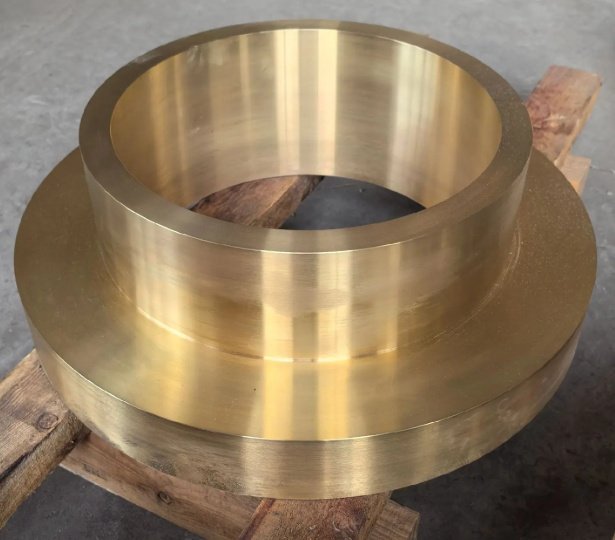
C37700 brass, also known as forging brass or leaded forging brass, is a copper-zinc-lead alloy widely used for hot-forged valves, fittings, hardware, plumbing components and machined parts. It combines good hot workability, high machinability and reliable dimensional control after forging, making it a practical choice when a component needs both near-net-shape forming and secondary machining.
This guide covers C37700 chemical composition, mechanical properties, machinability, forging behavior, corrosion considerations, comparable alloys and purchasing factors for engineers, buyers and manufacturers.
What Is C37700 Brass?
C37700 is a leaded alpha-beta brass designed primarily for hot forging and machining. The copper and zinc matrix provides strength and formability, while lead improves chip breaking, tool life and surface finish during machining. Compared with free-cutting brass C36000, C37700 is usually selected when the part will be forged before machining rather than produced entirely from bar stock.
The alloy is commonly supplied as rod, bar, billet, forging stock and forged shapes. Typical end products include water valves, gas fittings, hose connectors, compression fittings, faucet bodies, nuts, fasteners, electrical hardware and industrial connector bodies.
C37700 Brass Chemical Composition
The following composition ranges are commonly associated with UNS C37700. Actual values should be verified against the applicable standard, purchase specification and mill test certificate.
| Element | Typical Range | Function in C37700 Brass |
|---|---|---|
| Copper, Cu | 58.0% - 61.0% | Provides ductility, corrosion resistance and base alloy structure. |
| Lead, Pb | 1.5% - 2.5% | Improves machinability, chip control and tool life. |
| Iron, Fe | 0.30% max. | Controlled impurity; excessive iron may affect surface quality and processing. |
| Zinc, Zn | Remainder | Increases strength, hardness and hot working response. |
C37700 is often described as CuZn39Pb2 in commercial contexts, although exact cross-references depend on the national or regional standard being used.
Key Mechanical and Physical Properties
C37700 brass properties vary with product form, size, temper, forging reduction, heat treatment and final machining condition. The values below are typical engineering reference ranges, not guaranteed design limits.
| Property | Typical Value or Range | Engineering Meaning |
|---|---|---|
| Tensile strength | Approximately 360 - 520 MPa | Suitable for moderate-load fittings, valves and hardware. |
| Yield strength | Approximately 140 - 340 MPa | Depends strongly on temper and forming history. |
| Elongation | Approximately 15% - 35% | Supports deformation during hot forging and service assembly. |
| Hardness | Approximately 80 - 150 HB | Higher hardness may improve wear resistance but reduce ductility. |
| Density | Approximately 8.4 - 8.5 g/cm³ | Useful for weight, cost and logistics calculation. |
| Electrical conductivity | Lower than pure copper | Acceptable for some hardware, not ideal for high-conductivity applications. |
| Thermal conductivity | Moderate for copper alloy family | Useful for heat transfer fittings and general brass components. |
The defining performance advantage of this alloy is excellent hot forgeability combined with good machinability after forging. This makes it attractive where complex geometry, tight tolerances and production volume must be balanced.
C37700 Brass Machinability
C37700 is considered a highly machinable brass alloy. Its commonly referenced machinability rating is about 90% machinability rating when free-cutting brass C36000 is used as the 100% benchmark. The lead phase promotes discontinuous chips and reduces cutting friction, helping manufacturers maintain productivity on CNC lathes, screw machines, transfer machines and machining centers.
Typical Machining Characteristics
- Produces short, manageable chips under properly selected feeds and speeds.
- Supports good surface finish in turning, drilling, tapping, milling and threading.
- Allows high production rates compared with many non-leaded brasses.
- Works well for secondary machining after closed-die forging.
- Reduces tool loading in threaded fittings, valve bodies and connector parts.
Machining Recommendations
| Process | Practical Recommendation | Reason |
|---|---|---|
| Turning | Use sharp carbide or high-speed steel tools with positive rake geometry. | Improves chip flow and surface finish. |
| Drilling | Use adequate chip evacuation, especially for deep holes. | Prevents chip packing and dimensional drift. |
| Tapping | Use correct lubrication and monitor thread form. | Maintains thread quality in fittings and valve ports. |
| Reaming | Control tool wear and feed consistency. | Important for sealing bores and tolerance-critical fluid passages. |
| Deburring | Plan for internal burr control after cross-hole drilling. | Reduces leakage risk and assembly interference. |
Engineering note: machining forged C37700 valve bodies
In production, many C37700 parts are forged close to final shape and then machined only at sealing surfaces, threaded ports, bores and datum faces. Compared with machining the same valve body from solid bar, a near-net forged route can reduce chip volume by roughly 40% - 65%, depending on geometry. The main engineering challenge is not machinability itself, but controlling forging flash, die mismatch and datum selection so that machining allowance remains stable.
Hot Forging Behavior and Process Considerations
C37700 is primarily chosen for hot forging. It flows well into dies, fills complex shapes and can reduce material waste compared with fully machined components. Forging is commonly used for valve bodies, elbows, tees, nuts and pressure-containing fittings where grain flow and compact geometry are beneficial.
Forging Advantages
- Good die filling for complex shapes with bosses, ports and wrench flats.
- Lower material waste than machining from oversized bar or billet.
- Improved production consistency for medium- and high-volume parts.
- Good dimensional repeatability when billet temperature, die temperature and lubrication are controlled.
- Suitable for secondary operations such as trimming, shot blasting, machining, polishing and plating.
Common Forging Defects to Control
| Defect or Issue | Likely Cause | Prevention Method |
|---|---|---|
| Underfill | Low billet temperature, poor die design or insufficient press energy | Optimize preheat, billet volume, flash land and press parameters. |
| Surface cracking | Incorrect forging temperature or excessive deformation | Control heating window and avoid overworking colder zones. |
| Porosity exposure | Inconsistent billet quality or excessive machining allowance | Specify sound forging stock and inspect critical machined surfaces. |
| Die mismatch | Tool wear, alignment error or poor press setup | Maintain dies, verify alignment and use robust locating features. |
| Excessive flash | Overweight billet or worn die flash land | Improve cut billet weight control and die maintenance. |
For pressure-related components, forging process control should be supported by dimensional inspection, material traceability, leak testing where required and metallurgical verification when specified by the drawing or customer standard.
C37700 Brass vs C36000, C38500 and Other Brass Alloys
Choosing C37700 correctly requires comparison with other commonly specified brass grades. The best alloy depends on whether the priority is hot forging, high-speed machining, architectural appearance, corrosion resistance or regulatory compliance.
| Alloy | Common Name | Main Strength | Best Use Case | Compared with C37700 |
|---|---|---|---|---|
| C37700 | Forging brass | Hot forgeability plus good machining | Forged valves, fittings, hardware and connector bodies | Balanced option for forged and machined parts. |
| C36000 | Free-cutting brass | Highest machinability among common brasses | Screw machine parts, bushings, inserts and precision turned components | Machines faster, but is generally less suitable for hot forging. |
| C38500 | Architectural bronze | Extrudability and decorative appearance | Profiles, trim, rails and architectural shapes | Better for extruded profiles, not usually the first choice for forged fittings. |
| C35300 | High-leaded brass | Machinability and forming balance | Machined components requiring good formability | May be considered when machining and moderate forming are needed. |
| C46400 | Naval brass | Improved seawater resistance due to tin addition | Marine hardware, shafts, plates and corrosion-exposed components | Better for marine corrosion resistance, but not a direct forging-brass substitute. |
Do not specify C37700 solely for corrosion resistance in aggressive water, ammonia-bearing environments or severe marine service. If dezincification resistance, potable-water compliance or seawater performance is critical, evaluate DZR brass, low-lead brass, naval brass or bronze alternatives.
Buyer perspective: when C37700 is the better purchasing choice
C37700 is often the better commercial choice when the part geometry would waste too much material if machined from round bar, but still requires accurate threaded ports, sealing faces or reamed bores. Buyers should compare total part cost, not only raw material price. Forging tooling, minimum order quantity, machining allowance, scrap recovery, inspection cost and lead-time stability all affect the final landed cost.
Applications of C37700 Brass
C37700 is used where hot forged shape, moderate strength, machinability and brass corrosion behavior are required. It is especially common in fluid-control and mechanical hardware markets.
Common Industrial Applications
- Forged brass valve bodies and valve stems
- Plumbing fittings, elbows, tees, unions and adapters
- Gas fittings and compression fittings
- Hose connectors, couplings and nozzles
- Faucet bodies and sanitary hardware components
- Electrical and mechanical connector bodies
- Forged nuts, fasteners and specialty hardware
- Hydraulic and pneumatic fittings for moderate service conditions
Real Engineering Problem: Leakage After Machining
A common issue in forged brass valve production is leakage after machining, especially where cross-drilled holes intersect sealing bores. The root cause is often a combination of insufficient forging density in a localized area, tool wear during drilling and burrs that interfere with elastomer seals. In a representative corrective action program, three controls reduced leak-test rejects from about 2.8% to below 0.7%: tighter billet weight control, a revised machining datum strategy and mandatory internal burr inspection after cross-hole drilling.
This example shows why material selection alone is not enough. For C37700 components, consistent forging process control and machining validation are essential for pressure-retaining parts.
Corrosion Resistance, Lead Content and Compliance
C37700 brass has general corrosion resistance suitable for many indoor, industrial and plumbing-related components. However, it contains lead and is not automatically suitable for every potable-water or regulated application. Compliance depends on the destination market, wetted surface area, lead-content rules, certification requirements and the exact product standard.
Corrosion Considerations
- Performs well in many non-aggressive atmospheric and water-contact environments.
- May be vulnerable to dezincification in stagnant, acidic, high-chloride or high-temperature water.
- Should not be used in ammonia-rich environments because copper alloys can suffer stress corrosion cracking.
- Is generally not the first choice for seawater components; naval brass, aluminum bronze or other marine alloys may be more appropriate.
- May require plating, passivation, stress relief or controlled cleaning depending on the final service environment.
For potable-water components, engineers should review lead regulations such as NSF/ANSI/CAN 61, NSF/ANSI 372, U.S. Safe Drinking Water Act requirements and any local market rules. In many drinking-water applications, low-lead or lead-free brass grades may be required instead of traditional C37700.
Standards, Forms and Supply Requirements
C37700 may be referenced in standards covering brass rod, bar, shapes, forging stock or forged products. Common commercial references include ASTM and UNS designations, but the exact standard must match the purchased product form and application.
Typical Supply Forms
- Round rod and bar
- Hex bar and shaped bar
- Cut billets for hot forging
- Closed-die forgings
- Pre-machined or fully machined forged components
Recommended Purchase Specification Items
- UNS designation: C37700
- Applicable ASTM, EN, JIS or customer standard
- Chemical composition limits and lead range
- Product form, dimensions and tolerances
- Temper or processing condition
- Mechanical property requirements if applicable
- Surface condition, straightness and defect limits
- Forging quality requirements and inspection method
- Traceability, heat number and supplier mill test report
- Compliance requirements for RoHS, REACH, potable water or customer-specific restrictions
Procurement checklist for engineers and buyers
Before ordering C37700 brass, confirm whether the part is machined from bar, forged from billet or supplied as a finished component. Ask the supplier for chemical analysis, traceability, applicable standard, lead-content declaration, forging process capability, machining tolerance capability and inspection records. For pressure components, also confirm leak-test method, sampling plan and whether destructive section checks are required during production approval.
How to Select C37700 Brass for a Project
C37700 is the best overall choice when a component needs hot forging, efficient machining and stable production cost in medium- to high-volume manufacturing. It is less ideal when the application demands maximum machinability from bar stock, very high corrosion resistance, lead-free compliance or severe marine performance.
Specify C37700 When:
- The part has a forged geometry such as a valve body, fitting or connector.
- Secondary machining is required for threads, bores, sealing surfaces or precision faces.
- Material utilization is important and machining from solid bar would create excessive scrap.
- Production volume can justify forging tooling and process development.
- The service environment is compatible with standard leaded brass.
Consider Another Alloy When:
- The part is a simple turned component and C36000 can reduce cycle time.
- The application requires lead-free or low-lead potable-water compliance.
- Seawater, high-chloride water or dezincification risk is severe.
- Electrical conductivity is the primary performance requirement.
- The design requires extensive cold forming rather than hot forging.
Summary
C37700 brass is a practical forging brass for components that need good hot workability, high machinability and dependable production economics. Its main value is the ability to create near-net forged shapes and then machine accurate threads, bores and sealing surfaces. For valves, fittings, connectors and industrial hardware, it often provides a strong balance of manufacturability and cost.
Engineers should verify composition, mechanical properties, lead restrictions, corrosion environment and applicable standards before final approval. Buyers should evaluate total finished-part cost, including forging yield, machining time, inspection, compliance documentation and supplier process capability.