
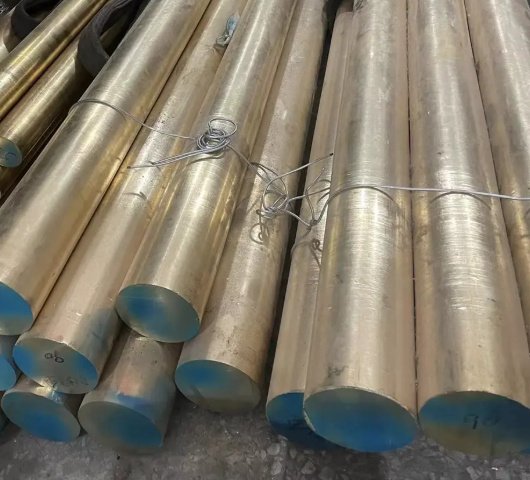
C51000 bronze, commercially known as phosphor bronze 5% or CuSn5, is a widely specified copper-tin-phosphorus alloy under the UNS designation UNS C51000 phosphor bronze. Engineers and procurement teams select this material for its exceptional combination of fatigue resistance, spring quality, and corrosion protection in electrical and mechanical systems. This guide provides detailed composition limits, mechanical property datasets, machinability parameters, and alloy selection criteria to support specification and purchasing decisions.
Material Overview and Alloy Designation
C51000 is classified as a wrought phosphor bronze containing 4.2% to 5.8% tin and 0.03% to 0.35% phosphorus. The tin phase solidifies into a copper matrix to improve strength and wear characteristics, while phosphorus functions primarily as a deoxidizer and increases wear resistance. Unlike cast bearing bronzes such as C93200, C51000 is delivered in mill-hardened tempers optimized for stampings, springs, electrical contacts, and precision bellows.
Common trade names and cross-references include PB103 (British Standard), CW451K (European EN designation), and AMS 4510 for aerospace strip applications. The alloy is not heat-treatable in the conventional sense; strength is developed exclusively through cold working and annealing cycles.
Chemical Composition Limits
The following composition ranges apply to C51000 bronze per ASTM B103 and ASTM B139 specifications:
| Element | Composition (%) |
|---|---|
| Copper (Cu) | Balance |
| Tin (Sn) | 4.2 – 5.8 |
| Phosphorus (P) | 0.03 – 0.35 |
| Lead (Pb) | 0.05 max |
| Iron (Fe) | 0.10 max |
| Zinc (Zn) | 0.30 max |
Mechanical Properties and Engineering Data
Mechanical performance varies significantly by temper. The table below summarizes typical values for common wrought tempers:
| Temper | UTS (ksi) | Yield Strength (ksi) | Elongation (%) | Hardness (HRB) |
|---|---|---|---|---|
| H01 (Quarter Hard) | 60 – 75 | 45 – 60 | 25 – 40 | 55 – 70 |
| H02 (Half Hard) | 70 – 90 | 55 – 75 | 15 – 30 | 70 – 82 |
| H04 (Hard) | 85 – 110 | 70 – 95 | 8 – 20 | 82 – 92 |
| H08 (Spring) | 98 – 120 | 85 – 105 | 4 – 12 | 90 – 96 |
The elastic modulus for C51000 is approximately 16,000 ksi (110 GPa), with a shear modulus of 6,000 ksi. 98 to 110 ksi ultimate tensile strength in spring temper makes this alloy suitable for high-deflection components, though designers must note its inferior stress relaxation resistance compared to beryllium copper. Specifically, C51000 retains only 65–75% of its initial clamping force after 1,000 hours at 150 °C, whereas beryllium copper alloys retain greater than 90% under identical conditions.
Fatigue and Corrosion Performance
Fatigue strength in the spring temper ranges between 25 and 30 ksi at 10^8 cycles under reversed bending. C51000 exhibits excellent resistance to atmospheric corrosion, salt water, and dilute organic acids. However, susceptibility to stress-corrosion cracking increases in ammonia or amine environments, requiring protective coatings or alloy substitution for chemical processing hardware.
Comparative Analysis: C51000 vs. C51100 vs. C52100
Selecting the correct phosphor bronze grade requires balancing formability, strength, and electrical conductivity. The following comparison highlights critical selection factors:
| Property | C51000 (5% Sn) | C51100 (4% Sn, High P) | C52100 (8% Sn) |
|---|---|---|---|
| Tensile Strength (H04) | 85 – 110 ksi | 80 – 100 ksi | 100 – 130 ksi |
| Electrical Conductivity | 15 – 20% IACS | 13 – 17% IACS | 7 – 11% IACS |
| Formability | Excellent | Superior | Good |
| Stress Relaxation | Moderate | Improved | Moderate |
| Primary Applications | General springs, contacts | Deep-drawn bellows, switches | Heavy-duty bearings, wear plates |
C51000 occupies the middle ground: it offers better conductivity than C52100 and higher strength than C51100, making it the default specification for multi-purpose electrical and mechanical spring components. C52100, with its higher tin content, delivers superior load-bearing capacity but sacrifices conductivity and becomes more expensive to machine.
Machining, Forming, and Heat Treatment
C51000 is rated at approximately 20% machinability rating relative to C36000 free-cutting brass. The alloy’s ductility produces long, stringy chips that can entangle tooling. Recommended turning parameters use carbide inserts at 200–400 surface feet per minute (SFM) with feed rates of 0.005–0.015 inches per revolution. Positive rake angles and ample coolant flow reduce built-up edge and improve surface finish.
Cold forming characteristics are excellent. Strip and wire products can be bent to radii equal to one times material thickness in H02 temper, though springback is typically 10–15 degrees greater than observed in mild steel. For severe forming operations, intermediate annealing at 900–1,100 °F (480–590 °C) restores ductility without excessive grain growth. Hot working is generally avoided because tin enhances hot shortness.
Joining and Surface Treatment
Soldering and brazing yield excellent joint integrity. Fusion welding requires care due to tin segregation; gas tungsten arc welding (GTAW) with a deoxidized copper filler and preheat to 400 °F is standard practice. Electroplating with tin or nickel is common for electrical contact surfaces.
Industrial Applications and Engineering Solutions
C51000 bronze appears across aerospace, marine, electrical, and precision instrument sectors. Typical components include:
- Electrical connectors and socket terminals requiring low contact resistance and high cycle life
- Lock washers and Belleville springs demanding high fatigue endurance
- Flexible metal bellows and diaphragms for pressure instrumentation
- Bridge bearing plates where corrosion resistance and load distribution intersect
- Clutch discs and friction hardware in moderate-duty powertrain assemblies
Real-World Engineering Failure Mitigation
A documented field failure involved C51000 lock washers in an outdoor electrical enclosure subjected to cyclic thermal loading. Thermal expansion mismatch generated fretting corrosion at the contact interface, reducing clamp load by 40% over 18 months. The engineering solution substituted the plain washers with tin-plated C51000 and increased contact surface area by 30%, extending service life beyond eight years in accelerated salt-spray validation.
Global Standards and Procurement Specifications
C51000 is standardized under ASTM B103, ASTM B139, and SAE J461. ASTM B103 covers phosphor bronze plate, sheet, strip, and rolled bar, while ASTM B139 governs rod and shapes. European purchasers reference EN 1652 (CW451K), and aerospace buyers often specify AMS 4510 for strip in spring tempers. When sourcing material, buyers should demand certificates of conformance and chemistry-only mill test reports verifying phosphorus and tin content, as deviations outside the specified window directly impact spring performance and bend ductility.
Procurement and Supply Chain Insights for Buyers
Procurement teams should specify temper, thickness tolerance (commercial vs. precision), and edge condition (slit, sheared, or edge-rolled) at the inquiry stage. C51000 strip is commonly stocked in 12-inch and 36-inch widths; custom slitting typically requires 1,000-pound minimums. Lead times extend to 8–12 weeks for non-standard rod diameters or imported European CW451K equivalents.
Price volatility tracks London Metal Exchange (LME) copper and tin premiums. Request locked pricing for quarter-long programs when alloy surcharges fluctuate. Always verify that suppliers provide dimensional reports and hardness check data alongside standard material certifications.
Design Engineer Checklist: Specifying C51000 on Drawings
Engineers should include the following callouts on technical drawings to prevent sourcing ambiguity:
- Alloy: UNS C51000 (Phosphor Bronze, 5% Sn)
- Applicable standard: ASTM B103 or ASTM B139 as appropriate
- Temper designation: H02, H04, H08, or equivalent
- Grain size requirement if critical for bending or deep drawing
- Surface finish: 2B mill, bright annealed, or pre-plated
Account for conductivity losses when specifying C51000 for electrical bussing; at 15–20% IACS, voltage drop calculations must use resistivity of 8.5–9.5 micro-ohm·cm rather than pure copper values.
Processing and Fabrication: Shop Floor Guidelines
Fabricators must segregate C51000 scrap from leaded brasses to avoid cross-contamination. Phosphor bronze turnings hold significant recycling value; maintain clean chip streams free of ferrous inserts.
For stamping operations, tool steel dies hardened to 58–62 HRC withstand production runs exceeding 500,000 hits. Apply drawing compound generously during severe forming; galling is minimal but lubrication prevents surface scoring. If stress relieving is required after forming, use 400–500 °F for two hours to reduce residual stresses without sacrificing hardness.