
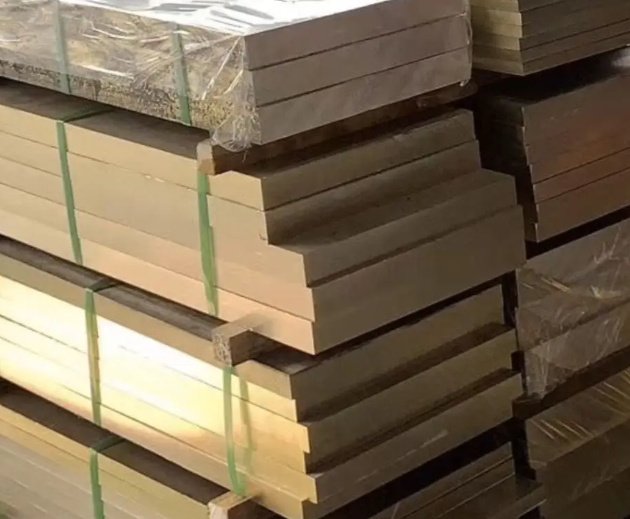
C86300 bronze, also classified as SAE 630 and UNS C86300 under ASTM B148, is a high-strength manganese bronze alloy engineered for extreme mechanical loads. Unlike general-purpose tin bronzes, this material combines high tensile strength, excellent wear resistance, and respectable anti-galling characteristics under boundary lubrication. It is widely specified for slow-speed, heavy-load bushings, worm gears, and bridge bearings where failure is not an option.
Chemical Composition and Alloy Specification
ASTM B148 defines C86300 as a copper-zinc-aluminum-iron-manganese system. The intentional addition of manganese and aluminum produces a complex microstructure of beta and alpha phases, delivering hardness unattainable in traditional leaded red brass alloys.
| Element | Weight % (ASTM B148) | Function in Microstructure |
|---|---|---|
| Copper (Cu) | 60.0 – 66.0 | Base matrix; corrosion resistance backbone |
| Aluminum (Al) | 5.0 – 7.5 | Hardness and strength via solid solution |
| Manganese (Mn) | 2.5 – 5.0 | Deoxidizer; refines grain structure |
| Iron (Fe) | 2.0 – 4.0 | Increases tensile strength and wear resistance |
| Zinc (Zn) | Remainder | Maintains castability; replaces tin economically |
| Lead (Pb) | ≤ 0.20 | Trace impurity; machining aid (minimal) |
| Tin (Sn) | ≤ 0.20 | Trace impurity |
The alloy is typically supplied in as-cast, annealed, or heat-treated tempers. Continuous cast bar and centrifugal cast hollow bar dominate stock shapes for machined bearings, while sand cast plates serve custom wear pads.
Mechanical Properties and Verified Performance Data
Post-cast mechanical testing per ASTM E8 and hardness per ASTM E10 confirm C86300 ranks among the highest-strength cast copper alloys commercially available for bearing service.
| Property | Typical Value | Test Standard |
|---|---|---|
| Ultimate Tensile Strength | 110 ksi (758 MPa) min | ASTM E8 |
| Yield Strength (0.2% offset) | 60 ksi (414 MPa) | ASTM E8 |
| Elongation in 2 inches | 14% | ASTM E8 |
| Brinell Hardness (500 kg) | 225 HBW | ASTM E10 |
| Modulus of Elasticity | 14,900 ksi (103 GPa) | ASTM E8 |
| Density | 0.269 lb/in³ (7.45 g/cm³) | — |
In heavy-load bearing design, the combination of high hardness and yield strength allows C86300 to resist plastic deformation under static bearing loads exceeding 10,000 psi. However, designers must pair these properties with adequate lubrication channels; dry-metal contact initiates adhesive transfer to unhardened steel shafts at loads above 6,000 psi.
C86300 Bronze vs. C83600 and C95400: Comparative Alloy Selection
Material selection between manganese bronze, leaded red brass, and aluminum bronze hinges on load intensity, corrosive exposure, and machining budget. The following comparison aligns common procurement and engineering criteria.
| Selection Criteria | C86300 Manganese Bronze | C83600 (Leaded Red Brass) | C95400 Aluminum Bronze |
|---|---|---|---|
| Tensile Strength | 110 ksi (758 MPa) | 30 – 40 ksi (207 – 276 MPa) | 85 – 105 ksi (586 – 724 MPa) |
| Hardness (HBW) | 210 – 250 | 55 – 75 | 140 – 170 |
| Machinability Rating | 30% of C36000 | 84% of C36000 | 55% of C36000 |
| Seawater Corrosion | Moderate risk (dezincification) | Good (lead dependent) | Excellent (no Zn) |
| Typical Bearing Load | Very high (up to 5,000+ psi mean) | Low to moderate | High (3,000 – 4,500 psi) |
| Primary Application | Worm wheels, heavy bushings | Valves, fittings, low-load bearings | Marine propellers, pump housings |
C83600 bronze offers superior machinability and is cheaper per pound, yet it cannot survive the contact stresses inherent in C86300 applications. Conversely, C95400 aluminum bronze outperforms C86300 in chloride environments due to zero zinc content, but at a raw-material premium and lower maximum hardness. Engineers specify C86300 when the design demands the highest mechanical load capacity among zinc-bearing bronzes without advancing to more expensive nickel-aluminum bronzes.
Machining, Casting, and Fabrication of C86300 Bronze
With a machinability rating of approximately 30% relative to C36000 free-cutting brass, C86300 is considered difficult to machine. Its toughness and rapid work-hardening require rigid setups and sharp tooling.
- Cutting tools: Brazed or throw-away carbide inserts with positive rake angles.
- Cutting speed (turning): 60–90 SFM (18–27 m/min) for roughing; reduce to 50 SFM for finishing.
- Feed rate: 0.010–0.020 in/rev roughing, 0.005–0.010 in/rev finishing.
- Coolant: Flood soluble oil or sulfurized mineral oil to dissipate heat and prevent built-up edge.
Casting considerations are equally critical. C86300 pours at approximately 1,050–1,100 °C (1,922–2,012 °F). Sand molds require adequate venting because zinc and aluminum vapors evolve during solidification. Centrifugal casting yields the densest, most sound structures for thick-wear bearing sleeves, minimizing internal shrinkage porosity that can act as crack nuclei under Hertzian contact stress.
Welding is generally discouraged. Fusion welding vaporizes zinc, producing porous, weak joints. If joining is unavoidable, silver brazing or mechanical fastening preserves base-metal integrity.
Real-World Engineering Applications and Load Ratings
C86300 bronze dominates applications where specific load exceeds 3,000 psi and surface speed remains below 150 fpm. Construction and mining equipment manufacturers specify this alloy for pivot bushings excavator joints because it withstands shock loading better than cast iron or lower-strength bronzes.
- Steel mill eccentric bushings and screw-down nuts
- Bridge trunnion bearings and heavy-duty wear plates
- Worm wheel rims in high-reduction gearboxes
- Hydraulic press guide bushings
Field data from heavy-equipment rebuild programs indicate that C86300 bushings outlast C83600 inserts by factors of 4× to 6× in articulating loader pivots, justifying the higher alloy cost through extended mean time between overhauls.
Common Failure Modes and Prevention Strategies
Despite its strength, C86300 is not immune to service failures. Engineers analyzing warranty returns identify three recurring mechanisms:
- Galling and seizure: Occurs under dry or starved-lubrication conditions against stainless steel shafts softer than 300 HB. Prevention: Harden mating shafts to 350–400 HB, maintain oil film thickness above 0.0001 in, and machine lead-in chamfers of 15° to 20° during assembly.
- Dezincification in seawater: The alloy’s high zinc content makes it vulnerable to selective phase corrosion in stagnant marine water. Prevention: Specify C95400 or nickel-aluminum bronze for submerged marine duty; use C86300 only above the splash zone or in fresh water.
- Casting porosity fatigue: Sub-surface shrinkage porosity reduces fatigue strength by 15–25%. Prevention: Source centrifugally cast stock for rotating components; require radiographic testing (ASTM E446) on critical static castings.
Addressing these three factors during the design and sourcing phases eliminates the majority of premature C86300 bronze failures in the field.
Procurement & Buyer’s Sourcing Guide
Buyers evaluating C86300 stock must distinguish between sand cast shapes and centrifugal or continuous cast product. Each form carries distinct lead times, minimum order quantities, and microstructural soundness.
- Stock forms: Solid round bar (continuous cast), hollow bar (centrifugal cast), and custom sand cast plates or rings.
- Lead time: Continuous cast bar typically ships in 1–2 weeks; centrifugal cast hollows require 3–5 weeks; sand cast prototypes take 4–8 weeks depending on pattern availability.
- Price volatility: Approximately 60% of raw-material cost tracks the LME copper price; aluminum and manganese premiums add volatility during steel-industry boom cycles.
- Receiving inspection: Demand mill test reports (MTRs) showing tensile strength, elongation, and Brinell hardness. Positive material identification (PMI) via XRF confirms aluminum and manganese levels—critical because low manganese reduces as-cast ductility.
Negotiate remnant stock programs for prototype jobs; C86300 is rarely inventoried in small diameters by general service centers due to lower demand versus C93200 bearing bronze.
Engineer’s Design & Maintenance Field Notes
From a design perspective, C86300 performs best when treated as a shaft-friendly but load-dominant material. The engineer must balance running clearance, lubrication geometry, and thermal expansion.
- Running clearance: Allocate 0.0015 in per inch of journal diameter for press-fit bushings operating between 100 °F and 200 °F. Increase by 25% if thermal cycling exceeds 250 °F.
- Groove geometry: Machine circumferential oil grooves at 90° spacing with radiused edges (R 0.03 in minimum). Sharp corners initiate micro-cracking under fatigue.
- Shaft differential hardness: Maintain a minimum 50 HB differential favoring the steel shaft. Paradoxically, because C86300 is harder than most shaft steels, the shaft often wears first unless induction-hardened.
- Press-fit assembly: Freeze bronze bushings in dry ice or liquid nitrogen before pressing into steel housings to reduce insertion force and avoid scoring the bearing bore.
Maintenance crews should monitor lubricant contamination; silicon grit ingress at 20+ mesh size embeds into the bronze surface and acts as a lap, accelerating shaft wear by an order of magnitude.
Global Standards and Equivalent Cross-Reference
C86300 bronze aligns with several international nomenclatures, though exact compositional twins are rare because the manganese-zinc-aluminum balance is unique to North American SAE/ASTM specifications.
- UNS: C86300
- ASTM: B148 (Aluminum-Bronze Sand Castings)
- SAE: J462 (Wrought and Cast Copper Alloys) – historically referenced as SAE 630
- ISO approximate: CuZn25Al6Fe3Mn3 (German/DIN designations closest, though not identical)
- EU EN equivalent: No direct EN counterpart; CC762S or CuZn20Al5As serve similar niches with altered chemistry.
When substituting alloys across standards, always re-validate tensile and hardness requirements. A direct drop-in replacement based on nominal composition alone risks performance gaps in bearing life calculations.