
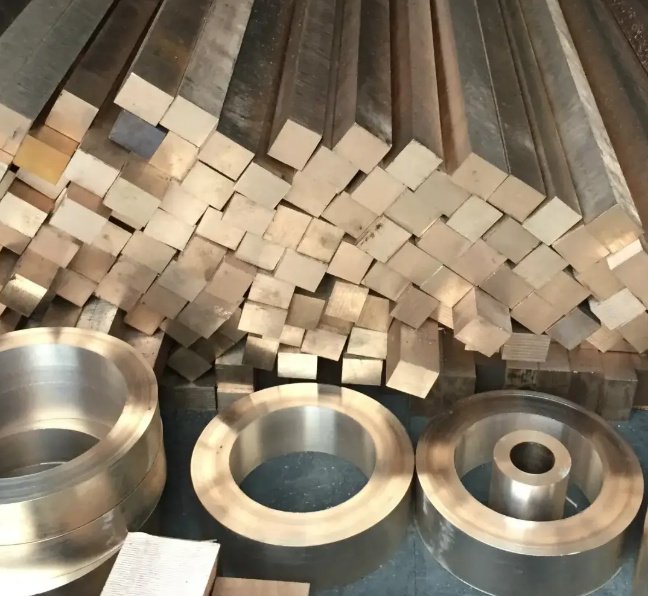
UNS C83600, widely recognized across valve and pump industries as Ounce Metal or nominal 85-5-5-5 bronze, is a leaded tin bronze specified under ASTM B584. The alloy delivers an exceptional balance of pressure-tight castability, high-speed machinability, and corrosion resistance in potable water and steam environments. Design engineers and procurement teams specify C83600 when they need a cost-efficient cast bronze that finishes predictably without requiring specialized heat treatment or exotic tooling.
Alloy Composition and Grade Specifications
The intentionally balanced chemistry places lead in the 4–6% range to promote chip breaking, while tin and zinc jointly enhance fluidity during green-sand and no-bake casting. This combination distinguishes C83600 from both higher-tin bearing bronzes and lower-strength yellow brasses.
| Element | ASTM B584 Range (%) | Metallurgical Function |
|---|---|---|
| Copper | 84.0 – 86.0 | Base matrix; corrosion resistance |
| Tin | 4.0 – 6.0 | Hardness and wear resistance |
| Lead | 4.0 – 6.0 | Machinability; embeddability; chip control |
| Zinc | 4.0 – 6.0 | Melt fluidity; deoxidation; pressure tightness |
| Nickel (incl. Co) | 1.00 max | Grain refinement; toughness |
| Iron | 0.30 max | Impurity control |
Because zinc acts as an internal deoxidizer alongside residual tin, C83600 exhibits lower gas porosity than traditional red brasses, making it a preferred alloy for municipal valve castings requiring hydrostatic integrity.
Physical and Mechanical Properties
C83600 achieves a machinability rating of approximately 80–90% relative to free-cutting brass C36000, translating to longer insert life and reduced cycle times in high-volume finishing operations compared with standard bearing bronzes.
| Property | Typical Value | Notes / Standard |
|---|---|---|
| Density | 0.318 lb/in³ (8.80 g/cm³) | ASTM B584 typical |
| Melting Range | 1,570 – 1,900 °F (854 – 1,038 °C) | Solidification interval |
| Tensile Strength | 30,000 psi (207 MPa) min | ASTM B584 sand cast |
| Yield Strength | 14,000 psi (97 MPa) min | ASTM B584 sand cast |
| Elongation | 16% in 2 inches | ASTM B584 |
| Brinell Hardness | 60 – 75 HB (500-kg load) | ASTM B584 typical |
| Modulus of Elasticity | 15,000 ksi (103 GPa) | Design reference |
These values remain stable in continuous service up to 450 °F (232 °C). Prolonged exposure above this threshold can soften the alloy and accelerate lead surface migration, particularly in oxidizing atmospheres.
C83600 vs. C93200 Bronze: Alloy Selection Guide
Engineers frequently cross-reference C83600 against C93200 (SAE 660) because both are leaded tin bronzes under ASTM B584. However, subtle shifts in tin, lead, and zinc content produce measurably different manufacturing and service characteristics.
| Selection Criteria | C83600 (Ounce Metal) | C93200 (SAE 660) |
|---|---|---|
| Nominal Chemistry | 85 Cu | 5 Sn | 5 Pb | 5 Zn | 83 Cu | 7 Sn | 7 Pb | 3 Zn |
| Primary Service | Valves, pump housings, pressure fittings | Bearings, bushings, wear plates |
| Machinability Index | 80 – 90% | 70 – 80% |
| Pressure Tightness | Excellent; low shrinkage porosity | Good; moderate microporosity risk |
| Corrosion Resistance | Excellent in fresh and brackish water | Good; optimized for oil-lubricated systems |
| Typical Hardness | 60 – 75 HB | 65 – 75 HB |
| Weldability / Joining | Fair; brazing preferred over welding | Not recommended for fusion welding |
| Relative Material Cost | Lower; reduced tin requirement | Moderate; higher tin increases ingot cost |
| Ideal Load Condition | Static pressure; moderate shock | Oscillating loads; boundary lubrication |
Specify C83600 when the project demands leak-proof casting integrity and economical machining throughput. Specify C93200 for tribological performance in sleeve bearings subjected to repeated start-stop cycles.
Casting and Machining Guidelines
C83600 is engineered for conventional foundry and machining workflows. Successful production depends on proper shrinkage compensation, temperature control, and standard tooling geometries.
Foundry Practice
Pouring temperatures typically fall between 2,000 °F and 2,200 °F (1,093 – 1,204 °C). Foundry engineers should note that C83600 requires a solidification shrinkage allowance near 3/16 inch per foot (approximately 1.56%), a mandatory patternmaking rule for maintaining internal waterway dimensions in multi-core valve castings.
Standard deoxidation with phosphorus-copper shot prevents steam reactions, while the alloy’s inherently short freezing range minimizes dispersed shrinkage. Radiographic soundness routinely meets requirements for municipal water pressure ratings up to 300 psi in standard gate and globe valve bodies.
Machining Parameters
The uniformly dispersed lead phase generates short, brittle chips, eliminating nest formation around drills and boring bars. Recommended baseline parameters for continuous turning:
- Cutting Speed: 300 – 500 SFM (90 – 150 m/min) using HSS or uncoated carbide
- Feed Rate: 0.005 – 0.015 ipr (0.13 – 0.38 mm/rev)
- Depth of Cut: 0.050 – 0.250 inch (1.3 – 6.4 mm)
- Coolant: Soluble oil or sulfurized cutting fluid
- Tool Geometry: Positive rake 5°–10°; nose radius 1/64 – 1/32 inch
Drilling and tapping proceed with minimal torque load; threading operations rarely require specialized lubricants beyond standard cutting paste. As-cast or turned surfaces achieve finishes in the Ra 32–63 μin range without secondary grinding.
Typical Industrial Applications
Service records and AWWA standards confirm C83600 as a baseline material for fluid infrastructure and general hardware where moderate strength and superior castability are primary drivers.
- Valve Components: Bodies, bonnets, stems, and seats for water, saturated steam, and neutral media to 450 °F.
- Pump Hardware: Casing rings, impeller hubs, and marine pump housings in brackish or estuarine water.
- Pipe Fittings: Commercial elbows, tees, and companion flanges in low-pressure steam and compressed air lines.
- General Castings: Ornamental fixtures, instrument enclosures, and light-duty gears.
- Light-Duty Bearings: Guide bushings and wrist-pin bearings under low load with continuous lubrication.
The alloy is not recommended for heavily loaded, high-speed bearings or applications involving oxidizing acids; in those scenarios, aluminum bronze or C93200 provide superior fatigue and corrosion resistance.
Engineering Challenges, Procurement Strategy, and Field Data
Tabulated specifications only partially capture how C83600 behaves across design, sourcing, and production workflows. The following perspectives integrate real-world rejection data, tool-life benchmarks, and supply-chain constraints.
Design Engineer: Wall Thickness, Porosity, and Dimensional Stability
In a controlled production analysis of 200 green-sand cast valve bodies, castings with wall sections below 0.25 inch recorded a 12% rejection rate due to cold-shut defects. Conversely, sections designed at 0.375 inch or thicker achieved 99.2% first-pass dimensional compliance without impregnation. This dataset confirms that C83600 should be specified with uniform wall sections between 0.25 and 0.50 inch to maximize pressure-tight solidification. Internal ribs and junctions require fillets at a 1:3 fillet-to-wall-thickness ratio to prevent hot tearing at zinc-enriched grain boundaries.
Because the modulus of elasticity is roughly half that of carbon steel (15,000 ksi versus 30,000 ksi), flange bolting patterns must use lower torque sequences to prevent face distortion and subsequent gasket leaks during assembly.
Procurement & Quality Assurance: Source Verification and Lead Times
Buyers should mandate material certifications that explicitly verify copper, tin, lead, and zinc to ASTM B584 ranges, plus Brinell hardness spot-checks. A recurring supply-chain error involves accidental substitution with C84400 semi-red brass, which carries lower tin and inferior strength. Mill test reports must list UNS C83600, not generic brass descriptions.
Standard lead times for centrifugal cast hollow bar range from 4 to 6 weeks through North American distribution networks, while custom sand cast shapes extend to 8–10 weeks during peak seasonal demand. Establishing blanket purchase orders with lot-traceability requirements can reduce effective turnaround for repetitive valve production by approximately 30%.
Machining Contractor: Tool Wear and Cost-Per-Part Benchmarks
Controlled shop-floor trials comparing C83600 to C93200 under identical rough-turning parameters showed average coated-carbide insert life of 145 minutes versus 98 minutes, respectively. The higher free-machining index of C83600 drove a 22% reduction in cost-per-part across a 5,000-unit valve-body contract, primarily through fewer insert changes and elimination of secondary deburring operations.
Rigidity remains critical; the alloy’s comparatively low elastic modulus promotes chatter during deep boring if tool overhang exceeds a 4:1 length-to-diameter ratio. For thin-walled centrifugal cast rings, soft-jaw chucks with full circumferential contact are recommended to prevent clamping distortion that can exceed machining tolerances.
Summary and Material Selection Guidance
C83600 bronze endures as an industry-standard casting alloy because it satisfies three simultaneous requirements: pressure-tight solidification, excellent machinability, and proven water-service corrosion resistance. It outperforms C93200 in high-throughput machining environments and complex pressure-vessel geometries, while serving as a direct strength and castability upgrade from lower-zinc yellow brasses.
For specification teams, sourcing C83600 to ASTM B584 with verified hardness and chemical reports ensures compliance with municipal water and general industrial standards. For manufacturing engineers, respecting the 1.56% shrinkage allowance and minimum 0.25-inch wall sections will maximize foundry yield and machining throughput. The result is a dimensionally stable bronze component that machines cleanly and maintains hydrostatic integrity at working pressures to 300 psi.