
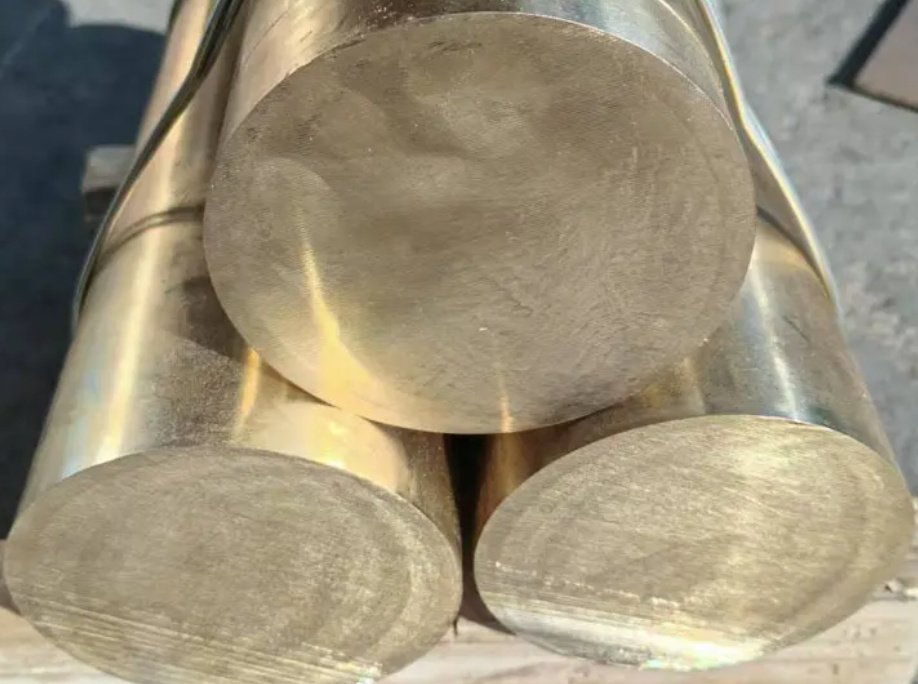
C93200 bronze, designated as SAE 660 bearing bronze and UNS C93200, is the most widely specified cast tin bronze for medium-duty plain bearings and bushings. Its leaded microstructure provides exceptional machinability and anti-galling characteristics under boundary lubrication. Engineers and procurement teams rely on this alloy when applications require conformability, embeddability of foreign particles, and reliable performance under hydrodynamic film conditions. The material is universally supplied to ASTM B505 standards for centrifugal and continuous cast products.
C93200 Bronze Composition and Metallurgical Standards
C93200 is a leaded tin bronze alloy engineered for tribological performance rather than maximum strength. The lead phase remains insoluble in the copper matrix, providing self-lubricating properties during startup and low-speed operation.
| Element | Weight % | Function in Alloy |
|---|---|---|
| Copper (Cu) | 81.0 – 85.0 | Base matrix; corrosion resistance |
| Tin (Sn) | 6.3 – 7.5 | Increases strength and hardness |
| Lead (Pb) | 6.0 – 8.0 | Machinability; anti-seizure |
| Zinc (Zn) | 2.0 – 4.0 | Casting fluidity; deoxidizer |
| Nickel (Ni) | 1.0 max | Toughness contribution |
| Iron (Fe) | 0.20 max | Impurity control |
Primary standards include ASTM B505 (Centrifugal Castings), SAE J461 (Wrought and Cast Copper Alloys), and ASME SB505. Continuous cast bar and tube offer finer dendritic structure and 10-15% higher tensile properties compared to sand castings of identical composition.
Mechanical Properties and Performance Data
Room temperature mechanical properties for C93200 vary by casting method. The values below represent typical data for continuous and centrifugal castings tested per ASTM B505.
| Property | Typical Value | ASTM B505 Minimum |
|---|---|---|
| Tensile Strength | 240 MPa (35 ksi) | 205 MPa (30 ksi) |
| Yield Strength (0.5% ext.) | 138 MPa (20 ksi) | 105 MPa (15 ksi) |
| Elongation | 18% in 2 in. | 10% |
| Brinell Hardness | 65 HB (500 kg load) | 60 HB |
| Compressive Yield Strength | 110 MPa (0.001 in/set) | — |
| Fatigue Strength (10⁸ cycles) | 90 MPa | — |
| Modulus of Elasticity | 100 GPa | — |
At elevated temperatures, C93200 retains bearing utility up to 230°C (450°F). Beyond this threshold, lead softening reduces wear resistance. For cryogenic service down to -196°C, the alloy maintains ductility without transition to brittle behavior.
Material Comparison: C93200 vs C93700 vs C86300 vs C95400
Selecting the correct bearing alloy requires evaluating load capacity, environmental exposure, and total machining cost. C93200 occupies the optimal intersection of machinability, embeddability, and conformability for general industrial service.
| Alloy | Common Name | UTS (MPa) | Hardness (HB) | Machinability | Primary Use Case |
|---|---|---|---|---|---|
| C93200 | SAE 660 | 240 | 65 | 70% | General bearings, pumps |
| C93700 | SAE 64 | 260 | 75 | 80% | High-load impact bearings |
| C86300 | Manganese Bronze | 760 | 210 | 30% | Heavy gears, slow bearings |
| C95400 | Aluminum Bronze | 620 | 170 | 50% | Corrosive, high-wear duty |
Unlike C95400 aluminum bronze, C93200 does not require carbide tooling and runs safely against soft steel shafts without galling. C86300 manganese bronze handles three times the bearing load but demands hardened shafting above 300 HB. C93700 offers marginally higher strength and better shock resistance, yet its higher lead content can reduce corrosion resistance in seawater compared to the balanced C93200 chemistry.
Machining, Casting and Processing Guidelines
The uniform distribution of lead particles throughout the copper-tin matrix gives C93200 a machinability rating of 70% relative to standard free-cutting brass (C36000). This characteristic reduces tooling costs and permits high-speed production of complex bushing geometries.
Turning, Boring and Milling Parameters
- Cutting speed (HSS): 90–150 m/min (300–500 SFM)
- Cutting speed (Carbide): 180–240 m/min (600–800 SFM)
- Feed rate (roughing): 0.15–0.30 mm/rev
- Feed rate (finish bore): 0.05–0.10 mm/rev
- Depth of cut: Up to 3.0 mm for roughing passes
- Tool geometry: 5–10° positive rake; adequate clearance to prevent rubbing
- Coolant: Water-soluble oil at 6–8% concentration. Avoid sulfurized EP oils that stain copper alloys and accelerate corrosion in storage.
Grinding, Honing and Surface Finish
Bearing bores requiring surface roughness between Ra 0.4–0.8 µm should be finished by diamond boring followed by honing. Conventional grinding with aluminum oxide wheels risks embedding abrasive particles into the soft bronze surface. When grinding is unavoidable, select silicon carbide wheels with open structure and apply flood coolant to prevent lead phase smearing.
Machinist Perspective: Achieving Precision Interference Fits
For press-fitting C93200 bushings into steel housings, machine the bronze outside diameter to h7 tolerance and the housing bore to H7. A standard press fit requires 0.001–0.002 inch of interference per inch of diameter. Pre-chilling the bronze to −40°C using industrial freezers reduces assembly force by approximately 60% compared to ambient temperature installation, minimizing risk of bore distortion. After fitting, allow 24 hours thermal equalization before final bore sizing.
Engineering Applications and Service Performance
C93200 bronze is specified wherever a conformable bearing surface must operate under hydrodynamic or boundary lubrication with minimal shaft wear. In oil-lubricated block-on-ring wear testing per ASTM G77, C93200 achieved a steady-state wear rate of 0.8 × 10⁻¹⁵ m³/N·m against hardened 4140 steel. Under identical test parameters, C95400 aluminum bronze produced a wear rate of 2.1 × 10⁻¹⁵ m³/N·m, confirming C93200's superior compatibility with steel counterfaces.
- Hydrodynamic sleeve bearings operating below 4 MPa bearing pressure and 2.5 m/s surface velocity
- Centrifugal pump bushings and impeller wear rings in freshwater and seawater
- Valve guides and seat components in plumbing and marine systems
- Worm wheel rims requiring conformable tooth engagement
- Machine tool lead screw nuts operating under intermittent lubrication
The embeddability of C93200 allows abrasive particles to sink below the bearing surface rather than score the rotating shaft. This property is quantified by its low hardness of 65 HB compared to shaft hardness recommendations of 180–250 HB.
Design Engineer Perspective: PV Limits and Thermal Management
The continuous service PV limit for C93200 is approximately 1.75 MPa·m/s (50,000 psi·fpm). Exceeding this boundary initiates thermoplastic flow in the lead-rich phases, converting steady-state wear to catastrophic seizure within hours. If application PV exceeds 2.0 MPa·m/s, transition to C93700 or redesign for full-film lubrication with pressurized oil grooves. Always verify shaft hardness exceeds 180 HB; softer shafts permit abrasive embedment but accelerate bronze wear by 200–300% due to micro-welding at asperity contacts.
Procurement, Certification and Supply Chain Guidelines
Procurement teams must specify three critical parameters when sourcing C93200 bronze to prevent receiving non-conforming material: casting method, certification standard, and testing level. The alloy is commercially available as continuous cast bar, centrifugal cast tube, and sand cast shaped blanks.
Standard Supply Forms and Tolerances
- Continuous cast round bar: 25 mm to 330 mm diameter; lengths up to 3 meters
- Centrifugal cast hollow bar: Custom OD/ID combinations from 50 mm to 600 mm OD
- Flat wear plates: Sand or continuous cast; 6 mm to 50 mm thickness
- Custom sand castings: Prototype to production volumes; typically supplied rough-machined (+3 mm stock)
Mill test reports (MTRs) must verify chemical composition within ASTM B505 limits, tensile test results, and Brinell hardness. For marine, nuclear, or pressure-retaining applications, require EN 10204 3.1 or 3.2 material certification with full traceability.
Buyer Perspective: Lead Times, MOQs and Quality Verification
Standard mill lead times for custom centrifugal castings range from 4–8 weeks in North America and Europe. Continuous cast bar stock is generally available from distribution networks within 1–2 weeks. Minimum order quantities for custom cast bushings typically start at 100 kg, while standard bar stock can be procured in single-piece quantities at premium cutting charges. Always cross-check supplier hardness claims with independent Brinell testing; substandard tin or excessive zinc content manifests as hardness deviations ±5 HB from the 60–70 HB specification band.
Procurement Cost Analysis: C93200 vs. Alternative Bearing Solutions
On a raw material basis, C93200 commands a 3–4× price premium over free-machining steel such as 12L14. However, life-cycle cost analysis for plain bearing assemblies favors bronze in critical equipment. Field data from wastewater treatment plant pump retrofits show C93200 bushings extending mean time between overhauls from 18 months to 48 months compared to steel sleeve bearings, reducing total maintenance cost by 52% over a 10-year operational horizon. Specify C93200 when hourly downtime costs exceed $400 or when shaft replacement requires equipment disassembly exceeding 8 labor hours.