
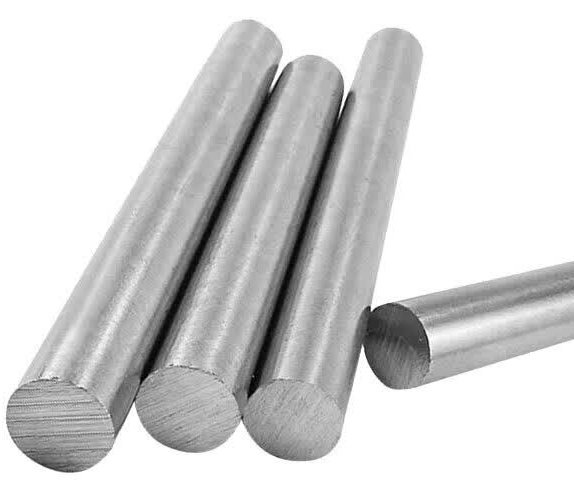
1045 carbon steel, also sold as AISI 1045 or SAE 1045 steel, is one of the most common grades for shafts, pins, gears, axles, couplings, and induction-hardened wear parts. If you need more strength and wear resistance than 1018 but do not need the deeper hardenability and higher alloy cost of 4140, 1045 is often the practical middle ground.
In plain terms, 1045 is a medium-carbon steel with about 0.45% carbon, giving it a useful balance of strength, toughness, machinability, and response to heat treatment [1]. It is widely supplied as hot-rolled bar, cold-finished bar, turned-ground-polished shafting, and forged components [2][3].
- Best known for: shafts, pins, keys, studs, couplings, hydraulic rod stock, and machine parts
- Common conditions: hot rolled, normalized, cold drawn, turned-ground-polished, quenched and tempered, induction hardened
- Main watchouts: limited weldability, low corrosion resistance, and only moderate through-hardening in larger sections
What Is 1045 Carbon Steel?
1045 belongs to the plain carbon steel family. Compared with low-carbon grades such as 1018, it contains more carbon and can reach higher hardness and strength after heat treatment. Compared with alloy steels such as 4140, it is simpler and usually less expensive, but it has less hardenability and less strength retention in thick cross-sections.
That combination explains why 1045 is widely chosen for rotating or sliding mechanical parts that need decent core strength, better surface wear performance, and straightforward machining. It is not a stainless steel, not a corrosion-resistant steel, and not the first choice for heavily welded fabrications.
Chemical Composition and Standards
The grade designation "1045" identifies a carbon steel with a nominal carbon content around 0.45%. The chemistry below reflects the standard SAE grade limits most buyers mean when they ask for 1045 steel [1].
| Element | Typical range |
|---|---|
| Carbon (C) | 0.43-0.50% |
| Manganese (Mn) | 0.60-0.90% |
| Phosphorus (P) | 0.040% max |
| Sulfur (S) | 0.050% max |
| Iron (Fe) | Balance |
In purchasing practice, chemistry is only part of the specification. The delivery standard also matters. Hot-wrought bars are commonly purchased to ASTM A29/A29M, while cold-finished bars are commonly purchased to ASTM A108 [2][3]. Surface finish, straightness, decarburization limits, and mechanical property requirements may change from one supply route to another.
For international sourcing, do not assume C45, C45E, CK45, EN8, or S45C are identical in every detail. Chemistry windows, deoxidation practice, sulfur limits, and delivery conditions can differ by standard.
Mechanical Properties, Hardness, and Physical Data
When engineers search for 1045 steel properties, the key point is that property values vary by delivery condition, section size, and heat treatment. A mill test report for hot-rolled bar will not match a cold-drawn bar of the same diameter, and neither will match a quenched-and-tempered shaft [4].
| Condition | Tensile strength | Yield strength | Elongation | Typical hardness |
|---|---|---|---|---|
| Hot rolled | Approx. 565-625 MPa | Approx. 310-380 MPa | Approx. 14-17% | 160-190 HB |
| Normalized | Approx. 620-700 MPa | Approx. 360-500 MPa | Approx. 14-18% | 170-210 HB |
| Cold drawn | Approx. 620-760 MPa | Approx. 530-630 MPa | Approx. 8-12% | 180-230 HB |
| Quenched and tempered | Broadly 700-950+ MPa | Broadly 500-800+ MPa | Depends on temper | Often 200-300 HB |
These are representative values used for material screening, not universal acceptance limits. Always verify the exact condition and certified values on the mill test report when the part is safety-critical or fatigue-loaded.
- Density: about 7.85 g/cm³
- Elastic modulus: about 200 GPa
- Poisson's ratio: about 0.29
- Thermal conductivity: roughly 49 W/m·K near room temperature
- Corrosion resistance: low; coatings, oiling, plating, phosphating, black oxide, or paint are commonly used
For hardening response, 1045 offers useful improvement over 1018, but it still has limited hardenability in thick sections. Small to medium diameters can respond well to quench-and-temper treatment, while larger cross-sections may not fully through-harden and can show a softer core than alloy steels such as 4140 [4].
Heat Treatment, Surface Hardening, and Weldability
Heat treatment basics
1045 can be annealed, normalized, quenched, and tempered. In general production practice, annealing is used to soften the steel and improve machinability; normalizing is used to refine grain structure and create a more uniform starting condition; and quench-and-temper treatment is used when higher strength is required [4].
Typical industrial practice is to austenitize at roughly 820-870°C, then quench in water or oil depending on section size, required hardness, and distortion risk, followed by tempering to the target strength and toughness. Exact temperatures should be set by the part geometry, furnace capability, and required final properties.
Surface hardening
For parts that need a tough core and a hard wear surface, induction hardening is one of the most valuable processing routes for 1045. Shafts, pins, rollers, and gear-related parts often use induction or flame hardening to achieve surface hardness commonly above 50 HRC while retaining a lower-hardness core. The resulting case depth depends on frequency, power density, scan speed, part geometry, and quench practice [4].
Welding considerations
Weldability is only moderate because the carbon level raises crack sensitivity, especially in restrained joints, thicker sections, or parts with high hardness. Where welding cannot be avoided, preheat, low-hydrogen consumables, controlled interpass temperature, and slow cooling are commonly required; post-weld stress relief may also be necessary for critical work. For many machine components, redesigning the part to avoid welding is the safer choice.
Machinability and Manufacturing Considerations
1045 steel is widely considered machinable, especially in normalized or cold-finished condition, but it is not a free-machining grade. Its machinability is commonly quoted at around 55-60% relative to B1112 = 100 [5]. In real production, chip control and tool life depend heavily on hardness, residual stress, sulfur content, coolant strategy, and whether the stock is hot rolled, cold drawn, or heat treated.
- Cold-drawn 1045 usually offers better straightness and higher yield strength, but it can contain more residual stress.
- Normalized 1045 often gives a predictable balance of machinability and dimensional stability.
- Quenched-and-tempered or induction-hardened 1045 requires slower cutting parameters and more rigid tooling.
- After heavy rough machining on cold-finished bars, stress relief can reduce movement during finish machining.
- Forged parts are often normalized before final machining to improve consistency.
Practical machining starting points
Use these as shop-floor starting points rather than fixed rules. Tool geometry, insert grade, workholding, coolant delivery, and machine rigidity can shift the best window significantly.
- Carbide turning of normalized 1045 often starts around 150-250 m/min, with feed and depth adjusted for rigidity and required finish.
- HSS turning is usually much lower, often around 20-35 m/min.
- Drilling and tapping benefit from good coolant supply because 1045 can build heat and work harden locally at the tool edge.
- For close-tolerance shafts, leave enough stock for finish grinding if the part will be heat treated after rough machining.
- If surface hardness is required only on journals or wear tracks, finish-machine the part first and then apply localized induction hardening.
For manufacturing planning, 1045 is often most economical when the part geometry allows straightforward turning, milling, drilling, or grinding and when corrosion protection can be handled by the assembly design or secondary finishing process.
Common Applications and Material Selection
1045 is used where designers want a practical step up from low-carbon steels without moving immediately to alloy grades. Typical examples include:
- Shafts and axle-like components
- Pins, dowels, keys, and studs
- Gears, gear blanks, and couplings
- Spindles, rollers, and machine tool parts
- Hydraulic rod stock and chrome-plated shafting bases
- Crank components, agricultural machine parts, and general industrial wear parts
It is especially attractive when the design can exploit surface hardening. A shaft made from 1045 can run with a hard journal surface and a tougher core, which is often enough for industrial power transmission and motion systems.
1045 vs 1018 vs 4140
| Grade | Main advantage | Main limitation | Typical use case |
|---|---|---|---|
| 1018 | Better weldability, forming, and lower cost | Lower strength and poor hardening response | Weldments, brackets, simple low-stress parts |
| 1045 | Better strength and wear resistance with manageable cost | Less weldable; less through-hardening than alloy steel | Shafts, pins, couplings, induction-hardened parts |
| 4140 | Higher hardenability, better thick-section performance, stronger after heat treatment | Higher alloy cost and more involved heat-treatment control | High-stress shafts, fatigue-loaded parts, larger sections |
Engineering note: when 1045 is not the right steel
- If the part must be heavily welded, a lower-carbon grade is often easier and safer.
- If you need deep through-hardening in larger diameters, 4140 or another alloy steel is usually a better fit.
- If corrosion is a primary design driver, use stainless steel or specify a robust protective finish.
- If the part needs extreme impact toughness at low temperature, review notch toughness data rather than assuming 1045 will be adequate.
- If dimensional stability after heat treatment is critical, the process route and stock condition may matter as much as the grade itself.
Equivalents, Procurement, and Specification Tips
In global trade, 1045 is commonly compared with C45 or C45E in European standards, S45C in Japanese standards, and EN8 in legacy UK market language [6][7]. However, approximate equivalents are not automatic substitutes. Small differences in chemistry, sulfur limit, deoxidation practice, cleanliness, delivery condition, or inspection requirements can change machining behavior and final performance.
- AISI/SAE: 1045
- EN/DIN family: C45, C45E, CK45 as approximate commercial comparisons
- JIS: S45C as an approximate comparison
- UK legacy market term: EN8 / 080M40 as a common commercial comparison
For buyer and engineer alignment, the biggest mistake is ordering only "1045 steel" without stating form, condition, size, finish, and certification requirements. A cold-drawn 1045 shafting bar is not interchangeable with hot-rolled 1045 bar in every application, even though the base grade name is the same.
Buyer checklist for RFQs and purchase orders
- State the governing standard and product form, such as hot-wrought bar to ASTM A29/A29M or cold-finished bar to ASTM A108 [2][3].
- Specify the delivery condition: hot rolled, normalized, cold drawn, turned-ground-polished, quenched and tempered, or induction hardened.
- Call out exact size, tolerance, straightness, and required surface finish.
- Request hardness or mechanical property limits when functional performance depends on them.
- Define allowable decarburization, surface defects, and any NDT or ultrasonic testing requirements.
- Require MTR/MTC traceability and the certificate format needed by your quality system.
- If approving an equivalent grade, review the chemistry and delivery condition line by line rather than relying on a name match.
From a cost-performance standpoint, 1045 is often a smart buy for general power transmission and machine components because it combines broad availability, familiar processing routes, and useful heat-treatment response. The value drops quickly, however, if the application actually needs high weldability, high corrosion resistance, or deep hardenability in large sections.
References
- SAE International, SAE J403, Chemical Compositions of SAE Carbon Steels.
- ASTM International, ASTM A29/A29M, Standard Specification for General Requirements for Steel Bars, Carbon and Alloy, Hot-Wrought.
- ASTM International, ASTM A108, Standard Specification for Steel Bar, Carbon and Alloy, Cold-Finished.
- ASM International, ASM Handbook, Volume 4: Heat Treating.
- ASM International, ASM Handbook, Volume 16: Machining.
- European Standard, EN 10083-2, Steels for Quenching and Tempering — Part 2: Technical Delivery Conditions for Non-Alloy Steels.
- Japanese Industrial Standards, JIS G4051, Carbon Steels for Machine Structural Use.