
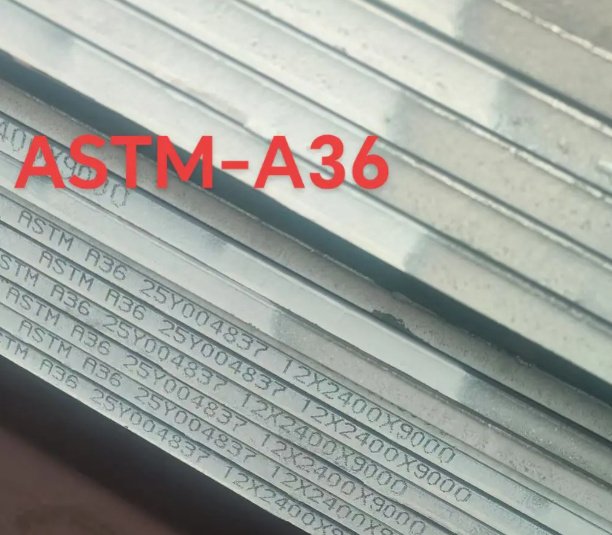
ASTM A36 carbon steel is one of the most widely used structural steels in North America. It is a low-carbon, hot-rolled steel commonly supplied as plate, bar, angle, channel, and structural shapes for buildings, supports, frames, brackets, and general fabrication. The reason it is so common is simple: it offers minimum 36 ksi yield strength, solid weldability, broad availability, and a cost profile that works for many everyday engineering jobs.
If your search intent is practical, this is the short answer: A36 is a general-purpose mild structural steel best suited to welded and bolted fabrications where extreme strength, wear resistance, or guaranteed low-temperature toughness are not the primary requirement. It is often the default choice for base plates, gussets, machine frames, agricultural equipment, platforms, and miscellaneous steelwork.
- Standard designation: ASTM A36/A36M
- Typical market description: mild steel, carbon structural steel, hot-rolled structural steel
- Minimum yield strength: 36 ksi (250 MPa)
- Typical tensile strength: 58 to 80 ksi (400 to 550 MPa)
- Best known for: weldability, availability, and value
What Is A36 Carbon Steel?
A36 is an ASTM material specification for carbon structural steel. Unlike SAE or AISI grades that are usually associated with a tighter chemistry target, A36 is a performance-based structural steel specification. In other words, it is purchased primarily around required strength and general product requirements, not around a single chemistry recipe for every form.
That distinction matters. Engineers often specify A36 because they need a dependable structural steel for static loads and ordinary fabrication. Buyers often choose it because mills and service centers stock it in many forms. Fabricators like it because it can be cut, drilled, welded, and formed without unusual difficulty.
What the “36” means
The “36” in A36 refers to the minimum yield strength in ksi. It does not mean 0.36% carbon, and it does not identify a single chemical composition. That naming point is often misunderstood by new buyers and non-metallurgical users.
Why A36 is often called mild steel
In workshop language, A36 is frequently called mild steel because its carbon content is relatively low compared with medium-carbon or alloy steels. That lower carbon level supports easier welding and forming, although exact fabrication behavior still depends on thickness, surface condition, and mill chemistry.
Chemical Composition and Mechanical Properties
One of the most important facts about A36 is that chemistry varies by product form. Plate, bars, and structural shapes can be produced within different chemistry limits or mill practices under the ASTM framework. Because of that, a generic internet chemistry chart should never override the actual mill test report for the specific heat and product you are buying.
In common commercial practice, A36 mill certifications usually show a low-carbon steel chemistry with carbon roughly around 0.25% to 0.29%, manganese commonly around 0.80% to 1.20%, phosphorus typically limited to about 0.04% max, and sulfur typically limited to about 0.05% max. Silicon, copper, and deoxidation practice may also vary. For compliance, always use the certified analysis on the MTR.
Common property data used in design and purchasing
| Property | Common value | Why it matters |
|---|---|---|
| Minimum yield strength | 36 ksi (250 MPa) | Baseline strength used for many structural calculations |
| Tensile strength | 58 to 80 ksi (400 to 550 MPa) | Useful for material comparison and weld procedure context |
| Elongation | Commonly cited as 20% min in 8 in and 23% min in 2 in | Indicates reasonable ductility; check product form and thickness |
| Density | 0.284 lb/in³ (7.85 g/cm³) | Used for weight estimates and shipping calculations |
| Elastic modulus | 29,000 ksi (about 200 GPa) | Important for deflection and stiffness calculations |
| Hardness | Often about 120 to 160 HB as supplied | Helpful for machining expectations; not usually a purchase-controlled A36 requirement |
These values are useful reference points, but final acceptance should follow the current ASTM standard, the applicable product form requirements, and the supplier’s certified test data.
Engineer’s note on chemistry, toughness, and substitutions
A36 is fine for many static, room-temperature structures, but the base specification does not automatically guarantee impact toughness for low-temperature or fracture-critical service. If your project needs Charpy V-notch performance, seismic reliability, fracture control, or enhanced through-thickness properties, specify those requirements directly or evaluate more suitable grades.
Also, avoid assuming that a “higher grade” is always an acceptable substitution. A stronger steel may change connection design, welding assumptions, or approval requirements, even if it looks like an upgrade on paper.
Product Forms, Sizes, and Surface Condition
A36 is most commonly stocked as plate, flat bar, round bar, angle, channel, and other hot-rolled structural shapes. It is especially common in base plates, clip plates, support steel, brackets, and fabricated assemblies that do not need the tighter dimensional control of cold-finished bar.
As supplied, A36 typically has a hot-rolled mill scale surface. That matters in real fabrication. Mill scale can affect paint adhesion, welding cleanliness, electrical contact, laser cutting consistency, and the appearance of finished parts. If your process depends on a clean surface, specify blasting, pickling, grinding, or machining allowance early in the job.
Important product-form buying nuance
Many people casually ask for “A36 sheet” or “A36 tube,” but that wording can be misleading. Thin-gauge hot-rolled sheet is often governed by standards such as ASTM A1011 rather than ASTM A36. Structural tube and HSS are usually purchased to ASTM A500 or similar tubing standards, not to A36. Likewise, wide-flange beams in building work are often supplied to ASTM A992 rather than A36. The product name in the warehouse does not always tell you the governing specification.
Tolerances and certification
For many plates, bars, and structural shapes, general requirements such as tolerances, repair, marking, and testing are coordinated through ASTM A6/A6M. That is why a complete material review should look beyond only the grade callout and include the governing general requirements standard as well.
- Plate and bar are often used where machining stock or welded fabrication is expected.
- Angles and channels are common for frames, supports, and miscellaneous steel.
- Structural shapes are common in platforms, equipment skids, and building supports.
- Surface cleaning may be required before coating, galvanizing, or precision welding.
Fabrication and Processing
From a shop perspective, weldability is generally very good. A36 can be welded successfully with common structural welding processes such as SMAW, GMAW, FCAW, and SAW, provided that procedure qualification, filler selection, joint design, and hydrogen control are appropriate for the thickness and restraint level.
Welding
For ordinary shop work, A36 is considered a forgiving steel compared with higher-carbon or alloy grades. Even so, preheat is not a one-number rule. Required preheat depends on thickness, restraint, ambient temperature, diffusible hydrogen, and the governing code. For structural work, shops should rely on the approved WPS and the current edition of AWS D1.1/D1.1M, not only on habit or verbal guidance.
Because A36 is common in fillet-welded brackets, base plates, and support frames, edge condition matters. Heavy mill scale, rust, moisture, or flame-cut slag can reduce weld quality if not removed before joining.
Cutting
A36 can be processed by sawing, shearing, laser cutting, plasma cutting, waterjet cutting, and oxy-fuel cutting. The best method depends on thickness, edge quality requirements, heat input tolerance, and cost. Oxy-fuel is common on thick plate, while laser and plasma are often preferred for speed and profile accuracy in thinner material.
For parts that will be welded after thermal cutting, edge cleanup may be necessary. Removing dross, oxide, and hardened edge artifacts improves fit-up and helps maintain consistent weld quality.
Machining and forming
A36 is machinable, but it is not the first-choice steel for precision machined shafts or high-volume turned parts. Hot-rolled scale is abrasive, and stock tolerances are usually looser than cold-finished bar. If your part needs tighter straightness, finer surface finish, or better machining predictability, grades such as 1018 cold-finished bar or 1045 may be more efficient.
In forming, A36 performs well for many bends and rolled shapes because of its low carbon content and useful ductility. Bend results still depend on thickness, bend radius, tooling, and whether the bend is taken parallel or transverse to the rolling direction.
Shop note on welding, surface prep, and galvanizing
If a fabricated A36 assembly will be painted, powder coated, or galvanized, surface preparation should be treated as part of the process plan, not an afterthought. Mill scale left in place can hurt coating adhesion and make the final finish look inconsistent.
A36 can also be hot-dip galvanized successfully, but coating appearance and thickness can vary with steel chemistry. If galvanized finish quality is important, coordinate the steel source, fabrication sequence, venting, drainage, and the applicable galvanizing standard before production starts.
Applications and Design Limits
A36 appears in a wide range of products because it sits at a useful intersection of strength, price, and fabricability. Typical applications include base plates, connection plates, brackets, frames, columns for light structures, machinery supports, agricultural equipment, trailers, storage racks, stairs, rails, and general welded fabrications.
Where A36 is a strong choice
- General structural parts with moderate load levels
- Welded frames and support structures
- Base plates, gussets, clips, and brackets
- Machine stands, skids, and maintenance platforms
- Projects where cost and local availability matter
Where another grade may be better
- Weight-sensitive designs that benefit from higher yield strength, such as ASTM A572 Grade 50
- Cold-service or fracture-critical applications requiring impact toughness
- Pressure-containing equipment that should be purchased to pressure-vessel grades
- Outdoor structures needing better atmospheric corrosion resistance, such as weathering steels
- Wear-intensive parts needing abrasion-resistant plate rather than mild structural steel
A useful engineering reminder is that stronger steel is not automatically stiffer steel. If deflection controls the design, moving from A36 to a higher-yield carbon steel usually does not change elastic modulus in a meaningful way. Strength may improve, but stiffness remains broadly similar.
Corrosion resistance is another practical limit. A36 is plain carbon steel, not stainless steel. In exposed service it usually needs paint, galvanizing, or another protective system.
A36 vs Other Common Steel Grades
A36 is often compared with 1018, A572 Grade 50, and S235JR, but these are not direct one-to-one equivalents. They come from different standards and are selected for different reasons. The correct comparison is not just chemistry or yield strength; it is the whole package of product form, mechanical requirements, tolerances, fabrication route, and code acceptance.
| Grade | What it is commonly used for | Main advantage | Main caution |
|---|---|---|---|
| A36 | General structural plate, bar, and shapes | Widely available, weldable, economical | Not the best choice where higher strength or guaranteed toughness is needed |
| 1018 | Machined parts, shafts, pins, cold-finished bar work | Better dimensional control and machining behavior in cold-finished form | Not a direct substitute for a structural A36 specification |
| A572 Grade 50 | Higher-strength structural members and plate | 50 ksi minimum yield strength can reduce section size or weight | Costs, approvals, and welding details may differ from A36 |
| S235JR | European structural steel applications | Nominally similar structural role in EN systems | Compare EN 10025 requirements carefully before substitution |
Fast selection logic
- Choose A36 when you need a broadly available structural mild steel for fabrication and cost control.
- Choose 1018 when machining quality and dimensional consistency matter more than structural-spec identity.
- Choose A572 Grade 50 when higher yield strength can improve the design economically.
- Compare S235JR by standard, certification, and project code, not by yield number alone.
Buying and Specification Tips
Many purchasing problems happen because drawings say only “A36 steel” and stop there. In production, that is often incomplete. A useful purchase description should include product form, thickness, dimensions, finish condition, any testing or supplementary requirements, and the standard that governs tolerances and general requirements.
- State the exact standard: ASTM A36/A36M
- Identify the product form: plate, bar, angle, channel, shape, or other
- Include size, thickness, and quantity clearly
- Call out finish needs if scale-free or blast-cleaned material is required
- Specify certification and heat traceability if required
- Do not assume sheet, tube, or wide-flange products are actually governed by A36
- Note coating plans early if painting or galvanizing is part of the job
For design-critical or customer-audited work, review the MTR before release and verify the latest ASTM edition, product-form requirements, and any governing fabrication code. That simple step prevents many costly mistakes involving incorrect substitutes, missing test data, or wrong form assumptions.
Buyer’s checklist before placing a purchase order
- Confirm whether the item is truly ASTM A36 or a different product standard sold under a similar shop name.
- Ask for the mill test report and verify heat number traceability if required by contract.
- Check whether impact testing, copper-bearing chemistry, galvanizing suitability, or coating prep must be specified separately.
- For machined parts, make sure enough cleanup stock is included to remove scale and meet final tolerance.
- For welded assemblies, coordinate material thickness, edge condition, and any prequalified welding procedure requirements before the steel arrives.
- For structural projects, confirm whether the engineer of record allows substitutions such as A572 Grade 50 or A992.
References
- ASTM A36/A36M, Standard Specification for Carbon Structural Steel, latest edition.
- ASTM A6/A6M, General Requirements for Rolled Structural Steel Bars, Plates, Shapes, and Sheet Piling, latest edition.
- AWS D1.1/D1.1M, Structural Welding Code—Steel, latest edition.
- AISC Steel Construction Manual, latest edition.
- ASM Handbook, properties and selection data for carbon and low-alloy steels.
- ASTM A123/A123M, Standard Specification for Zinc (Hot-Dip Galvanized) Coatings on Iron and Steel Products, latest edition.
This article is intended as a practical technical overview. For design acceptance, purchasing compliance, code work, or contractual decisions, use the current governing standards and the certified material documents for the exact product being supplied.