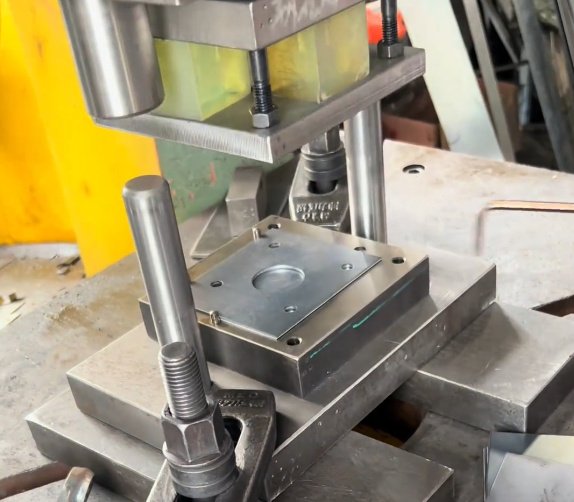
Metal punching is a sheet metal fabrication process used to create holes, slots, louvers, knockouts, perforations, embossed features and shaped cutouts by forcing a punch through metal into a matching die. It is widely used for electrical enclosures, server racks, brackets, HVAC panels, automotive components, appliance parts, filters, architectural panels and industrial machinery guards.
For buyers, engineers and sourcing teams, the main search intent behind “metal punching” is usually practical: how the process works, what tolerances are realistic, when it is more cost-effective than laser cutting, and how to design parts that can be produced accurately without excessive tooling or secondary finishing. This guide covers those points with manufacturing-focused detail.
What Is Metal Punching?
Metal punching is a cold-forming and cutting operation in which a punch presses into sheet metal and shears material against a die opening. The removed slug falls through the die, leaving a punched hole or profile. In CNC turret punching, multiple tools are loaded in a turret so the machine can create different hole sizes, slots and forms in one setup.
The process is different from drilling because it does not remove material as chips. It is also different from laser cutting because it uses mechanical shearing rather than thermal cutting. The result is a fast, repeatable process with excellent productivity for parts that contain many holes, repeated patterns or standard geometric features.
Metal punching is most valuable when a part requires high hole density, repeatable geometry, short cycle time and economical production without dedicated progressive stamping dies.
How the Metal Punching Process Works
A typical sheet metal punching workflow includes CAD review, material selection, tool selection, nesting, punching, deburring, forming if required, surface finishing and final inspection. CNC machines can automatically index the sheet, rotate certain tools and create complex hole patterns with high positional repeatability.
- Design review: Engineers check hole size, edge distance, feature spacing, material thickness and bend relationship.
- Tool selection: Standard round, square, obround, rectangular, countersink, extrusion, louver or forming tools are chosen.
- Nesting: Parts are arranged on the sheet to reduce scrap and avoid clamp zones.
- Punching: The punch descends, shears the material and ejects the slug through the die.
- Secondary operations: Parts may be deburred, bent, tapped, welded, powder coated, anodized or plated.
- Inspection: Hole size, location, burr height, flatness and surface condition are checked against the drawing.
Common Metal Punching Operations
- Hole punching: Round, square or shaped holes for fasteners, ventilation and cable access.
- Blanking: Cutting the outside profile of a part or slug.
- Piercing: Creating internal holes or openings.
- Nibbling: Producing irregular contours with repeated overlapping punch hits.
- Lancing: Cutting and bending a tab without completely removing material.
- Embossing: Raising or recessing a feature for stiffness, clearance or branding.
- Perforating: Creating repeated holes for airflow, filtration, sound control or decorative panels.
- Forming: Producing louvers, knockouts, countersinks, bridge forms and extrusions.
Example tonnage calculation for a punched hole
Punching force can be estimated with this formula: perimeter × material thickness × shear strength. For example, a 10 mm diameter hole in 2 mm mild steel with approximate shear strength of 300 MPa requires about 18.8 kN, or roughly 1.9 metric tons, before safety factor. In production planning, fabricators add margin for tool wear, coating, material variation and dynamic load.
Materials Suitable for Metal Punching
Metal punching works with many sheet materials, but each material behaves differently in terms of punching force, burr formation, tool wear and surface finish. Harder materials require more tonnage and can reduce punch life. Softer materials may gall or smear if tooling clearance and lubrication are not controlled.
| Material | Typical Use | Manufacturing Notes |
|---|---|---|
| Mild steel | Brackets, frames, enclosures, industrial panels | Good punchability, economical, suitable for high-volume hole patterns |
| Stainless steel | Food equipment, medical cabinets, marine components | Higher punching force, greater tool wear, burr control is important |
| Aluminum | Electronics housings, aircraft panels, lightweight brackets | Easy to punch but may require attention to galling and surface protection |
| Galvanized steel | HVAC, outdoor enclosures, cable trays | Coating condition near punched edges should be reviewed for corrosion exposure |
| Copper and brass | Electrical contacts, decorative panels, shielding parts | Ductile materials; tool clearance and flatness control are important |
| Spring steel | Clips, retainers, functional springs | Requires careful tooling and may need specialized processing |
Typical sheet thickness for CNC punching ranges from about 0.5 mm to 6 mm, depending on material, machine tonnage and feature geometry. Heavy plate can sometimes be punched, but laser, plasma, waterjet or machining may become more practical as thickness increases.
Typical Tolerances, Burrs and Edge Quality
Metal punching is repeatable, but it is not a zero-clearance process. Hole size, position and edge condition depend on machine accuracy, tool wear, sheet flatness, material thickness, tool clearance and feature location. A punched edge usually has a rollover zone, burnish zone, fracture zone and burr.
Typical CNC punching tolerances for many commercial sheet metal parts are approximately ±0.10 mm to ±0.30 mm for hole position, although tighter or looser limits may apply depending on part size, material, tooling and inspection method. Critical features should be clearly identified on the engineering drawing.
| Quality Item | Typical Concern | Engineering Recommendation |
|---|---|---|
| Hole diameter | Punch wear, die clearance, material springback | Avoid unnecessarily tight tolerances on non-critical holes |
| Burr height | Sharp edges, assembly interference, coating defects | Specify deburring requirement only where functional or safety-related |
| Flatness | Sheet distortion after dense perforation | Use balanced hole patterns and consider stress relief or leveling |
| Edge distance | Bulging, tearing or distorted holes near edges | Keep holes at least 1.5× to 2× material thickness from edges when possible |
| Formed features | Interference with clamps, bends or adjacent tools | Confirm tool access and forming direction during DFM review |
Real engineering issue: burrs causing assembly failure
A control cabinet panel with 312 punched ventilation holes passed dimensional inspection but failed assembly because burrs scratched a powder-coated internal bracket. The drawing did not define an edge condition. After adding a maximum burr height requirement of 0.08 mm on the contact side and changing tool clearance, rework dropped from 14.6% to under 2% across the next production batch.
Design for Manufacturability Guidelines for Punched Sheet Metal
Good DFM can reduce cost, improve lead time and prevent avoidable quality issues. The most common design mistakes include holes that are too close to bends, slots that are narrower than the material thickness, decorative perforations that distort large panels and overly tight tolerances on non-functional features.
Designing for standard punching tools is one of the simplest ways to reduce fabrication cost. Custom punch tools are useful, but they add lead time and tooling expense. If a standard round, obround or rectangular tool can meet the function, it is usually the best first option.
Recommended DFM Rules
- Use hole diameter equal to or greater than material thickness whenever possible.
- Keep hole-to-edge distance at least 1.5× material thickness; 2× is safer for cosmetic parts.
- Keep hole-to-hole spacing at least 2× material thickness for high-quality punching.
- Avoid placing punched holes too close to bend lines; distortion risk increases near forming zones.
- Use radiused slot ends to reduce stress concentration and tooling wear.
- Group repeated hole sizes to minimize tool changes and cycle time.
- Specify grain direction only when it matters for bending, appearance or functional performance.
- Define which side may contain burrs if assembly or appearance is side-sensitive.
- For perforated panels, consider open area percentage, strength loss and flatness requirements.
Perforation and Open Area Considerations
Perforated metal punching is commonly used for airflow, filtration, sound attenuation and visual screening. Open area percentage affects pressure drop, strength and panel rigidity. For example, increasing open area from 30% to 50% may improve airflow, but it can also increase panel flex and the risk of distortion during punching or forming.
| Design Goal | Helpful Punching Strategy | Risk to Check |
|---|---|---|
| High airflow | Use staggered round holes or elongated slots | Reduced stiffness and possible oil-canning |
| Decorative pattern | Use consistent pitch and controlled edge margins | Visible distortion or pattern misalignment |
| Acoustic attenuation | Coordinate hole size with backing material | Performance depends on full assembly, not only metal sheet |
| Lightweight panel | Optimize open area while maintaining ribs or borders | Handling damage during transport or installation |
Cost Drivers in Metal Punching
The cost of metal punching is influenced by material, thickness, machine time, number of hits, tool requirements, setup complexity, secondary operations, inspection level and order quantity. Unlike laser cutting, which may be efficient for complex contours, punching can be extremely cost-effective for repeated holes because each hit is fast and consistent.
The number of punch hits is a major cost driver. A panel with 2,000 small holes requires much more machine time and tool wear than a bracket with eight mounting holes, even if both parts are cut from the same sheet size.
Typical Cost Factors Buyers Should Review
- Material utilization: Efficient nesting can reduce scrap cost, especially for stainless steel, copper and aluminum.
- Tooling: Standard tools reduce upfront cost; custom shapes may be justified for repeat production.
- Thickness: Thicker or harder material requires more tonnage and may reduce speed.
- Feature density: More holes, louvers, knockouts or formed features increase machine time.
- Deburring: Cosmetic or safety-critical edge finishing adds labor or machine processing.
- Surface finish: Powder coating, plating, passivation, anodizing or brushing may drive lead time.
- Tolerances: Overly tight tolerances can increase inspection time and scrap risk.
- Packaging: Visible or pre-finished surfaces may require protective film, separators or special crates.
RFQ checklist for purchasing punched metal parts
To receive accurate pricing, provide a 2D drawing, 3D model if available, material grade, thickness, quantity, finish, tolerance requirements, burr direction, critical dimensions, inspection requirements, annual usage estimate and any packaging expectations. If the part will be bent after punching, include bend angles, inside radii and the required finished orientation.
Metal Punching vs Laser Cutting, Stamping and Machining
Choosing between metal punching, laser cutting, stamping and machining depends on geometry, quantity, material, thickness, edge requirements and tooling budget. Many sheet metal parts use more than one process. For example, a panel may be laser-cut for the outside contour, punched for repeated holes and press-brake formed afterward.
| Process | Best For | Limitations |
|---|---|---|
| Metal punching | Repeated holes, slots, knockouts, louvers and perforated patterns | Tool geometry limits, burrs, potential distortion in dense patterns |
| Laser cutting | Complex profiles, low tooling cost, fast design changes | Heat-affected edge, slower for thousands of repeated holes |
| Progressive stamping | Very high-volume parts with stable design | High upfront die cost and longer tool development |
| CNC machining | Thick parts, tight precision features, threaded holes and pockets | Higher cost for simple sheet metal hole patterns |
| Waterjet cutting | Thick or heat-sensitive materials | Slower for high-volume sheet metal perforation |
For low- to medium-volume sheet metal parts with many standard holes, CNC metal punching often delivers a strong balance of speed, accuracy and cost. For complex profiles without repeated features, laser cutting may be more flexible. For millions of parts with a mature design, progressive stamping may provide the lowest unit cost after tooling investment.
Quality Control and Inspection for Punched Metal Parts
Quality control for metal punching should match the function of the part. A hidden internal bracket may not need the same cosmetic standard as an architectural perforated panel. Critical-to-quality characteristics should be defined before production, not after parts arrive.
Inspection plans should focus on hole location, feature size, burr direction, burr height, flatness, formed feature height, material certification, surface scratches and finish adhesion where applicable.
Common Inspection Methods
- Calipers and pin gauges for hole size and slot width.
- Coordinate measuring machine or optical inspection for hole patterns and positional tolerance.
- Go/no-go gauges for high-volume functional features.
- Burr height measurement using visual standards, tactile checks or measuring equipment.
- Flatness checks on granite tables, fixtures or specified datum setups.
- Coating thickness testing after powder coating, plating or anodizing.
- First article inspection for new tools, new suppliers or critical production launches.
Buyer and Engineer Considerations Before Ordering
From a procurement perspective, the best metal punching supplier is not only the lowest quote. A capable supplier should understand sheet metal behavior, tooling clearance, nesting, forming sequence, surface protection and inspection requirements. Good technical review early in the project often prevents expensive rework later.
Engineers should communicate the function of each critical feature. If a hole is only for airflow, it may not need a tight positional tolerance. If a punched extrusion will receive a screw, thread engagement and material thickness become more important. If a part is visible to the end user, grain direction, burr side and handling marks may matter as much as dimensions.
Questions to Ask a Metal Punching Supplier
- What sheet thickness and material grades can your punching equipment handle reliably?
- Do you have standard tools for the required hole sizes, slots and formed features?
- Can you support punching, bending, welding, tapping and finishing in one production flow?
- How do you control burr height and prevent surface scratches?
- Can you provide first article inspection or dimensional reports for critical parts?
- How do you package cosmetic or coated components to prevent transit damage?
- Can you recommend design changes to reduce hits, scrap rate or custom tooling?
Conclusion: When Metal Punching Is the Right Choice
Metal punching is a proven, efficient and scalable sheet metal manufacturing process for holes, slots, perforations, louvers, knockouts and formed features. It is especially effective when parts use standard tooling, repeated patterns and practical tolerances. The process can reduce cycle time, improve consistency and support cost-effective production across prototypes, batch production and ongoing industrial supply.
For the best result, align the design with punching constraints early: choose manufacturable hole sizes, maintain proper spacing, define burr and finish expectations, and avoid unnecessary tight tolerances. When engineering, purchasing and fabrication teams share clear requirements, punched metal parts can be produced with better quality, shorter lead times and more predictable cost.