
Titanium Machining Services
Titanium machining services support the production of lightweight, corrosion-resistant and high-strength components for aerospace, medical, marine, energy, robotics and precision industrial applications. Unlike aluminum or stainless steel, titanium has low thermal conductivity, strong chemical reactivity and a high strength-to-weight ratio, which makes it valuable in service but demanding during CNC machining.
- Fast prototype & low MOQ support
- Tight tolerance up to +0.002mm
- Surface finishing available
- Engineering review before production
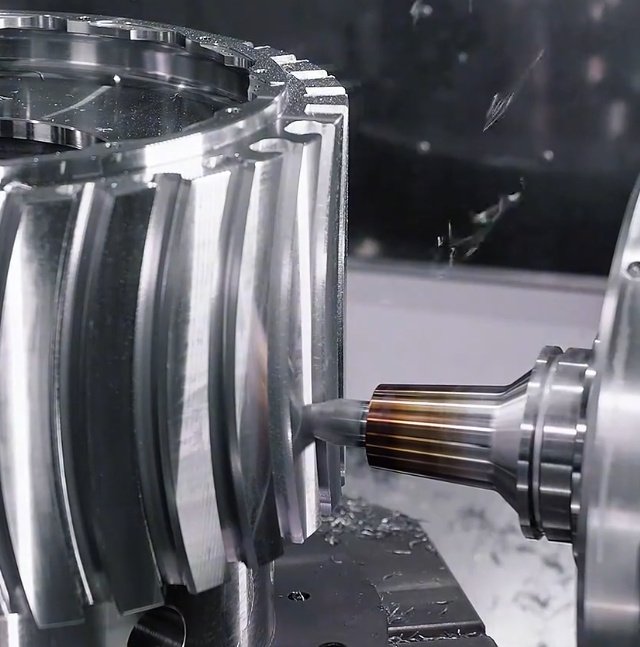
Titanium CNC Machining Capabilities
Titanium machining services refer to the controlled removal of material from titanium billet, bar, plate, forging or casting stock using CNC equipment. Common processes include CNC milling, CNC turning, drilling, tapping, boring, reaming, thread milling, surface finishing and dimensional inspection.
CNC machining is often selected for titanium parts because it can produce accurate features without dedicated tooling, making it suitable for prototypes, bridge production, low-volume manufacturing and complex end-use components. For high-value parts, the machining plan usually includes fixture design, tool life control, in-process inspection and final dimensional verification.
Precision Milling
- Multi-axis CNC milling for complex geometries.
- Tight tolerances as tight as ±0.002mm and fine surface finishes.
- Suitable for prototypes and mass production.
CNC Turning
- High-speed turning for shafts, rods, and cylindrical parts.
- Thread cutting, grooving, and facing operations.
- Supports both small and large batch production.
Drilling, Tapping & Boring
- CNC drilling for holes of all sizes and depths.
- Threading and tapping for assemblies.
- High repeatability for precision alignment.
Multi-Axis Machining
- 4-axis and 5-axis machining for intricate parts.
- Reduced setups and improved accuracy.
- Ideal for aerospace, automotive, and medical components.
Secondary Operations
- Deburring, grinding, tapping, honing, keyways, broaching support.
- Specialized processes for hard-to-machine metals.
- Used when critical surfaces, fit, or assembly requirements exceed standard machining
CNC Prototyping
- Rapid CNC prototyping to test designs quickly.
- Small batch to full-scale production runs.
- Flexible workflow to meet tight deadlines.
Reliable titanium machining process
A reliable titanium machining process requires more than simply slowing down a CNC program. It depends on tool geometry, chip load, coolant delivery, workholding rigidity, toolpath strategy, inspection planning and material traceability.
- CNC milling, CNC turning, mill-turn machining and 5-axis machining for titanium parts
- Support for commercially pure titanium, Grade 2 titanium, Grade 5 Ti-6Al-4V and other alloys
- Guidance for tolerances, wall thickness, surface finish, threaded features and inspection
- Engineering-focused machining recommendations for manufacturable titanium designs
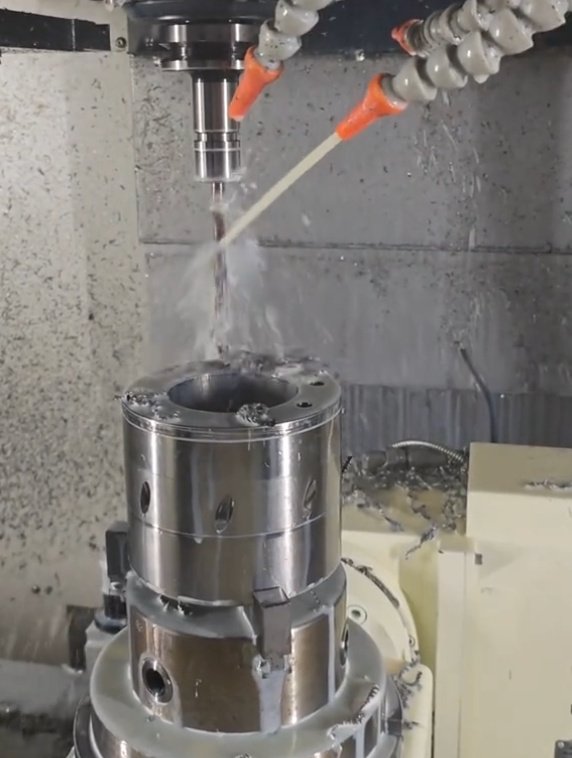
Common Titanium Grades for CNC Machining
Material selection has a direct effect on machinability, mechanical performance, corrosion resistance, cost and lead time. Titanium grades are not interchangeable, so drawings and purchase specifications should identify the grade, standard and required certification.
| Titanium Grade | Common Name | Machining Notes | Typical Uses |
|---|---|---|---|
| Grade 2 | Commercially pure titanium | More ductile than alloyed grades; can form stringy chips | Chemical processing, marine parts, heat exchangers, medical components |
| Grade 5 | Ti-6Al-4V | Most widely machined titanium alloy; strong but heat-sensitive during cutting | Aerospace brackets, medical devices, performance motorsport, robotics |
| Grade 7 | Palladium-enhanced CP titanium | Similar to Grade 2 with improved corrosion resistance | Chemical equipment, chloride environments, process hardware |
| Grade 23 | Ti-6Al-4V ELI | Extra-low interstitial variant; often requires controlled documentation | Medical implants, surgical tools, high-reliability applications |
How Grade 2 and Grade 5 titanium differ in machining behavior
Grade 2 titanium is commercially pure and generally softer, but its ductility can create long chips and built-up edge if the cutting tool is not sharp. Ti-6Al-4V (Grade 5) is stronger and more common in aerospace and medical applications, but it generates higher cutting loads and concentrates heat at the cutting edge. Grade 5 usually requires more conservative cutting parameters, rigid workholding and close tool wear monitoring.
Tolerances, Surface Finishes and Inspection
| Feature Type | Typical CNC Machining Range | Engineering Notes |
|---|---|---|
| General milled dimensions | ±0.05 mm to ±0.10 mm | Suitable for many structural and enclosure features |
| Precision bores | ±0.01 mm to ±0.025 mm | May require boring, reaming, honing or controlled inspection |
| Turned diameters | ±0.01 mm to ±0.05 mm | Depends on length-to-diameter ratio and workholding |
| Flatness and parallelism | Application dependent | Thin titanium plates may require stress-relief strategy and balanced machining |
| Surface roughness | Ra 0.8 to 3.2 µm commonly achievable | Finer finishes may require finishing passes, polishing or grinding |
When tight tolerances are most likely to increase titanium machining cost
Tight tolerances become costly when they apply to deep pockets, thin walls, long slender parts, intersecting features, small internal radii or multiple datums across several setups. A single ±0.01 mm bore may be reasonable, while applying ±0.01 mm to every non-functional outside profile can significantly increase inspection time, finishing passes and scrap risk.
Why Titanium Is Difficult to Machine
Titanium is not difficult because it is extremely hard; it is difficult because its physical and chemical properties stress the cutting process. The material retains strength at elevated temperature, transfers heat poorly into the chip and tends to react with cutting tools under high temperature.
- Low thermal conductivity: Heat remains near the tool edge instead of flowing into the workpiece or chip.
- High strength-to-weight ratio: Cutting forces can be high relative to the part mass, especially on thin features.
- Work hardening risk: Rubbing instead of cutting can harden the surface and shorten tool life.
- Galling and built-up edge: Titanium can adhere to cutting edges, especially with dull tools or poor lubrication.
- Elastic recovery: Thin walls and flexible features may deflect during machining and spring back after tool pressure is removed.
The practical goal is heat management. Successful titanium machining keeps tools cutting with a consistent chip load, avoids dwelling, removes chips quickly and uses coolant effectively to reduce thermal damage and tool wear.
Engineering Problems in Titanium Machining and Practical Results
Titanium machining problems often appear as chatter, rapid tool wear, poor surface finish, dimensional drift, burr formation or broken taps. The root cause is commonly a combination of heat, vibration, tool engagement and workholding.
| Engineering Problem | Likely Cause | Process Change | Measured or Typical Result |
|---|---|---|---|
| Chatter in deep pocket milling | Long tool overhang and high radial engagement | Use adaptive toolpaths, reduce radial engagement, increase axial engagement within tool limits | Surface finish improved from approximately Ra 4.0 µm to Ra 1.6 µm in a controlled benchmark setup |
| Rapid end mill wear in Ti-6Al-4V | Excessive surface speed and poor heat evacuation | Lower cutting speed, maintain chip load, add high-pressure coolant or directed coolant | Tool life commonly improves by 30% to 80% depending on geometry and tool coating |
| Thread tapping failure | Chip packing, high torque and work hardening | Use thread milling or form-specific tap strategy with suitable lubricant | Reduced broken-tool risk and improved thread size control for blind holes |
| Thin wall deflection | Low stiffness and residual stress release | Machine symmetrically, leave semi-finish stock, use support fixtures and final light passes | Wall thickness variation can often be reduced from over 0.15 mm to below 0.05 mm |
Results vary with machine tool rigidity, coolant pressure, cutter design, part geometry and alloy condition. However, the data shows why titanium machining should be engineered as a controlled process rather than treated as standard metal cutting.
Design Guidelines for Machined Titanium Parts
- Use generous internal radii: Larger corner radii allow stronger tools and reduce heat concentration.
- Avoid unnecessary deep narrow slots: Deep slots require long tools, which increase chatter risk.
- Control thin wall geometry: Thin walls should be evaluated for deflection, vibration and residual stress.
- Specify functional tolerances only: Apply tight tolerances where fit, sealing, alignment or motion requires them.
- Define datums clearly: Good datum structure reduces ambiguity during machining and CMM inspection.
- Choose threads carefully: Thread milling may be preferred for expensive titanium parts, especially blind holes.
- Plan finishing requirements: Anodizing, polishing, passivation or blasting may change appearance and dimensions.
Recommended drawing information for titanium CNC machining
A complete drawing should include material grade, applicable standard, heat treatment or annealed condition if required, critical dimensions, datum references, surface finish, thread specifications, edge break requirements, inspection requirements and any certification needs. If the part is used in medical, aerospace or pressure equipment, additional documentation may be required by the governing specification.
Applications of Titanium Machined Components
Titanium is selected when designers need strength, low weight, corrosion resistance, biocompatibility or performance at elevated temperatures. CNC machining allows these properties to be used in precise custom geometry.
| Industry | Examples of Machined Titanium Parts | Why Titanium Is Used |
|---|---|---|
| Aerospace | Brackets, fittings, housings, structural links, fastener components | High strength-to-weight ratio and fatigue resistance |
| Medical and dental | Surgical instruments, implant-related components, device housings | Biocompatibility and corrosion resistance |
| Marine | Valve components, pump parts, sensor housings, shaft hardware | Resistance to seawater and chloride environments |
| Energy and chemical processing | Manifolds, heat exchanger parts, nozzles, process fittings | Corrosion resistance in aggressive media |
| Motorsport and robotics | Lightweight links, custom fasteners, mounts, rotating components | Mass reduction without sacrificing strength |
Quality Control for Titanium CNC Machining
Quality control for titanium parts should begin before machining starts. Material verification, datum planning, fixture validation and toolpath simulation reduce the risk of nonconforming parts. During machining, operators may monitor tool wear, critical dimensions, part temperature, burr formation and surface finish.
For precision or regulated applications, first-article inspection can confirm that the manufacturing process is capable before a full batch is produced. Final inspection may include dimensional reports, CMM data, thread gauge results, surface roughness readings, material certificates and finish documentation.
Common Quality Standards and References
- ASTM B348: Standard specification for titanium and titanium alloy bars and billets
- ASTM F136: Wrought Ti-6Al-4V ELI alloy for surgical implant applications
- AMS 4928: Titanium alloy bars, wire, forgings and rings for aerospace applications
- ISO 2768: General tolerances for linear and angular dimensions where applicable
- ASME Y14.5: Geometric dimensioning and tolerancing practices
How to Evaluate a Titanium Machining Supplier
Titanium parts are often expensive before machining even begins, so supplier selection should focus on process capability, not only quoted price. A capable CNC machining supplier should understand titanium cutting behavior, fixture strategy, inspection requirements and documentation expectations.
- Experience with Grade 2, Grade 5 Ti-6Al-4V or the specified titanium alloy
- Capability for CNC milling, turning, 5-axis machining or mill-turn operations as required
- Use of appropriate carbide tools, coatings, coolant strategy and tool life controls
- Ability to inspect critical dimensions with suitable equipment such as CMM or calibrated gauges
- Understanding of surface finish, deburring, cleaning and edge condition requirements
- Support for material certificates, inspection reports and traceability when required
- Engineering communication for manufacturability risks before production
The best titanium machining outcomes come from aligning design intent, material requirements, CNC process planning and inspection criteria. When those elements are controlled, titanium can be machined into accurate, reliable and high-performance components for demanding applications.