
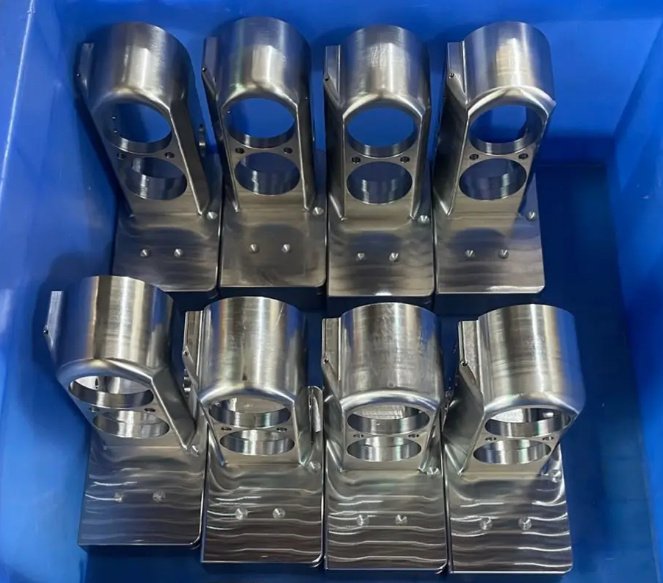
Engineers and procurement teams face a recurring specification decision when designing stainless steel components: 304 or 316? These two grades dominate global stainless steel consumption, yet their differences in machinability, corrosion resistance, and cost create significant implications for CNC manufacturing outcomes. This guide delivers the technical depth required to make an informed selection, with particular focus on how each grade behaves under precision machining conditions.
Compositional Foundation: Why 316 Differs from 304
Both 304 and 316 belong to the austenitic family, characterized by face-centered cubic crystal structure, non-magnetic behavior, and excellent formability. Their base compositions are nearly identical: approximately 18% chromium and 8-10% nickel. The critical distinction lies in molybdenum.
Grade 316 contains 2-3% molybdenum, while 304 contains essentially none. This single alloying addition transforms corrosion resistance, mechanical properties, and—critically for manufacturing—machinability. Molybdenum dissolves in the austenitic matrix, increasing solid solution strength and altering the material's response to cutting forces and thermal loads.
Carbon content also varies slightly. Standard 304 allows up to 0.08% carbon, while 304L and 316L variants limit carbon to 0.03% maximum to prevent sensitization during welding. For machining applications where welding is not required, the standard grades offer marginally higher strength and are generally preferred.
Machinability Comparison
Machinability ratings quantify how easily a material can be cut relative to a reference standard. In the American Iron and Steel Institute rating system, free-machining 1212 steel represents 100%. Both 304 and 316 score poorly in absolute terms, but their relative performance reveals important differences for manufacturing planning.
Relative Machinability Ratings
Grade 304 achieves a machinability rating of approximately 45% of free-machining steel. Grade 316 rates closer to 35-40%. This 10-15% machinability deficit translates directly into longer cycle times, accelerated tool wear, and higher per-part manufacturing cost for 316 components.
The machinability difference stems primarily from molybdenum's solid solution strengthening effect. The 316 matrix resists plastic deformation more aggressively than 304, increasing cutting forces and promoting built-up edge formation on tool faces. Additionally, 316 exhibits slightly greater work-hardening tendency, creating a harder surface layer that accelerates subsequent tool wear.
Cutting Parameter Adjustments
CNC programmers cannot simply apply 304 parameters to 316 and expect equivalent results. Recommended practice reduces cutting speed by 10-15% when transitioning from 304 to 316. For turning operations where 304 runs at 300 SFM, 316 typically performs optimally at 250-270 SFM.
Feed rates require similar reduction. The work-hardening threshold—the minimum feed required to penetrate the hardened surface layer rather than rubbing against it—shifts higher for 316. A feed of 0.004 inches per revolution that suffices for 304 may require 0.005 inches per revolution for 316 to maintain chip formation efficiency.
Depth of cut strategy remains similar between grades, though 316 benefits from slightly more conservative radial engagement during roughing to manage heat generation. Finish passes of 0.005-0.010 inches depth at elevated speed produce comparable surface finishes on both grades when tooling is appropriate.
Tool Life Expectations
Tool life reduction when machining 316 versus 304 is the most significant cost driver. Carbide inserts that produce 60 minutes of cutting time on 304 typically achieve 45-50 minutes on 316—a 15-25% reduction. For high-volume production, this differential necessitates more frequent tool changes and higher tooling budgets.
Coating selection partially mitigates the tool life gap. TiAlN coatings perform well on both grades, but CVD alumina-based coatings show particular advantage on 316 due to their superior oxidation resistance at the elevated cutting temperatures 316 generates. The additional coating cost is typically recovered through extended insert life.
Surface Finish and Integrity
Both grades achieve excellent surface finishes under proper machining conditions, but 316 presents greater challenges in maintaining consistency. The material's elevated cutting temperatures and tendency toward built-up edge formation create surface finish variation that requires active management.
Typical achievable surface finishes range from Ra 32-63 microinches in roughing to Ra 8-16 microinches in precision finishing for both grades. However, 316 requires more attention to coolant delivery and chip evacuation to achieve the lower end of this range consistently. High-pressure coolant systems become particularly valuable for 316 finishing operations.
White layer formation—surface phase transformation from excessive heat—is more prevalent in 316 due to its higher matrix strength and cutting temperatures. Precision applications requiring specific surface integrity (aerospace, medical) may need post-machining processes like electropolishing or vibratory finishing to remove thermally affected layers.
Corrosion Resistance Performance
The primary justification for specifying 316 over 304 is superior corrosion resistance. Understanding the specific environments where this advantage manifests prevents unnecessary cost inflation from over-specification.
Chloride Environments
Molybdenum's contribution to corrosion resistance becomes decisive in chloride-containing media. Seawater, de-icing salts, bleach solutions, and many chemical process streams contain chlorides that aggressively attack 304 through pitting and crevice corrosion. Grade 316 resists these attack modes through molybdenum's stabilization of the passive oxide film.
The critical chloride concentration threshold for 304 is approximately 200 ppm at room temperature. Above this level, pitting probability increases rapidly. Grade 316 extends this threshold to roughly 1000 ppm, providing a fivefold safety margin. For marine splash zones or chemical equipment handling chloride solutions, 316 is essentially mandatory.
Oxidizing Acid Environments
In nitric acid and other oxidizing environments, 304 actually outperforms 316. The higher chromium content of 304 (18% versus 16-18% for 316) provides superior resistance to oxidizing attack. This reversal explains why nitric acid passivation processes work effectively on 304 but may be less aggressive on 316 surfaces.
For sulfuric acid and reducing environments, 316's molybdenum provides clear advantage. The grade maintains integrity in dilute sulfuric acid concentrations where 304 would suffer general corrosion. Process equipment in the chemical industry frequently specifies 316 for this reason.
Atmospheric and Freshwater Exposure
For atmospheric exposure in non-marine environments and freshwater immersion, 304 provides adequate corrosion resistance at significantly lower cost. Architectural cladding, food processing equipment, and municipal water system components typically use 304 successfully. Specifying 316 for these applications adds material cost without proportional benefit.
Mechanical Properties Comparison
The mechanical properties of 304 and 316 are sufficiently similar that most structural applications do not require grade selection based on strength. Both grades in the annealed condition exhibit:
Yield strength: 30,000 psi minimum
Tensile strength: 75,000 psi minimum
Elongation: 40% minimum in 2 inches
Hardness: Rockwell B 70-90
The slight differences—316 typically shows marginally higher yield strength and lower elongation—result from molybdenum solid solution strengthening. These differences are insufficient to drive specification decisions for most machined components.
At elevated temperatures, both grades maintain strength well but experience sensitization risk in the 800-1500°F range. For high-temperature service, stabilized grades (321, 347) or low-carbon variants (304L, 316L) may be required regardless of base grade selection.
Cost Analysis: Material and Machining
Cost comparison between 304 and 316 extends beyond raw material price to encompass total manufacturing cost including tooling, cycle time, and secondary operations.
Raw Material Pricing
Grade 316 bar stock and plate typically command a 25-40% premium over equivalent 304 forms. The premium reflects molybdenum's cost (historically volatile) and lower production volume. For a component requiring 10 pounds of material, this premium might add $15-30 to material cost—a meaningful but not overwhelming difference for most precision machined parts.
Material form affects pricing differential. Bar stock shows the most consistent premium, while plate and sheet pricing varies with market conditions and mill inventory. Long-term supply agreements can lock in 316 pricing at narrower spreads when volume justifies negotiation leverage.
Machining Cost Impact
The machining cost differential between 304 and 316 exceeds the raw material premium. Reduced tool life, slower cutting parameters, and increased surface finish management requirements compound to increase per-part machining cost by 15-30% for 316 versus 304.
For a typical precision turned component with $50 total manufacturing cost in 304, the 316 equivalent might cost $58-65. The combined material and machining premium makes 316 approximately 20-35% more expensive overall—a differential that must be justified by application requirements rather than specification inertia.
Total Cost of Ownership
In corrosive environments, 316's superior performance often reduces lifecycle cost despite higher acquisition cost. A 316 component lasting 15 years in seawater exposure versus a 304 component requiring replacement after 5 years delivers threefold lifecycle value. Total cost of ownership calculations should incorporate replacement frequency, downtime costs, and maintenance requirements.
Weldability Considerations
Both grades weld readily using standard austenitic stainless steel procedures. TIG (GTAW) welding produces the highest quality joints for precision components. However, important differences emerge in the heat-affected zone.
Grade 316 experiences slightly greater carbide precipitation tendency during welding due to its molybdenum content. For thick sections or multipass welds, 316L (low carbon) specification prevents sensitization more reliably than standard 316. Post-weld heat treatment is rarely required for either grade but may be specified for maximum corrosion resistance in critical applications.
Filler metal selection must match or exceed base metal alloy content. ER316L filler wire is standard for 316 welding; ER308L suffices for 304. Using 308L filler on 316 base metal creates a weld deposit with insufficient molybdenum, compromising corrosion resistance in the fusion zone.
Application Selection Framework
The following decision criteria guide grade selection for specific machined component applications:
Specify 304 when these conditions apply
Atmospheric or indoor exposure without chloride contact. Freshwater immersion or splash. Food processing equipment not exposed to salt or bleach. General industrial components where corrosion resistance is desirable but not critical. Applications where cost sensitivity outweighs marginal corrosion performance gains. Architectural elements in non-marine environments. Most automotive and consumer product applications.
Specify 316 when these conditions apply
Marine or coastal exposure including splash zones and salt spray. Chemical processing equipment handling chlorides, sulfuric acid, or reducing media. Pharmaceutical and medical devices requiring enhanced corrosion resistance and cleanability. Pulp and paper industry equipment exposed to bleaching chemicals. Desalination plant components. Underwater or subsea applications. Any environment where pitting or crevice corrosion would compromise safety or function.
CNC Programming Best Practices by Grade
Programming strategies should account for each grade's specific machining characteristics rather than applying generic stainless steel parameters.
For 304 programming, moderate speeds with consistent feeds prevent work-hardening while maintaining productivity. Chip breaking is generally manageable with standard geometries. Coolant concentration of 8-10% provides adequate lubrication and cooling for most operations.
For 316 programming, reduce speeds 10-15% and increase feeds slightly to maintain chip thickness above the work-hardening threshold. Aggressive chip breaking geometries become more important due to 316's tendency toward long, stringy chips. Coolant concentration should increase to 10-12% with enhanced extreme-pressure additives. Through-tool coolant delivery is strongly recommended for drilling and deep cavity milling.
Both grades benefit from climb milling strategies that reduce cutting forces and improve surface finish. Conventional milling increases work-hardening depth and should be reserved for applications requiring specific surface characteristics or when machine rigidity is insufficient for climb milling forces.
Common Specification Mistakes
Engineers frequently err in 304 versus 316 selection through habit, overspecification, or misunderstanding of actual service conditions.
Overspecification: Specifying 316 for indoor food service equipment where 304 provides equivalent performance inflates cost without benefit. The food-grade designation applies equally to both grades when properly finished.
Underspecification: Using 304 for marine hardware or chemical equipment where chlorides are present invites premature failure. The cost savings from 304 specification are quickly consumed by replacement and warranty claims.
Mixing grades in assemblies: Joining 304 and 316 components creates galvanic potential differences that accelerate corrosion at interfaces. While both grades are cathodic to carbon steel, the slight potential difference between 304 and 316 can promote preferential attack in aggressive environments.
Ignoring surface finish requirements: Corrosion resistance depends on surface condition as much as base grade. A poorly machined 316 component with residual stresses and surface defects may underperform a properly finished 304 component. Passivation and surface finishing requirements must be specified regardless of grade selection.
Heat Treatment and Post-Machining Processes
Neither 304 nor 316 responds to heat treatment for strengthening. Both grades are used in the annealed condition for machined components. However, several post-machining processes affect final properties and performance.
Stress relief annealing at 400-800°F reduces machining-induced residual stresses without significantly affecting mechanical properties. This treatment benefits components requiring dimensional stability during service or subsequent welding. Hold times of 1-2 hours per inch of section thickness are typical.
Passivation in nitric or citric acid solutions removes free iron from machined surfaces and restores the passive chromium oxide layer. Both grades require passivation for maximum corrosion resistance, though 316's superior base corrosion resistance provides greater tolerance for imperfect passivation.
Electropolishing creates a smooth, passive surface that enhances corrosion resistance and cleanability. The process removes 0.0005-0.002 inches of material, which must be accounted for in final dimension planning. Electropolishing is particularly valuable for 316 medical and pharmaceutical components.
Conclusion
The 304 versus 316 decision in stainless steel machining is not a matter of universal superiority but of matching material capability to application requirement. Grade 304 delivers adequate corrosion resistance for the majority of atmospheric and industrial applications at lower material and machining cost. Grade 316 justifies its premium in chloride-containing, marine, and aggressive chemical environments where its molybdenum-enhanced corrosion resistance prevents premature failure.
For CNC manufacturing, the 15-25% machining cost premium for 316 must be incorporated into quotations and production planning. Tool life management, parameter optimization, and coolant strategies require grade-specific adjustment. Engineers who understand these differences make specification decisions that balance performance, cost, and manufacturability—delivering components that meet functional requirements without unnecessary expense.