
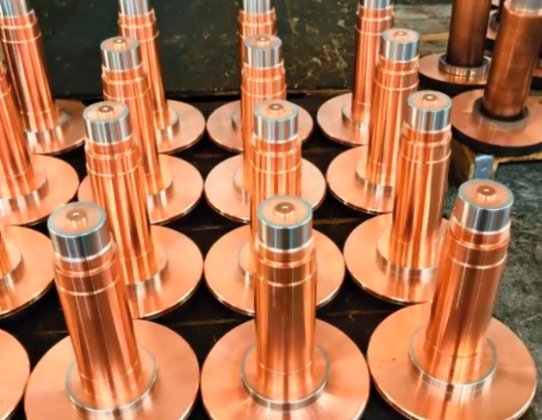
C18200 is a precipitation-hardenable chromium copper alloy valued for combining high electrical conductivity with higher strength, wear resistance and softening resistance than pure copper. It is widely known as UNS C18200 chromium copper, RWMA Class 2 copper, Class 2 electrode copper and, in many international specifications, CuCr1 or similar chromium copper designations.
For engineers, buyers and machine shops, C18200 is often selected when C11000 electrolytic tough pitch copper is too soft, but the part still needs efficient heat transfer, current carrying capacity and dimensional stability under moderate thermal load. Common uses include resistance welding electrodes, spot welding wheels, EDM electrodes, injection mold components, electrical contacts, current-carrying shafts, heat sinks and custom CNC-machined conductive hardware.
What Is C18200 Chromium Copper?
C18200 is a copper-chromium alloy containing a small addition of chromium, typically about 0.6% to 1.2%, with copper as the balance. The chromium addition allows the alloy to be solution heat treated and aged, forming fine chromium-rich precipitates that strengthen the copper matrix while retaining much of copper’s natural conductivity.
In practical terms, C18200 occupies a useful middle ground: it is stronger and more wear resistant than commercially pure copper, while remaining far more conductive than many high-strength copper alloys. This balance makes it a preferred material for conductive tooling and parts that are exposed to friction, pressure, heat or repeated electrical cycling.
The alloy is frequently associated with resistance welding standards because it provides the combination needed for electrode life: thermal conductivity to remove heat, electrical conductivity to carry current, and enough hardness to resist mushrooming, deformation and pickup.
C18200 Chemical Composition and Equivalent Designations
The nominal composition of C18200 is copper with chromium as the primary alloying element. Exact limits vary by product form and governing standard, so the purchase specification should always control the final acceptance criteria.
| Element or Designation | Typical Information |
|---|---|
| Copper | Balance, often including silver where permitted by specification |
| Chromium | Commonly about 0.6% to 1.2% |
| Other elements | Controlled residuals such as iron, silicon, lead and total impurities depending on standard |
| UNS designation | C18200 |
| Common name | Chromium copper |
| RWMA classification | Class 2 copper alloy |
| Related international name | CuCr1 / chromium copper family, depending on regional standard |
Commonly referenced standards and specifications may include ASTM product standards for copper-chromium rod, bar, plate, sheet, strip or forged forms, RWMA resistance welding material classifications, and aerospace or customer-specific specifications such as AMS-type requirements. Because limits and testing requirements can change, buyers should verify the latest revision and the exact mill certificate requirements before placing an order.
Key Physical, Mechanical and Electrical Properties
The performance of C18200 depends strongly on temper, product form, heat treatment history and section size. A precipitation-hardened bar will not show the same hardness or elongation as annealed sheet. However, the following property ranges are commonly used for preliminary engineering evaluation.
| Property | Typical Range or Value | Engineering Relevance |
|---|---|---|
| Density | Approximately 8.89 g/cm³ | Useful for weight estimates and cost-per-part calculations |
| Electrical conductivity | Often about 75% to 85% IACS, depending on temper | Supports high-current electrical parts and resistance welding electrodes |
| Thermal conductivity | Often around 300 to 340 W/m·K | Improves heat removal in electrodes, molds and heat-transfer parts |
| Elastic modulus | Approximately 115 to 130 GPa | Important for deflection and contact-pressure calculations |
| Tensile strength | Commonly about 350 to 550 MPa in hardened tempers | Higher load capacity than pure copper |
| Hardness | Often roughly 70 to 95 HRB, depending on processing | Indicates resistance to wear, indentation and electrode deformation |
| Softening resistance | Better than C11000 and many unalloyed coppers | Helps maintain hardness during elevated-temperature service |
The most important performance advantage is the combination of conductivity and strength. Pure copper may provide higher conductivity, but it can deform quickly under pressure. Many stronger copper alloys have lower conductivity. C18200 balances conductivity, hardness and heat resistance for parts that must carry current while also maintaining geometry.
Heat Treatment, Tempers and Form Availability
C18200 is strengthened by solution treatment followed by aging. During solution treatment, chromium is dissolved into the copper matrix. During aging, fine chromium-rich particles precipitate, increasing strength and hardness while preserving useful conductivity.
Typical supplied forms include round bar, flat bar, plate, sheet, strip, rod, billet, forged blocks, custom cut blanks and near-net-shape components. Available tempers may include annealed, cold-worked, solution-treated, aged or hard-drawn conditions depending on mill capability and product standard.
When specifying C18200, it is not enough to state only the alloy number. The order should define the material form, dimensions, temper, hardness or tensile requirement, conductivity requirement, inspection standard and certification level. For resistance welding electrodes, conductivity and hardness are often more important than tensile strength alone.
Engineer and buyer note: what to confirm before ordering C18200
Confirm whether the part needs maximum conductivity, maximum hardness, or a balanced condition. For example, a welding electrode may require RWMA Class 2 compliance, while a CNC-machined current-carrying component may require a specific conductivity range, flatness, surface finish and stress condition.
- Ask for the applicable standard and revision on the material certificate.
- Specify temper, hardness and conductivity where performance is critical.
- Check whether the supplier can provide ultrasonic testing, chemical analysis or mechanical test reports if required.
- For machined parts, define grain direction, blank allowance and post-machining inspection needs.
CNC Machining C18200 Chromium Copper
C18200 can be CNC machined into accurate, conductive parts, but it behaves differently from free-machining brass, aluminum or steel. Its high thermal conductivity removes heat quickly from the cutting zone, while its ductile copper matrix can produce stringy chips if tools, speeds and feeds are not optimized.
Compared with pure copper, C18200 is usually easier to hold dimensionally because its higher hardness reduces smearing and burr formation. Compared with brass, it generally requires more attention to tool sharpness, chip control and workholding. Sharp carbide tools with positive rake geometry are commonly preferred for turning, milling, drilling and boring.
CNC Turning
For CNC turning C18200 bar, use rigid setups, sharp inserts and polished chipbreaker geometries intended for nonferrous metals. Positive rake angles reduce cutting pressure and help prevent built-up edge. Flood coolant or a suitable mist system can improve chip evacuation and surface finish, particularly in deep grooves and small-diameter work.
CNC Milling
During milling, two-flute or three-flute carbide end mills designed for copper alloys often provide good chip clearance. High helix geometry can help reduce burrs on thin walls and edges. Climb milling is generally preferred when the machine and workholding are rigid. For electrode plates and heat-transfer blocks, flatness control may require balanced roughing, stress-relief planning and finish passes after the part has thermally stabilized.
Drilling, Tapping and Threading
Drilling C18200 requires attention to chip packing, especially in deep holes. Peck drilling, through-tool coolant and polished drills can improve reliability. Tapping should use high-lubricity cutting fluid and proper tap geometry for ductile copper alloys. Thread milling may be preferable for expensive parts, fine threads or blind holes where broken taps are unacceptable.
EDM and Electrode Manufacturing
C18200 is often used for electrical discharge machining electrodes when higher wear resistance is desired than pure copper can provide. Its thermal and electrical conductivity support stable discharge performance, while its higher strength improves edge retention in certain EDM applications. For very fine detail, machinability, burr control and polishing response should be validated with a prototype electrode.
CNC shop note: practical machining controls for C18200
Use sharp tools, high rigidity and conservative engagement during the first process trial. Monitor burrs, built-up edge, wall movement and surface finish rather than judging the process only by spindle load.
- Use polished carbide tooling for nonferrous alloys.
- Avoid dull tools; they can smear copper and increase burr formation.
- Use coolant or lubricant to improve surface finish and thread quality.
- Deburr carefully because functional electrical-contact surfaces may be sensitive to raised edges.
- For precision parts, consider rough machining, resting or stress relieving, then final machining.
Applications of C18200 Chromium Copper
C18200 is chosen where electrical conductivity, heat transfer and mechanical durability must work together. It is especially common in production environments where downtime, electrode wear or thermal distortion has a direct cost impact.
- Resistance welding electrodes: spot welding tips, seam welding wheels, projection welding components and electrode holders.
- Electrical components: current-carrying contacts, busbar-related hardware, switchgear components and conductive connectors.
- Mold and tooling components: mold inserts, cores, heat-transfer blocks and wear-resistant conductive tooling.
- EDM electrodes: electrodes requiring better wear resistance than pure copper while retaining good conductivity.
- Industrial machinery: shafts, bushings, conductive rollers and fixtures exposed to pressure and heat.
- Aerospace and defense hardware: specialized conductive components where certified material and stable properties are required.
In resistance welding, the alloy’s role is especially clear. The electrode must conduct current to the workpiece, remove heat from the weld zone and resist deformation under repeated force. C18200 is often more durable than unalloyed copper in this environment, which can reduce electrode dressing frequency and improve process consistency.
C18200 vs C11000, C18150 and Beryllium Copper
Material selection often comes down to trade-offs. C18200 is not the highest-conductivity copper, nor is it the highest-strength copper alloy. Its value lies in its balanced performance and broad availability.
| Material | Main Advantage | Typical Limitation | When to Consider It |
|---|---|---|---|
| C11000 ETP copper | Very high electrical and thermal conductivity | Low strength and poor wear resistance | Busbars, simple conductive parts and heat-transfer parts with low mechanical stress |
| C18200 chromium copper | Balanced conductivity, strength and electrode life | Lower conductivity than pure copper | Resistance welding electrodes, EDM electrodes, conductive tooling and CNC-machined copper components |
| C18150 chromium zirconium copper | Often better softening resistance at elevated temperature | May cost more or require tighter supply planning | High-duty welding electrodes, continuous thermal cycling and demanding tooling |
| Beryllium copper alloys | Very high strength and fatigue resistance | Lower conductivity than C18200 in many grades and stricter health/safety controls during processing | Springs, high-strength contacts and wear parts where strength is more critical than conductivity |
If maximum current carrying capacity is the only design goal, C11000 may be more suitable. If the part must resist heat, wear and deformation while still conducting electricity efficiently, C18200 is often a practical upgrade from pure copper. If service temperature is more severe, C18150 or another chromium-zirconium copper may be evaluated.
Corrosion Resistance, Joining and Surface Finishing
C18200 has corrosion behavior broadly similar to many copper alloys in normal indoor, industrial and mildly atmospheric environments. It forms a natural oxide film and can develop discoloration or patina over time. For electrical contact surfaces, oxidation, contamination and surface roughness should be controlled because they can affect contact resistance.
The alloy can be polished, plated or coated when surface performance requires it. Nickel, silver, tin or other finishes may be used depending on conductivity, wear, solderability, corrosion protection and contact requirements. Surface preparation is important because residual cutting fluid, oxide or embedded abrasive can reduce plating quality.
Joining processes require care. Brazing or soldering may be possible depending on flux, filler metal and joint design, but high heat exposure can reduce hardness by overaging or softening the material. Welding can also alter the heat-treated condition. Critical components should be qualified with mechanical, conductivity and hardness testing after the complete joining cycle.
How to Specify C18200 for Manufacturing and Procurement
A strong C18200 specification reduces disputes between design, purchasing, machining and quality teams. The most common sourcing problems occur when a drawing lists “C18200” but does not define temper, conductivity, hardness, inspection level or surface requirements.
A practical purchase description may include alloy designation, governing standard, product form, dimensions, temper, hardness range, minimum conductivity, certification requirement and any special machining allowance. For example, a resistance welding component may require C18200 Class 2 chromium copper with certified hardness and conductivity, while a CNC-machined electrical connector may require tight dimensional tolerances and a defined surface finish.
Buyer checklist for C18200 parts and raw material
- Confirm whether the supplier is quoting C18200 chromium copper, not a generic copper alloy substitute.
- Request mill test certificates showing chemical composition and applicable mechanical or conductivity results.
- Define whether bars, plates or forgings must be supplied in aged, hard, annealed or stress-relieved condition.
- For CNC-machined parts, clarify tolerances, surface finish, deburring, inspection method and packaging against oxidation or damage.
- For welding electrodes, confirm RWMA Class 2 suitability and electrode-life expectations in the actual production environment.
Quality Control and Testing Considerations
Quality verification for C18200 may include chemical analysis, conductivity testing, hardness testing, tensile testing, dimensional inspection, ultrasonic testing for larger sections, and visual inspection for cracks, laps or surface defects. Conductivity is commonly reported as percent IACS, while hardness may be reported on Rockwell, Brinell or Vickers scales depending on product form and customer requirement.
For parts used in electrical or welding applications, dimensional inspection alone is not enough. A part can meet size requirements but fail in service if the material condition is too soft, conductivity is too low or the surface finish causes unstable contact. Conductivity and hardness should be treated as functional properties for many C18200 applications.
Traceability is also important. Heat number, lot number, certificate data and inspection records help link a finished component back to raw material. This is particularly valuable for aerospace, automotive, energy, defense and high-volume welding operations where repeatability matters.
Summary: When C18200 Is the Right Copper Alloy
C18200 chromium copper is a proven engineering material for conductive parts that need more strength, wear resistance and thermal stability than pure copper can provide. Its combination of electrical conductivity, thermal conductivity, hardness and precipitation-hardened strength makes it especially useful for resistance welding electrodes, EDM electrodes, conductive tooling, mold components and precision CNC-machined copper parts.
The best results come from specifying the alloy completely: C18200 or UNS C18200, the required standard, product form, temper, hardness, conductivity, dimensions, inspection requirements and finishing needs. When those details are controlled, C18200 offers a reliable balance of manufacturability and performance for demanding electrical and thermal applications.