
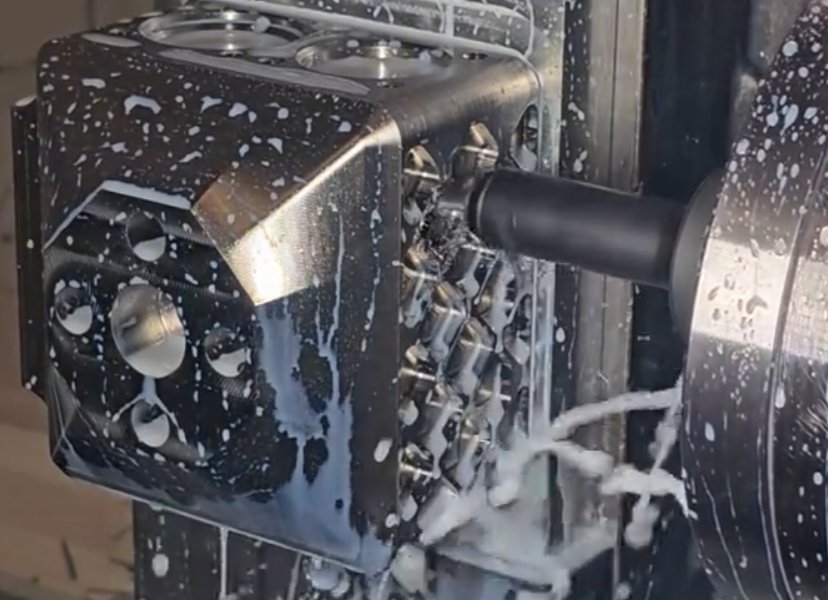
Titanium machining services in the USA serve critical industries including aerospace, medical devices, defense, and energy. Domestic shops offer AS9100D-certified precision CNC milling, turning, and grinding for Ti-6Al-4V, Ti-6Al-4V ELI, Grade 2, and Grade 5 titanium alloys. With rising demand for reshoring and ITAR-compliant manufacturing, U.S.-based titanium machining providers combine advanced multi-axis capabilities with strict quality systems to deliver complex geometries within ±0.001 inch tolerances.
What Are Titanium Machining Services?
Titanium machining services encompass the subtractive manufacturing of titanium alloys into precision components through processes such as CNC milling, CNC turning, 5-axis machining, wire EDM, and surface grinding. Unlike aluminum or steel, titanium presents unique challenges: low thermal conductivity (approximately 7 W/m·K for Ti-6Al-4V versus 270 W/m·K for CRS1018 steel), high chemical reactivity at elevated temperatures, and a tendency toward work hardening during cutting. These properties demand specialized tooling, optimized cutting parameters, and robust coolant systems.
Leading U.S. providers maintain capabilities across multiple titanium grades. Grade 2 (commercially pure) offers excellent corrosion resistance and is widely used in chemical processing and marine applications. Grade 5 (Ti-6Al-4V) dominates aerospace and medical markets due to its superior strength-to-weight ratio and biocompatibility. Ti-6Al-4V ELI (extra low interstitial) variants are preferred for surgical implants and orthopedic devices where ductility and fracture toughness are paramount.
Core Capabilities of U.S. Titanium Machining Shops
CNC Milling and 5-Axis Machining
American titanium machining facilities operate high-rigidity CNC mills with through-spindle coolant and high-pressure delivery systems. 5-axis simultaneous machining enables single-setup production of complex aerospace housings, impellers, and structural brackets, reducing cumulative tolerance stack-up and improving surface integrity. Typical spindle speeds for titanium range from 1,500 to 4,000 RPM with carbide or PCD tooling, significantly lower than aluminum to manage heat generation at the tool-workpiece interface.
CNC Turning and Swiss Machining
For cylindrical titanium components such as fasteners, valve bodies, and surgical screws, CNC turning centers with live tooling and sub-spindle capabilities provide efficient production. Swiss-type lathes excel at long, slender titanium medical components, maintaining tight concentricity and surface finishes down to Ra 0.4 µm through synchronized guide bushing support.
Wire EDM and Surface Grinding
Wire electrical discharge machining (EDM) offers non-contact material removal for intricate titanium geometries that would deflect under conventional cutting forces. Surface and cylindrical grinding achieve precise dimensional control for bearing surfaces and sealing interfaces, with tolerances held to ±0.0002 inch in production environments.
Post-Machining Treatments
U.S. shops frequently provide value-added finishing processes including passivation, anodizing, shot peening, and hot isostatic pressing (HIP). Passivation removes surface iron contamination and enhances corrosion resistance for medical implants. Shot peening induces compressive residual stresses that improve fatigue life for aerospace structural components subjected to cyclic loading.
Why Source Titanium Machining in the USA
Regulatory Compliance and Security
Domestic titanium machining eliminates the complexity of ITAR (International Traffic in Arms Regulations) and EAR (Export Administration Regulations) compliance for defense and aerospace components. U.S. facilities with AS9100D, ISO 13485, and NADCAP certifications provide auditable quality systems that satisfy prime contractor and FDA requirements. For medical device manufacturers, FDA-registered machining partners streamline 510(k) and PMA submission processes through established device history records (DHR) and material traceability protocols.
Supply Chain Resilience and Lead Time Control
Reshoring titanium production to U.S. shops reduces transit times from 4–8 weeks (offshore) to 1–3 weeks for standard production lots. Domestic sourcing mitigates risks associated with customs delays, tariff fluctuations, and geopolitical disruptions. Furthermore, U.S.-based shops can accommodate engineering change orders (ECOs) and prototype iterations with same-day or next-day turnaround, a critical advantage during product development cycles.
Technical Expertise and Process Control
American titanium machining specialists accumulate decades of application-specific knowledge in aerospace blisk manufacturing, orthopedic implant production, and subsea component fabrication. This expertise translates into optimized toolpaths, reduced scrap rates, and consistent metallurgical outcomes. Many facilities employ in-process inspection with CMM (coordinate measuring machines), laser scanning, and CT metrology to validate complex geometries against CAD models without removing parts from fixtures.
Challenges and Disadvantages of U.S. Titanium Machining
Higher Hourly Machine Rates
The most significant disadvantage of domestic titanium machining is cost. U.S. shop rates typically range from $85 to $180 per hour for 5-axis CNC work, compared to $25–$60 per hour at comparable facilities in Asia. For commodity-grade titanium fasteners or non-critical brackets, this cost differential can render offshore sourcing economically compelling despite longer lead times.
Limited Capacity for High-Volume Production
While U.S. shops excel at low-to-medium volume precision work (10–10,000 units annually), high-volume titanium component production (100,000+ units) often remains more cost-effective in regions with lower labor costs and dedicated high-volume titanium forging and machining ecosystems. Domestic capacity constraints during peak aerospace production cycles can also extend lead times beyond quoted windows.
Tooling Costs and Material Waste
Titanium's poor machinability accelerates tool wear, with carbide inserts requiring replacement every 15–45 minutes of cutting time depending on speed and depth of cut. Advanced coatings such as TiAlSiN can extend tool life by up to 40%, but the cumulative tooling expense remains substantial. Additionally, titanium chips and scrap require specialized recycling streams; while U.S. scrap yards do purchase titanium swarf, the buyback value rarely offsets the premium paid for virgin material.
Engineering Data: Cutting Parameters and Tool Wear
Research on titanium alloy machining provides quantitative guidance for process planning. In orthogonal cutting tests of Ti-6Al-4V, cutting temperatures at the tool-chip interface reach 670–800 °C at cutting speeds of 65 m/min, with cutting forces approaching 1,000 N. The low thermal conductivity of Ti-6Al-4V (approximately 7 W/m·K) concentrates heat at the cutting edge, promoting adhesive wear and coating delamination. By contrast, Ti-55531 (a near-β alloy) exhibits even higher microhardness (379 HV versus 317 HV for Ti-6Al-4V) and generates greater tool wear under identical parameters, with worn contact lengths extending approximately 33% further.
Optimal machining strategies for U.S. shops include:
- Cutting speeds: 20–65 m/min for roughing; 15–30 m/min for finishing
- Feed rates: 0.1–0.2 mm/rev for turning; adaptive feed control for milling
- Depth of cut: Shallower depths (0.10 mm) for improved surface finish and reduced tool wear
- Coolant: High-pressure through-spindle coolant at 70–150 bar to evacuate chips and reduce thermal damage
- Tool coatings: TiAlN or TiAlSiN PVD coatings for enhanced heat resistance and reduced adhesion
High-pressure coolant systems and minimum quantity lubrication (MQL) with nanolubricants have demonstrated reductions in cutting force of 6–10% and tool wear reduction of 4–30% compared to dry machining, offering viable paths to improved productivity and sustainability.
Industry Applications of U.S. Titanium Machining
Aerospace and Defense
Titanium accounts for approximately 10% of the structural weight in modern commercial aircraft and up to 35% in advanced military platforms. U.S. machining shops produce engine compressor blades, landing gear components, firewalls, and structural brackets that must withstand temperatures from −54 °C to 540 °C while maintaining fatigue resistance. The Boeing 787 and Airbus A350 programs each consume thousands of titanium machined components per airframe, with tolerances frequently specified to ±0.005 mm for critical interfaces.
Medical Devices and Implants
The U.S. medical device market represents one of the largest consumers of precision-machined titanium. Orthopedic implants (hip stems, acetabular cups, spinal cages) require biocompatible surfaces with controlled roughness (Ra 0.8–3.2 µm) to promote osseointegration. Dental implants and surgical instruments demand even finer surface finishes, achieved through precision grinding and electropolishing. FDA regulations mandate full material traceability and process validation, capabilities that AS9100D and ISO 13485-certified U.S. shops routinely provide.
Oil and Gas, Marine, and Energy
Subsea wellhead connectors, riser components, and desalination equipment utilize Grade 2 and Grade 5 titanium for seawater corrosion resistance. U.S. Gulf Coast machining shops serve offshore energy clients with NACE MR0175-compliant components capable of withstanding hydrogen sulfide exposure and high-cycle fatigue in deepwater environments.
How to Select a Titanium Machining Partner in the USA
Evaluating domestic titanium machining suppliers requires assessment across multiple dimensions:
- Certifications: Verify AS9100D for aerospace, ISO 13485 for medical, and ITAR registration for defense work. NADCAP accreditation for special processes (heat treat, welding, NDT) adds further credibility.
- Equipment: Confirm availability of 5-axis mills, through-spindle coolant, and in-process probing. Swiss lathes and wire EDM expand capability breadth.
- Material Handling: Ensure the shop maintains segregated titanium storage to prevent cross-contamination with ferrous materials, which can initiate galvanic corrosion.
- Quality Data: Request first article inspection (FAI) reports, statistical process control (SPC) charts, and material test reports (MTRs) with full chemical and mechanical certification.
- Prototype-to-Production Scalability: Choose partners capable of supporting design-for-manufacturing (DFM) feedback during prototyping and scaling to production volumes without process requalification.
Frequently Asked Questions About Titanium Machining Services in the USA
What is the typical lead time for titanium machining in the USA?
Standard lead times range from 2–4 weeks for production quantities, with prototype parts available in 3–7 days from shops with dedicated rapid-response cells. Complex 5-axis aerospace components may require 6–8 weeks including first article inspection and customer source inspection.
How much does titanium machining cost per hour in the USA?
Hourly rates vary by machine type and complexity: 3-axis CNC milling at $65–$95/hour, 5-axis machining at $120–$180/hour, and Swiss turning at $85–$140/hour. Material costs for Ti-6Al-4V bar stock typically run $35–$55 per pound, significantly higher than aluminum or stainless steel.
What surface finishes can U.S. titanium machining shops achieve?
As-machined surface finishes typically range from Ra 1.6–3.2 µm. With precision grinding and polishing, medical-grade finishes of Ra 0.2–0.4 µm are achievable. Electropolishing can further reduce surface roughness for implant applications.
Why is titanium more difficult to machine than steel or aluminum?
Titanium's low thermal conductivity traps heat at the cutting edge, accelerating tool wear. Its chemical reactivity causes adhesion to tool surfaces, and its low modulus of elasticity promotes chatter and deflection. These factors necessitate slower cutting speeds, rigid setups, and specialized tooling compared to more machinable metals.
Conclusion
Titanium machining services in the USA offer a compelling value proposition for industries where quality assurance, regulatory compliance, and supply chain security outweigh pure cost minimization. While hourly rates exceed offshore alternatives, domestic shops deliver AS9100D-certified precision, ITAR-compliant security, and responsive engineering support that reduces total program risk. For aerospace structural components, medical implants, and defense systems, the technical expertise and process control of U.S.-based titanium machining providers represent a strategic manufacturing advantage.