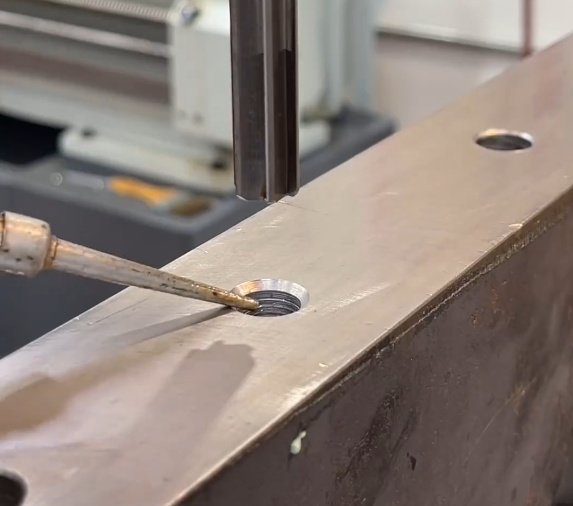
Metal drilling is one of the most common holemaking operations in fabrication, maintenance, mold making, automotive machining, aerospace manufacturing, construction equipment, and general engineering. The goal is simple: produce a round, accurate, burr-controlled hole in metal. In practice, drilling metal requires the correct drill bit geometry, cutting speed, feed rate, coolant strategy, machine rigidity, and inspection method.
This guide explains how metal drilling works, how to choose drilling tools, how to set speeds and feeds, and how engineers, machinists, and purchasing teams can reduce cost per hole while improving hole quality.
What Is Metal Drilling?
Metal drilling is a machining process that removes material by rotating a cutting tool into a metallic workpiece. The tool creates chips as its cutting lips shear the material. Unlike drilling wood or plastic, drilling metal generates higher heat, cutting forces, and tool wear. Because metals vary widely in hardness, ductility, thermal conductivity, and work-hardening behavior, drilling parameters must be matched to the workpiece material.
In production machining, the most important performance metric is often cost per acceptable hole, not simply the price of the drill bit. A more expensive carbide or coated drill may be the better choice if it increases tool life, reduces cycle time, or eliminates secondary deburring.
Common Metal Drilling Methods
Different drilling methods are used depending on hole diameter, depth-to-diameter ratio, tolerance, equipment, and production volume.
Manual Drilling
Manual drilling is common in repair work, steel fabrication, installation, and prototype shops. It may use hand drills, magnetic drills, bench drills, or radial drilling machines. Manual drilling is flexible, but hole accuracy depends heavily on operator skill, workholding, pilot holes, and tool condition.
CNC Drilling
CNC drilling uses machining centers, turning centers with live tooling, or dedicated drilling machines. It provides repeatability, programmed feed control, coolant delivery, and integration with tapping, reaming, boring, countersinking, or chamfering operations. CNC metal drilling is preferred for high-volume or tolerance-critical parts.
Deep Hole Drilling
Deep hole drilling usually refers to holes deeper than 5 to 10 times the drill diameter. Gun drilling, BTA drilling, and high-pressure through-coolant carbide drills are used when straightness, chip evacuation, and surface finish are critical.
Step Drilling and Pilot Drilling
Step drilling uses smaller drills before the final diameter tool, especially for large holes or low-power machines. Pilot drilling can reduce walking and improve location accuracy, but too many steps may increase cycle time and create tool alignment issues.
When is pilot drilling useful?
Pilot drilling is useful for large-diameter holes, hard materials, thin sheet metal, manual drilling, and holes that start on curved or angled surfaces. For high-performance CNC carbide drills, pilot drilling is not always recommended because modern self-centering drill geometries are designed to cut directly at full diameter under stable conditions.
Metal Drill Bit Types and When to Use Them
Selecting the right metal drilling bit depends on material, production volume, hole depth, tolerance, and machine capability.
| Drill Type | Best For | Key Advantage | Typical Limitation |
|---|---|---|---|
| HSS twist drill | Mild steel, aluminum, general repair | Low cost and easy resharpening | Lower heat resistance than cobalt or carbide |
| Cobalt drill | Stainless steel, alloy steel, harder metals | Better hot hardness and wear resistance | More brittle than standard HSS |
| Carbide drill | CNC drilling, cast iron, hardened materials, high-volume production | High speed, long life, excellent accuracy | Requires rigid setup and stable workholding |
| Indexable drill | Medium to large holes in production | Replaceable inserts reduce tool change cost | May not match solid carbide accuracy |
| Step drill | Sheet metal and thin plates | Multiple hole sizes with one tool | Not suitable for deep holes |
| Core drill / annular cutter | Structural steel, magnetic drilling, large through holes | Removes less material than a twist drill | Primarily for through holes |
For a buyer comparing metal drilling tools, the drill substrate and coating matter as much as nominal diameter. HSS is economical for low-volume work. Cobalt is a strong choice for stainless steel drilling and tough alloys. Solid carbide drills are usually preferred for CNC drilling where cycle time, hole consistency, and tool life justify the higher initial cost.
Drill Geometry, Coatings, and Material Compatibility
Drill geometry controls how the tool enters the workpiece, forms chips, reduces heat, and maintains hole location. Important terms include point angle, helix angle, web thickness, chisel edge, split point, margin width, flute form, and coolant hole design.
- 118-degree point angle: Common for general-purpose HSS drills and softer materials.
- 135-degree split point: Reduces walking and is widely used for steel and stainless steel.
- High-helix drills: Improve chip evacuation in aluminum and ductile materials.
- Parabolic flute drills: Useful for deeper holes because they provide more chip space.
- Through-coolant drills: Deliver coolant directly to the cutting zone, improving chip removal and tool life.
For stainless steel and nickel alloys, chip control and heat management are critical because these materials can work-harden if the drill rubs instead of cuts. A sharp cobalt or carbide drill, positive feed engagement, and suitable coolant can prevent rapid edge failure.
| Coating | Typical Use | Benefit |
|---|---|---|
| Black oxide | General-purpose HSS drilling | Improves lubricity and corrosion resistance |
| TiN | Steel, aluminum, general metal machining | Increases surface hardness and wear resistance |
| TiAlN / AlTiN | High-temperature drilling and alloy steels | Performs well under heat and higher speeds |
| DLC | Aluminum and non-ferrous metals | Reduces built-up edge and improves chip flow |
Should aluminum drilling use coated or uncoated tools?
Aluminum often drills well with polished, uncoated carbide or DLC-coated tools. The main issue is built-up edge, where aluminum sticks to the cutting lip. A sharp edge, polished flute, suitable lubricant, and high chip evacuation capacity are usually more important than maximum coating hardness.
Metal Drilling Speeds and Feeds
Cutting speed and feed rate determine productivity, heat generation, chip thickness, tool wear, and hole quality. Cutting speed is usually expressed as surface speed, such as meters per minute or surface feet per minute. Feed is expressed as millimeters per revolution or inches per revolution.
The basic spindle speed formula is:
RPM = (Cutting Speed × 1000) ÷ (π × Drill Diameter in mm)
For example, a 10 mm HSS drill in mild steel at 25 m/min:
RPM = (25 × 1000) ÷ (3.1416 × 10) ≈ 796 RPM
The following ranges are typical starting points. Final values should be adjusted for tool manufacturer data, machine rigidity, coolant pressure, hole depth, and required tolerance.
| Material | HSS Cutting Speed | Carbide Cutting Speed | Feed Guidance for 10 mm Drill |
|---|---|---|---|
| Low-carbon steel | 20-30 m/min | 70-120 m/min | 0.12-0.25 mm/rev |
| Stainless steel 304/316 | 10-18 m/min | 40-80 m/min | 0.08-0.18 mm/rev |
| Aluminum 6061 | 60-100 m/min | 150-300 m/min | 0.15-0.35 mm/rev |
| Cast iron | 18-30 m/min | 80-160 m/min | 0.10-0.25 mm/rev |
| Titanium alloys | 6-12 m/min | 25-60 m/min | 0.05-0.15 mm/rev |
A common drilling mistake is reducing feed too much when the tool begins to squeal. In stainless steel and some superalloys, low feed can cause rubbing, heat buildup, and work hardening. In many cases, the better correction is to use a sharper drill, improve coolant, increase rigidity, and maintain enough feed to form a proper chip.
Coolant, Lubrication, and Chip Evacuation
Heat and chips are the two biggest enemies of reliable metal drilling. Coolant reduces cutting temperature, lubricates the drill margins, and helps flush chips out of the hole. In deep holes, chip packing can break drills, enlarge holes, damage the surface finish, or overload the spindle.
- Flood coolant: Suitable for general CNC drilling and many steel applications.
- Through-tool coolant: Preferred for deep holes, carbide drilling, and high-volume production.
- Cutting oil: Effective for manual drilling, tapping, stainless steel, and tough alloys.
- MQL: Minimum quantity lubrication can reduce fluid consumption in selected applications.
- Dry drilling: Possible for some cast irons and coated carbide tools, but requires careful dust and heat management.
Chip shape provides immediate feedback. Short, consistent chips usually indicate stable cutting. Long stringy chips can wrap around the drill or workpiece. Blue chips may indicate excessive heat, although some coated carbide drilling operations naturally run hotter than HSS drilling.
When should peck drilling be used?
Peck drilling helps break chips and clear holes, especially with HSS drills or deep holes. However, excessive pecking can increase cycle time and may accelerate work hardening in stainless steel. For CNC production, high-performance through-coolant drills often use continuous feed or optimized micro-peck cycles instead of aggressive retract pecks.
Hole Quality: Tolerance, Burrs, Surface Finish, and Inspection
Metal drilling is often the first operation in a holemaking sequence. If the drilled hole must support a bearing, precision pin, threaded fastener, hydraulic passage, or press-fit component, drilling alone may not be enough. Reaming, boring, honing, countersinking, or chamfering may be required.
Important hole quality factors include:
- Diameter accuracy: A standard twist drill often produces a hole slightly larger than the drill diameter.
- Roundness: Poor tool balance, runout, or walking can create out-of-round holes.
- Straightness: Deep holes are vulnerable to drill drift.
- Surface roughness: Influenced by feed, tool sharpness, material, and coolant.
- Burr height: Critical for assembly, sealing surfaces, electrical contact, and safety.
- Hole location: Controlled by spotting, fixturing, machine accuracy, and tool geometry.
For tight-tolerance holes, drilling should be treated as a pre-machining operation. A typical process may drill undersize, then ream or bore to final size. This is especially important when specifying H7 holes, dowel pin holes, or precision alignment features.
| Problem | Likely Cause | Engineering Correction |
|---|---|---|
| Oversized hole | Runout, worn drill, poor point symmetry | Check spindle runout, replace drill, use spotting or carbide drill |
| Drill breakage | Chip packing, excessive feed, poor rigidity | Improve coolant, adjust peck cycle, reduce overhang |
| Burned cutting edge | High speed, low coolant, rubbing | Reduce speed, increase lubrication, verify feed per revolution |
| Heavy exit burr | Ductile material, high thrust, unsupported exit | Use backup support, optimize feed near breakthrough, add chamfering |
| Poor surface finish | Built-up edge, vibration, dull tool | Use sharper geometry, improve clamping, select suitable coating |
Production Example: Improving Stainless Steel Drilling Performance
A common engineering problem in stainless steel drilling is short tool life caused by heat and work hardening. In one representative production scenario, a shop drilling 12 mm through holes in 304 stainless steel plate experienced frequent drill edge chipping, inconsistent hole diameter, and heavy burrs at breakthrough.
The original process used a general-purpose HSS drill at low feed with repeated full retract pecks. The tool often rubbed during re-entry, and chips were not evacuated consistently. The revised process used a 135-degree cobalt split-point drill, reduced unnecessary retracts, applied sulfurized cutting oil, and increased feed enough to maintain chip formation.
| Metric | Before Optimization | After Optimization |
|---|---|---|
| Average holes per drill | 42 holes | 60 holes |
| Tool life improvement | Baseline | Approx. 43% |
| Average exit burr height | 0.32 mm | 0.18 mm |
| Operator intervention | Frequent chip clearing | Reduced chip clearing |
This example shows why metal drilling optimization should consider the complete system: drill material, point geometry, feed, coolant, chip evacuation, fixture support, and breakthrough control. Changing only RPM rarely solves a production drilling problem.
Design and Machining Considerations for Engineers
Engineers can reduce drilling cost during part design. A hole that appears simple on a drawing may be expensive if it is too deep, located too close to a wall, requires a flat-bottom feature, intersects another hole, or demands a tolerance tighter than drilling can reliably produce.
- Avoid unnecessarily deep blind holes when a through hole is acceptable.
- Provide enough clearance for drill length, chuck, collet, coolant nozzle, or spindle nose.
- Specify realistic tolerances based on function, not default title block limits.
- Use standard drill diameters when possible to reduce tooling cost and lead time.
- Add chamfers where assembly alignment or burr control matters.
- Consider reaming or boring for accurate diameter and roundness requirements.
- Avoid angled entry surfaces unless spot-facing or specialized tooling is planned.
A drilled hole tolerance should match the manufacturing process. If a drawing requires a precise sliding fit, the routing should identify drilling plus reaming or drilling plus boring rather than assuming a twist drill will meet final tolerance.
Can drilling achieve precision holes without reaming?
High-quality carbide drills in rigid CNC machines can produce consistent holes, but drilling alone is generally less accurate than reaming or boring. For precision pin fits, bearing fits, hydraulic sealing diameters, and gauge-critical holes, a finishing operation is usually recommended.
Procurement Checklist for Metal Drilling Tools and Services
Purchasing teams and project buyers should evaluate more than unit tool price. The best supplier or drilling solution should reduce scrap, machine downtime, secondary finishing, and tool change frequency.
- Workpiece material: Confirm alloy grade, hardness, heat treatment, and coating or scale condition.
- Hole requirements: Define diameter, depth, tolerance, surface finish, burr allowance, and position tolerance.
- Production volume: Low-volume maintenance drilling may justify HSS; high-volume CNC drilling may justify carbide.
- Machine capability: Check spindle speed, horsepower, coolant pressure, toolholding, and rigidity.
- Total cost: Compare tool life, cycle time, regrinding options, scrap risk, and inspection cost.
- Supplier support: Request cutting data, application engineering, coating recommendations, and troubleshooting support.
For outsourced machining, buyers should provide complete drawings, CAD files, material certificates if required, annual volume estimates, inspection requirements, and any assembly-critical features. This helps suppliers quote the correct drilling, reaming, tapping, or deburring process instead of quoting only the lowest apparent machining time.
Safety and Best Practices in Metal Drilling
Metal drilling involves rotating tools, sharp chips, heat, noise, coolant mist, and clamping forces. Safety controls should be part of every drilling operation, whether manual or CNC.
- Clamp the workpiece securely; never hold metal by hand during drilling.
- Wear eye protection and avoid loose clothing or gloves near rotating spindles.
- Use chip hooks or brushes instead of hands to remove sharp chips.
- Confirm correct drill speed before starting the cut.
- Reduce tool overhang to improve rigidity and lower breakage risk.
- Use proper coolant handling and filtration to control mist, odor, and tramp oil.
- Deburr holes that will be handled, assembled, sealed, or electrically connected.
Key Takeaways
Metal drilling is a fundamental machining process, but reliable results require more than choosing a drill diameter. Material behavior, drill geometry, coating, RPM, feed rate, coolant, chip evacuation, machine rigidity, and inspection requirements all affect hole quality and cost.
For general fabrication, HSS and cobalt drills remain practical and economical. For CNC production, carbide drills, through-coolant tooling, and optimized cutting data can significantly improve productivity. For precision holes, drilling should be planned as part of a complete holemaking process that may include reaming, boring, chamfering, or deburring.
By evaluating metal drilling from both the machining and purchasing perspectives, manufacturers can improve tool life, reduce scrap, control burrs, and achieve more consistent hole quality across materials such as steel, stainless steel, aluminum, cast iron, titanium, and high-strength alloys.