
C122 is a commercially important copper material known as phosphorus-deoxidized copper, high-residual phosphorus copper, or DHP copper. In international and North American specifications it is commonly identified as C122 copper, UNS C12200, Cu-DHP, or CW024A. The grade is widely used for plumbing tube, refrigeration and air-conditioning tube, heat exchangers, brazed assemblies, fabricated copper components, and formed sheet parts where reliable joining and resistance to hydrogen embrittlement are more important than maximum electrical conductivity.
For engineers, buyers, and manufacturers, C12200 is often selected because it combines high thermal conductivity, excellent formability, good corrosion resistance in many water and HVAC environments, and dependable weldability and brazability. It is not a free-machining copper alloy, so CNC machining requires the right tooling strategy, chip control, coolant, and fixturing.
What Is C122 Copper?
C122 copper is a wrought copper grade deoxidized with phosphorus. The addition of phosphorus reduces oxygen in the copper and improves performance during brazing, soldering, welding, and exposure to reducing atmospheres at elevated temperature. This characteristic helps prevent steam blistering and hydrogen-related cracking that can affect oxygen-bearing copper grades under certain heating conditions.
The material is classified as a high-copper alloy rather than a brass, bronze, or copper-nickel alloy. Its copper content is typically at least 99.9% copper plus silver, with a controlled phosphorus range. Because phosphorus slightly reduces conductivity, C12200 has lower electrical conductivity than oxygen-free copper C10100 or electrolytic tough pitch copper C11000, but it offers better behavior in many heated fabrication and joining processes.
C12200 Chemical Composition and Common Standards
The exact composition limits must be verified against the product form and governing standard, but C12200 is generally defined by very high copper purity and a phosphorus addition. The grade is often specified by UNS number, ASTM product standard, temper, dimensional tolerance, and mill test certification.
| Element | Typical requirement | Engineering relevance |
|---|---|---|
| Copper plus silver | 99.9% minimum | Provides high thermal conductivity, corrosion resistance, and ductility. |
| Phosphorus | Approximately 0.015% to 0.040% | Deoxidizes the copper and improves performance in brazing and reducing atmospheres. |
| Oxygen | Very low residual level | Supports resistance to hydrogen embrittlement during thermal processing. |
Common product standards for C122 copper
- ASTM B88: seamless copper water tube.
- ASTM B280: seamless copper tube for air conditioning and refrigeration field service.
- ASTM B819: seamless copper tube for medical gas systems.
- ASTM B75: seamless copper tube for general engineering applications.
- ASTM B152: copper sheet, strip, plate, and rolled bar.
- ASTM B306: copper drainage tube.
- EN CW024A / Cu-DHP: European designation commonly associated with DHP copper.
Engineer note: how to avoid specification ambiguity
Do not specify C122 only by name when ordering production material. A complete specification should include the UNS number, product form, ASTM or EN standard, temper, dimensions, tolerances, surface condition, certification level, and any special requirements such as grain size, cleanliness for refrigeration service, or compatibility with brazing procedures.
Key Physical and Mechanical Properties of C122 Copper
C12200 is valued for a practical balance of thermal performance, ductility, and fabrication reliability. Mechanical values vary significantly by product form and temper, especially between annealed tube, hard-drawn tube, cold-rolled strip, and machined bar. The following values are typical engineering ranges and should not replace certified material data for design-critical applications.
| Property | Typical value or range | Notes |
|---|---|---|
| Density | 8.94 g/cm³ | Similar to other high-copper grades. |
| Melting point | About 1083°C | Close to pure copper. |
| Thermal conductivity | Approximately 330 to 350 W/m·K | Excellent for heat transfer, HVAC, and thermal components. |
| Electrical conductivity | Often around 75% to 85% IACS | Lower than C101 and C110 because of phosphorus content. |
| Elastic modulus | Approximately 110 to 130 GPa | Used for stiffness and deflection estimates. |
| Coefficient of thermal expansion | About 16.9 µm/m·K | Important for brazed assemblies and thermal cycling. |
| Tensile strength | Roughly 200 to 360+ MPa depending on temper | Annealed material is more ductile; cold-worked material is stronger. |
| Elongation | Often 10% to 45% depending on temper | Higher elongation supports bending, flaring, and forming. |
The most important design point is that C122 copper is not a single-strength material. Temper has a major effect on tensile strength, hardness, bendability, and springback. Annealed C122 tube is excellent for field bending and flaring, while hard-drawn tube or cold-rolled sheet may be selected when dimensional stability and higher strength are required.
Corrosion Resistance and Service Performance
C12200 copper provides good resistance to atmospheric corrosion, many potable water environments, HVAC condensate, and compatible heat-transfer fluids. Its natural oxide film contributes to long service life in properly designed systems. The material is also widely accepted in plumbing and refrigeration applications because it can be joined reliably and manufactured into clean, seamless tube.
Like all copper materials, C122 is not universally corrosion-proof. Water chemistry, velocity, dissolved gases, temperature, microbial activity, flux residues, galvanic couples, and installation practices can strongly influence service life. In aggressive waters, high-velocity flow, ammonia-containing environments, or systems with improper dissimilar-metal contact, copper corrosion can accelerate.
Important service considerations
- Maintain proper flow velocity to reduce erosion-corrosion risk in tube systems.
- Remove flux residues after soldering or brazing where applicable.
- Avoid unfavorable galvanic contact with more active metals unless the system is designed for it.
- Evaluate water chemistry, pH, chlorides, sulfides, and ammonia exposure for critical applications.
- Use clean, capped, dehydrated tube for refrigeration and medical gas systems when required by standard.
Buyer and quality note: why clean tube matters
For refrigeration, air-conditioning, oxygen, and medical gas service, internal cleanliness can be as important as alloy selection. Buyers should confirm the applicable standard, cleaning requirement, capping method, residual oil limit, and packaging condition. A low-cost tube that lacks cleanliness documentation may create system contamination risk.
Fabrication, Forming, Joining, and Heat Treatment
C122 copper has excellent cold workability and can be bent, expanded, flared, swaged, deep drawn, stamped, and spun depending on product form and temper. It is also well suited to soldering and brazing, which is one reason the grade is heavily used for tube assemblies and heat-transfer systems.
The phosphorus-deoxidized structure of UNS C12200 makes the material more suitable than oxygen-bearing C110 copper for many high-temperature joining operations in reducing atmospheres. This advantage is especially relevant in brazed manifolds, refrigeration lines, heat exchangers, and fabricated thermal components.
Joining methods commonly used with C122
- Soldering for lower-temperature plumbing and light-duty assemblies.
- Brazing for HVAC, refrigeration, heat exchanger, and pressure-related tube assemblies.
- Gas tungsten arc welding and resistance welding where procedure qualification supports the application.
- Mechanical joining, flaring, compression fittings, and press fittings depending on tube specification.
Annealing can restore ductility after cold work. However, heat treatment should be controlled to avoid oxidation, grain growth, dimensional distortion, or surface contamination. For pressure systems and regulated applications, fabrication procedures should follow the relevant codes, standards, and qualified joining practices.
CNC Machining C122 Copper
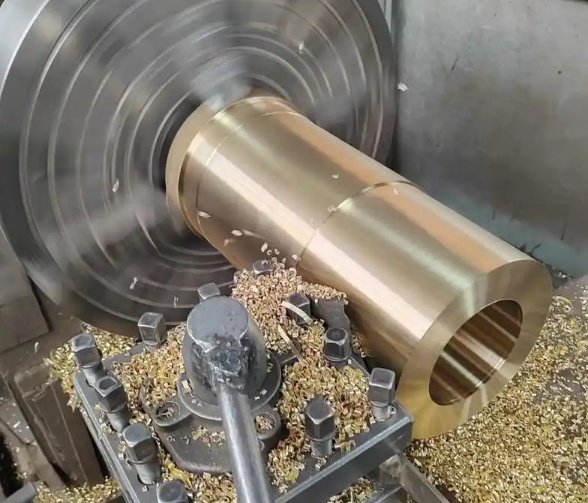
CNC machining C122 copper is possible, but it is more demanding than machining free-cutting brass, bronze, or leaded copper alloys. C122 is ductile and tends to form continuous, stringy chips. Built-up edge, burr formation, tool rubbing, and poor chip evacuation are common if the process is not optimized.
In many machinability rating systems, pure and high-copper grades such as C12200 are rated much lower than free-cutting brass C36000. This does not mean C122 cannot be machined; it means the process should prioritize sharp cutting edges, stable fixturing, lubrication, and chip control.
CNC milling recommendations
- Use polished, sharp carbide end mills, high-positive rake geometry, or tools designed for non-ferrous metals.
- Prefer climb milling when the machine, workholding, and part geometry allow it.
- Use sufficient feed to cut instead of rub, while avoiding excessive tool pressure on thin sections.
- Apply flood coolant, mist lubrication, or high-lubricity cutting fluid to reduce built-up edge.
- Use chip breakers, optimized flute count, and air blast or coolant direction to prevent recutting chips.
CNC turning and drilling recommendations
- Use positive-rake inserts with sharp edges and smooth chip-flow surfaces.
- Consider PCD tooling for high-volume production or tight surface-finish requirements.
- For drilling, use sharp drills with good flute polishing and frequent chip evacuation.
- For tapping, use high-lubricity fluid; form taps may work well when material thickness and thread requirements allow.
- Expect burrs at hole exits, milled edges, and thin-wall features; plan deburring into the process route.
The best machining results usually come from sharp tools, positive rake geometry, and controlled chip evacuation. Thin-wall C122 tube and soft annealed sheet require extra attention to workholding because copper can deform under excessive clamping pressure. For precision parts, engineers should specify realistic flatness, concentricity, and surface-finish requirements based on the starting form and temper.
Machining process note for estimators and manufacturing engineers
C122 copper should not be costed like aluminum or free-machining brass. Cycle time may be affected by chip control, deburring, tool maintenance, and workholding. When quoting CNC-machined C122 parts, review material temper, part stiffness, edge-break requirements, thread quality, coolant compatibility, and whether the part will be brazed, cleaned, or pressure tested after machining.
Applications of C122 Copper by Industry
C12200 is used wherever thermal performance, corrosion resistance, and fabrication reliability are needed. It is especially common in tube products, but it is also available as sheet, strip, plate, bar, and custom fabricated components.
Plumbing and building systems
C122 copper tube is widely used in potable water, heating, drainage, and building service systems when specified under the appropriate standard. Its bendability, solderability, and long field history make it a common choice for residential, commercial, and industrial installations.
HVAC and refrigeration
Air-conditioning and refrigeration tube often uses C12200 because the grade is compatible with brazed joints, flaring, coil forming, and clean tube manufacturing. Dehydrated and capped tube is commonly specified to protect internal cleanliness before installation.
Heat exchangers and thermal systems
Because of its high thermal conductivity, C122 is used in heat exchanger tubes, solar thermal collectors, heat pipes, thermal plates, and fabricated cooling components. It is not the highest-conductivity copper grade, but its joining behavior often makes it more practical for brazed assemblies.
Electrical and electronic components
C122 can be used for some conductive and thermal components, but it is generally not the first choice for maximum electrical conductivity. For high-current bus bars, transformer conductors, and electrical contacts, C10100 or C11000 may be more suitable unless brazability or deoxidized copper performance is the primary requirement.
C122 Copper vs C101, C110, C120, and Brass
Material selection often comes down to whether the application prioritizes electrical conductivity, thermal transfer, brazing performance, formability, corrosion resistance, or machinability. C12200 is not always the cheapest or easiest alloy to machine, but it offers a valuable balance for tube, thermal, and joined assemblies.
| Material | Key characteristic | When it may be preferred |
|---|---|---|
| C10100 oxygen-free copper | Very high electrical conductivity and very low oxygen | High-conductivity electrical and vacuum applications. |
| C11000 ETP copper | High conductivity, oxygen-bearing copper | Electrical conductors, bus bars, and general conductive parts where reducing-atmosphere heating is not a concern. |
| C12000 DLP copper | Low-phosphorus deoxidized copper | Applications needing better conductivity than C122 with some deoxidized copper benefits. |
| C12200 DHP copper | Higher phosphorus deoxidized copper with excellent brazing behavior | Plumbing, HVAC, refrigeration, heat exchangers, and formed or brazed assemblies. |
| C36000 free-cutting brass | Excellent machinability, lower copper content | High-volume CNC turned parts where machinability is more important than pure copper thermal performance. |
In practical terms, C122 is usually chosen for performance, fabrication reliability, and code acceptance rather than for the lowest machining cost. If the part is primarily a CNC-machined fitting with no need for high thermal conductivity or deoxidized copper behavior, a brass or machinable bronze may reduce cost. If the part must be brazed, bent, heat-cycled, or used in copper tube systems, C12200 may be the more appropriate engineering choice.
How to Specify and Source C122 Copper
A strong purchase specification reduces the risk of receiving material that is chemically correct but unsuitable for the intended process. C12200 material should be ordered with the correct standard, product form, temper, dimensional tolerance, surface condition, and certification package.
Information to include on a C122 copper purchase order
- Material designation: C12200, Cu-DHP, or CW024A as applicable.
- Product form: tube, pipe, sheet, strip, plate, bar, coil, or custom machined blank.
- Applicable standard: ASTM B88, ASTM B280, ASTM B75, ASTM B152, EN standard, or project specification.
- Temper: annealed, hard-drawn, cold-worked, or other specified temper.
- Dimensions and tolerances: outside diameter, wall thickness, width, thickness, length, straightness, or flatness.
- Surface and cleanliness requirements: bright finish, mill finish, degreased, capped, dehydrated, or cleaned for service.
- Certification: chemical composition, mechanical properties, traceability, and mill test report (MTR) requirements.
- Compliance requirements: RoHS, REACH, pressure system requirements, medical gas requirements, or project-specific documentation.
Procurement note: questions buyers should resolve before ordering
- Will the material be bent, flared, brazed, welded, CNC machined, or pressure tested?
- Is annealed ductility more important than strength and dimensional stability?
- Does the application require internal cleanliness, capped tube, or dehydration?
- Is electrical conductivity a design requirement or only a secondary benefit?
- Are there project standards that require a specific ASTM, EN, or customer-controlled specification?
Limitations and Design Considerations
C122 copper is versatile, but it should be selected with an understanding of its limitations. It has lower electrical conductivity than high-conductivity copper grades, lower machinability than free-cutting brass, and lower strength than many copper alloys, bronzes, steels, and stainless steels. Its excellent ductility can also create springback and burr-control challenges in forming and machining.
Designers should evaluate wall thickness, unsupported spans, vibration, fatigue, pressure rating, fluid chemistry, joining method, and post-fabrication cleaning. For assemblies that combine C122 with stainless steel, aluminum, carbon steel, or plated components, galvanic compatibility and environmental exposure should be reviewed.
When the application involves bending, brazing, refrigeration tubing, plumbing tube, or heat-transfer components, C12200 is often one of the most practical copper materials available. When maximum electrical conductivity or high-speed CNC machinability is the main objective, another copper grade or copper alloy may provide better overall value.
Summary: Why C12200 Remains a Widely Specified Copper Material
C122 copper, or UNS C12200 DHP copper, remains a standard engineering material because it solves a specific set of manufacturing and service problems. It offers high copper purity, strong thermal conductivity, excellent formability, dependable brazing and soldering behavior, and good resistance to hydrogen embrittlement in suitable thermal processes.
For procurement teams, the key is to order the correct product standard, temper, cleanliness level, and documentation. For engineers, the key is to match the grade to the actual service environment and fabrication route. For CNC shops, the key is to treat C122 as a ductile, high-copper material that needs sharp tooling, lubrication, chip control, and realistic deburring allowances.