
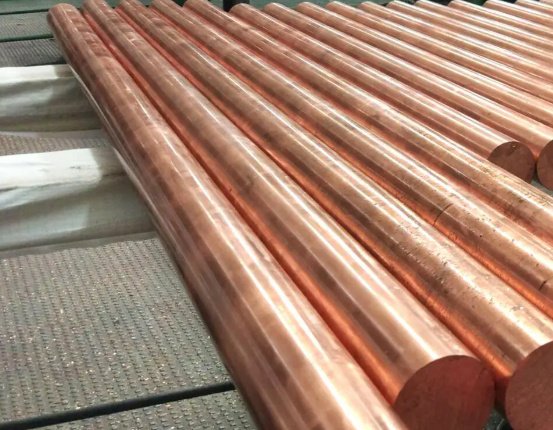
C101 copper, also known as UNS C10100 or oxygen-free electronic copper, is a high-purity copper grade used where electrical conductivity, thermal conductivity, cleanliness, and resistance to hydrogen embrittlement are critical. It is commonly specified for precision electrical components, vacuum systems, RF devices, semiconductor tooling, busbars, heat-transfer parts, and CNC-machined copper components that must perform reliably in demanding environments.
For engineers, purchasing teams, and manufacturers, C101 is not simply “pure copper.” It is a premium oxygen-free copper grade with tightly controlled chemistry and very low residual impurities. That makes it different from standard electrolytic tough pitch copper such as C110, especially in vacuum, high-conductivity, brazing, welding, and electronic applications.
What Is C101 Copper?
C101 copper is a high-purity copper alloy designation under the Unified Numbering System, commonly written as UNS C10100. It is often referred to as oxygen-free electronic copper because it is produced to extremely low oxygen levels and high copper purity for electronic and high-performance industrial use.
In practical engineering terms, C101 is chosen when a component requires:
- Very high electrical conductivity, typically around 100% IACS or higher depending on product form and temper.
- Excellent thermal conductivity for heat spreading and thermal management.
- Low oxygen content for improved performance in reducing atmospheres and vacuum systems.
- Good formability, ductility, brazability, and solderability.
- Material cleanliness and traceability for critical components.
C101 is part of the oxygen-free copper family, which also includes grades such as C10200. Compared with common commercial copper grades, C101 is usually specified when the application justifies tighter purity control and more demanding material documentation.
C101 Copper Standards, Names and Chemical Composition
C101 may be referenced by several names depending on region, standard, or supplier documentation. Common identifiers include UNS C10100, CDA 101, oxygen-free electronic copper, OFE copper, and high-conductivity oxygen-free copper. In European contexts, related oxygen-free high-conductivity copper grades may be compared with Cu-OFE or CW009A, although direct substitution should always be verified against the project specification.
Typical C101 copper chemistry is dominated by copper content with extremely low oxygen and residual elements. Published limits may vary by standard, product form, and mill certification, so procurement should rely on the applicable material specification and mill test report rather than a generic datasheet.
| Item | Typical Description |
|---|---|
| UNS designation | C10100 |
| Common name | Oxygen-free electronic copper, OFE copper, CDA 101 |
| Copper purity | Commonly specified as approximately 99.99% copper minimum, depending on standard |
| Oxygen level | Very low, typically far below electrolytic tough pitch copper |
| Key standards often encountered | ASTM, SAE, AMS, CDA, and customer-specific specifications depending on product form |
| Common forms | Bar, rod, plate, sheet, strip, tube, wire, billet, and custom machined parts |
Common ASTM specifications associated with copper products may include standards for plate, sheet, strip, bar, rod, and wire. The exact standard depends on the purchased form. For example, plate and sheet requirements are not the same as rod or wire requirements, and temper designations can significantly affect mechanical properties.
Engineer’s specification note
When specifying C101, include the UNS number, product form, applicable ASTM or customer standard, temper, dimensional tolerance, conductivity requirement, surface condition, grain-size requirement if relevant, and documentation requirements such as mill test reports or full heat traceability.
Key Physical and Mechanical Properties of C101 Copper
The main reason engineers choose C101 is the combination of high electrical conductivity with very low oxygen content. Its mechanical strength is moderate compared with copper alloys such as beryllium copper, bronze, or brass, but its conductivity and purity are significantly higher than most copper alloys.
| Property | Typical Value or Range |
|---|---|
| Density | Approximately 8.94 g/cm³ |
| Electrical conductivity | Typically around 100% IACS or higher, depending on condition |
| Thermal conductivity | Approximately 390 W/m·K at room temperature |
| Melting point | Approximately 1083°C |
| Coefficient of thermal expansion | Approximately 16.5 to 17.0 µm/m·K |
| Elastic modulus | Approximately 110 to 120 GPa |
| Annealed tensile strength | Often around 200 to 240 MPa, depending on product form |
| Hard-drawn tensile strength | Can be substantially higher, depending on cold work and temper |
These values are typical references, not guaranteed design limits. Final acceptance should be based on the governing specification, supplier certificate, and tested lot data.
C101 Copper vs C110 Copper, C102 Copper and Other Copper Grades
One of the most common search and sourcing questions is whether C101 is interchangeable with C110 or C102. The short answer is: sometimes for simple conductive parts, but not always for critical, vacuum, brazed, welded, or high-purity applications.
C110 copper, also called electrolytic tough pitch copper or ETP copper, is widely used because it is economical, available, conductive, and easy to source. However, it contains oxygen intentionally retained from processing. That oxygen can be undesirable in reducing atmospheres because it may contribute to hydrogen embrittlement or steam-related internal defects under certain conditions.
C102 copper is also an oxygen-free copper grade and is often used where high conductivity and low oxygen are required. C101 generally represents a higher-purity electronic grade and is often selected for stricter impurity control. In procurement terms, C101 is usually selected for purity and conductivity, not for low cost.
| Grade | Common Name | Primary Advantage | Typical Use Case |
|---|---|---|---|
| C10100 | OFE copper | Highest purity and very low oxygen | Vacuum, electronics, RF, precision conductive parts |
| C10200 | Oxygen-free copper | Low oxygen and high conductivity | Electrical, thermal, and brazed components |
| C11000 | ETP copper | Availability and cost-effectiveness | Busbars, electrical hardware, general conductive parts |
| C14500 | Tellurium copper | Improved machinability | High-speed machined copper parts with moderate conductivity needs |
| C17200 | Beryllium copper | High strength and spring properties | Contacts, springs, tooling, wear-resistant components |
If the drawing specifically calls for UNS C10100, substituting C110, C102, or tellurium copper should be treated as an engineering change, not a purchasing shortcut.
CNC Machining C101 Copper
C101 copper can be CNC machined into precision parts, but it behaves differently from aluminum, brass, stainless steel, or free-machining copper alloys. Pure copper is soft, ductile, and thermally conductive. These characteristics are valuable in service but challenging during machining because the material can smear, form built-up edge, create stringy chips, and transfer heat rapidly into the workpiece.
Successful CNC machining of C101 typically depends on sharp tools, positive rake geometry, controlled chip evacuation, and appropriate coolant/lubrication. Carbide tools are commonly used, but tool geometry and edge preparation often matter more than tool material alone.
CNC Milling C101 Copper
For CNC milling, machinists usually prefer polished, sharp end mills with high positive rake angles. Toolpaths should minimize rubbing because copper can work-harden locally and smear if the cutter is dull or feed is too light. Climb milling can improve surface finish when the machine and fixturing are rigid enough.
- Use sharp, polished carbide tools to reduce adhesion.
- Maintain enough chip load to cut rather than rub.
- Use coolant or mist lubrication to control chip welding and surface finish.
- Avoid excessive tool pressure on thin walls because C101 can deform.
- Deburr carefully to avoid rolled edges and raised burrs.
CNC Turning C101 Copper
For turning, positive rake inserts, sharp cutting edges, and chip-control geometry are important. Long, continuous chips are common, especially on annealed material. Process planning may include chip breakers, pecking strategies, optimized feed rates, or manual chip management for safety and consistency.
- Use sharp inserts with polished rake faces.
- Control built-up edge with coolant, cutting oil, or appropriate lubricity.
- Support slender parts to prevent deflection.
- Plan finishing passes carefully because soft copper can show tool marks.
- Inspect critical bores and threads for burrs, smearing, and dimensional springback.
Surface Finish, Tolerances and Deburring
C101 copper can achieve good surface finishes, but it often requires dedicated finishing parameters. Because the material is soft, aggressive clamping can leave marks, and careless deburring can alter edges or functional surfaces. For sealing faces, RF contact surfaces, heat-transfer interfaces, and vacuum components, surface roughness requirements should be defined clearly on the drawing.
For precision CNC copper parts, engineering drawings should specify critical dimensions, flatness, parallelism, surface roughness, deburring limits, and whether cosmetic handling marks are acceptable. Copper oxidation or tarnish may occur during storage, so packaging requirements may also be relevant.
Manufacturing note for machined C101 parts
For high-value parts, it is useful to confirm material temper before machining. Annealed C101 is easier to form but may be more prone to deformation and burr formation. Hard or half-hard tempers may hold geometry better but can affect forming, bending, and stress-relief behavior.
Heat Treatment, Forming, Joining and Finishing
C101 copper is not strengthened by precipitation hardening. Its strength is primarily controlled by cold work and annealing. Cold working increases strength and hardness while reducing ductility. Annealing restores ductility and can reduce residual stress, but it may also reduce mechanical strength.
C101 has excellent formability in softer tempers and can be bent, drawn, stamped, spun, or formed depending on geometry and thickness. For tight bends, the selected temper and grain direction should be considered to reduce cracking or distortion.
Joining methods may include soldering, brazing, diffusion bonding, electron-beam welding, laser welding, and TIG welding, depending on design requirements. Oxygen-free copper is often preferred for brazing or welding in reducing atmospheres because it avoids the oxygen-related issues associated with ETP copper.
Finishing options include mechanical polishing, electropolishing, plating, passivation-like cleaning procedures, anti-tarnish protection, and controlled packaging. Plating may be used to improve solderability, wear resistance, corrosion behavior, or contact performance. Common plating systems include silver, nickel, tin, and gold, depending on conductivity, contact resistance, and environmental requirements.
Common Applications of C101 Copper
C101 is used where the cost of premium copper is justified by performance, reliability, or process compatibility. Its high conductivity and low oxygen content make it valuable in advanced manufacturing and electrical systems.
- High-conductivity busbars, terminals, connectors, and electrical contacts.
- RF and microwave components, waveguides, resonators, and shielding parts.
- Vacuum components, seals, flanges, feedthroughs, and accelerator parts.
- Semiconductor manufacturing tooling and heat-transfer components.
- Heat sinks, cold plates, thermal spreaders, and high-performance cooling plates.
- Resistance welding electrodes and conductive tooling where purity matters.
- Brazed assemblies exposed to reducing atmospheres.
- Medical, scientific, and laboratory equipment requiring clean copper surfaces.
- Custom CNC machined copper parts requiring high conductivity and dimensional precision.
In many of these applications, the part is not selected only for bulk conductivity. Surface condition, cleanliness, oxide control, grain structure, dimensional accuracy, and documentation can be equally important.
Corrosion Resistance and Environmental Performance
C101 copper offers good corrosion resistance in many indoor, atmospheric, freshwater, and non-oxidizing environments. Like other copper grades, it can develop a natural oxide or patina over time. This surface film may be acceptable in some applications but undesirable for electrical contact surfaces, vacuum parts, or cosmetic components.
C101 is not recommended for all chemical environments. Ammonia, certain sulfur compounds, strong oxidizing acids, and specific industrial atmospheres can attack copper or cause staining. For marine, chemical processing, or outdoor electrical applications, the full service environment should be reviewed before material selection.
Electrical contact resistance can be affected by oxidation, contamination, and surface roughness. If stable low contact resistance is required, plating, controlled storage, or specified cleaning procedures may be necessary.
How to Buy and Specify C101 Copper
For procurement teams, the most important buying factor is not only price per kilogram. The real value comes from matching the correct copper grade, form, temper, certification level, and manufacturing route to the intended application. For critical work, material traceability should be part of the purchasing requirement.
A strong C101 purchasing specification may include:
- UNS C10100 or CDA 101 designation.
- Applicable ASTM, AMS, SAE, or customer material standard.
- Product form: bar, rod, plate, sheet, strip, tube, wire, forging, or machined component.
- Temper, hardness, or annealed condition.
- Electrical conductivity requirement, if performance-critical.
- Dimensional tolerances and flatness or straightness requirements.
- Surface condition, oxide limits, or finish requirements.
- Mill test report, heat number, country of origin, and traceability requirements.
- Packaging requirements to prevent scratches, contamination, or tarnish.
Buyer’s checklist for C101 copper parts
Before approving a purchase order, confirm whether the supplier is quoting certified UNS C10100 material or a “commercially pure copper” substitute. Also check whether machining, deburring, cleaning, plating, inspection, and packaging are included, because these steps can significantly affect final part performance and total cost.
When C101 Copper Is the Right Material Choice
C101 copper is the right choice when the application requires premium conductivity, low oxygen, high purity, clean processing, and reliable performance in demanding environments. It is especially suitable for electronic, vacuum, RF, thermal, and precision CNC-machined components where lower-cost copper grades may introduce avoidable risk.
It may not be the best choice when the application primarily requires high strength, extreme wear resistance, or low-cost mass production. In those cases, alternatives such as C110 copper, tellurium copper, brass, bronze, or beryllium copper may be better depending on the balance of conductivity, machinability, strength, and cost.
For critical engineering use, C101 should be specified by its recognized designation, verified with material certification, and processed with machining or fabrication methods suited to high-purity copper. That combination helps ensure the finished component delivers the electrical, thermal, and environmental performance expected from UNS C10100 oxygen-free electronic copper.