
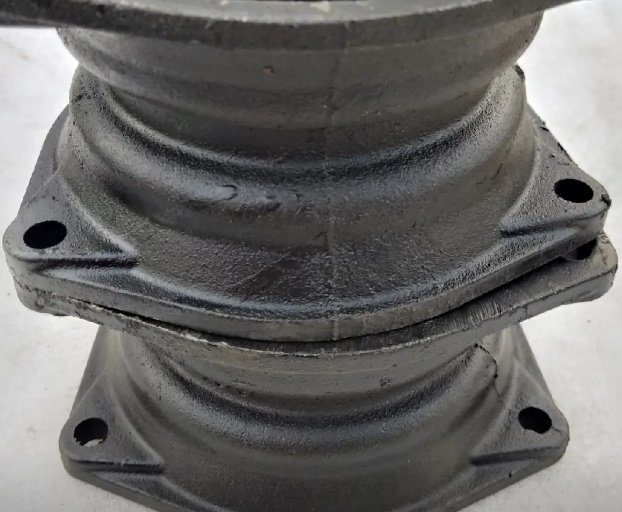
A48 cast iron refers to gray iron castings specified under ASTM A48/A48M, one of the most widely used material standards for general engineering cast iron parts. In most purchasing, machining, and foundry contexts, “A48 cast iron” means ASTM A48 gray cast iron classified by minimum tensile strength, such as Class 20, Class 30, Class 35, Class 40, or Class 50.
Gray cast iron is valued for excellent vibration damping, good compressive strength, thermal stability, wear resistance, and cost-effective castability. These characteristics make ASTM A48 cast iron common in machine bases, gear housings, pump bodies, valve components, brake parts, tooling plates, and many CNC-machined industrial castings.
What Is ASTM A48 Cast Iron?
ASTM A48/A48M is a specification for gray iron castings. Unlike many steel standards, it does not define a single chemical composition. Instead, the grade is primarily designated by tensile strength class. For example, ASTM A48 Class 30 gray iron has a minimum tensile strength of approximately 30 ksi, while Class 40 has a minimum tensile strength of approximately 40 ksi.
The material gets its “gray iron” name from the gray appearance of its fracture surface, caused by flake graphite within the iron matrix. This graphite flake structure gives A48 gray cast iron its well-known damping capacity and machinability, but it also means gray iron is relatively brittle compared with ductile iron.
In engineering drawings, the material may be written in several equivalent ways, including:
- ASTM A48 Class 30
- ASTM A48 CL30 gray iron
- ASTM A48/A48M Class 40B
- Gray cast iron ASTM A48 Class 35
- A48 gray iron casting, stress relieved and machined
ASTM A48 Cast Iron Classes and Tensile Strength
The class number in ASTM A48 normally corresponds to minimum tensile strength in thousands of pounds per square inch. Higher classes generally provide higher strength and hardness, but may show reduced machinability and lower damping performance compared with lower-strength gray iron.
| ASTM A48 Class | Minimum Tensile Strength | Typical Engineering Use | General Machinability |
|---|---|---|---|
| Class 20 | 20 ksi / about 138 MPa | Light-duty housings, covers, non-critical castings | Excellent |
| Class 25 | 25 ksi / about 172 MPa | General castings, low-stress machine parts | Very good |
| Class 30 | 30 ksi / about 207 MPa | Machine bases, brackets, pump housings, tooling plates | Very good |
| Class 35 | 35 ksi / about 241 MPa | Structural machine castings, gear housings, compressor parts | Good |
| Class 40 | 40 ksi / about 276 MPa | Higher-strength machine components, hydraulic parts, wear surfaces | Good to moderate |
| Class 45 | 45 ksi / about 310 MPa | Heavy-duty castings requiring higher tensile strength | Moderate |
| Class 50 | 50 ksi / about 345 MPa | High-strength gray iron castings, demanding industrial parts | Moderate |
| Class 55 and Class 60 | 55–60 ksi / about 379–414 MPa | Special high-strength gray iron applications | More demanding |
These values are minimum tensile requirements, not guaranteed yield strength values. Gray iron does not have a clear yield point like many steels, so designers usually apply conservative stress limits and consider compressive loads, fatigue, section thickness, and casting quality.
Buyer and engineer note: choosing the right A48 class
For most CNC-machined industrial castings, ASTM A48 Class 30 and Class 35 are common starting points because they balance strength, damping, cost, and machinability. Class 40 or Class 50 may be selected for higher load capacity or wear resistance, but they often require closer control of hardness, tool wear, and casting soundness. If the part is mainly a cover, base, or enclosure, over-specifying a high class can increase cost without improving service life.
Key Mechanical and Physical Properties
A48 gray cast iron is not selected only for tensile strength. Its value comes from a combination of castability, machinability, vibration control, and dimensional stability. The graphite flakes interrupt crack propagation differently from steel and provide a natural solid lubricant during machining.
Typical property considerations include:
- Tensile strength: Defined by ASTM A48 class, typically from 20 ksi to 60 ksi minimum.
- Compressive strength: Usually much higher than tensile strength, making gray iron suitable for machine bases and press components.
- Hardness: Commonly specified in Brinell hardness, often increasing with higher tensile class.
- Elastic modulus: Lower than carbon steel and influenced by graphite morphology and matrix structure.
- Damping capacity: Excellent compared with steel, helping reduce chatter, noise, and vibration.
- Thermal conductivity: Useful for brake parts, engine components, molds, and heat-transfer applications.
- Wear resistance: Good when the matrix and hardness are properly controlled.
The most important design point is that gray iron performs best in compression and under stable, well-distributed loads. It is less suitable for impact, severe shock, high tensile loading, or applications requiring significant ductility.
Chemical Composition and Microstructure
ASTM A48 does not require a fixed chemistry for every class. Foundries adjust carbon, silicon, manganese, sulfur, phosphorus, inoculation practice, cooling rate, and heat treatment to meet the specified tensile class and casting performance. This is why two A48 Class 30 castings may have different chemical analyses but still conform to the same tensile standard.
The microstructure of A48 cast iron typically consists of graphite flakes distributed in a ferritic, pearlitic, or ferritic-pearlitic matrix. Higher-strength classes usually contain a more pearlitic matrix and finer graphite. Lower-strength classes often have more ferrite and coarser graphite, which improves machinability and damping but reduces tensile strength.
Important microstructural factors include:
- Graphite flake size, type, and distribution
- Ferrite-to-pearlite ratio
- Carbide presence, especially in thin sections or chilled areas
- Section thickness and cooling rate
- Inoculation quality and melt control
- Residual stress from casting and cooling
For critical components, engineering specifications may add requirements for hardness range, microstructure, pressure tightness, soundness testing, or stress relief beyond the basic ASTM A48 class.
CNC Machining A48 Cast Iron
A48 gray cast iron is generally considered one of the easier cast metals to CNC machine. The graphite flakes improve chip breakage and reduce friction, often allowing dry machining. However, cast iron dust is abrasive, and inconsistent hardness, chilled edges, sand inclusions, or hard spots can shorten tool life.
For production machining, tooling, dust control, and casting consistency are as important as cutting speed. CNC shops usually prefer stable castings with controlled hardness, good datum surfaces, and enough machining allowance to remove scale and surface variation.
Recommended CNC Machining Practices
- Use carbide inserts for turning, milling, boring, and facing operations.
- Consider CBN tooling for high-volume finishing of harder gray iron classes.
- Machine dry when possible, but use proper extraction because gray iron dust is fine and abrasive.
- Avoid excessive coolant use unless the machine is designed for cast iron sludge management.
- Use rigid fixturing to prevent vibration, especially on large housings and thin-wall castings.
- Specify stress relief before precision machining when dimensional stability is critical.
- Plan rough machining and finish machining separately for large or high-precision castings.
- Inspect hardness across critical zones to detect chilled areas or inconsistent microstructure.
Typical CNC operations for ASTM A48 castings include face milling, drilling, tapping, boring, counterboring, reaming, surface grinding, thread milling, and coordinate machining of datum features. For machine bases and plates, flatness, parallelism, and hole-position accuracy are often more important than the casting’s nominal tensile class.
Machining note for procurement teams
When buying A48 castings that will be CNC machined, it is helpful to specify casting tolerance, machining allowance, datum scheme, surface finish, maximum hardness, and whether stress relief is required. A casting that meets ASTM A48 tensile strength can still create machining problems if it has hard edges, porosity near sealing surfaces, poor locating features, or insufficient stock allowance.
A48 Cast Iron vs Ductile Iron, Steel, and Other Gray Iron Standards
ASTM A48 gray cast iron is often compared with ductile iron, carbon steel, and international gray iron grades. The right choice depends on load direction, impact requirement, damping, cost, machinability, and casting geometry.
| Material | Main Advantage | Main Limitation | When It Is Commonly Selected |
|---|---|---|---|
| ASTM A48 Gray Iron | Excellent damping, castability, machinability, and cost efficiency | Low ductility and lower tensile impact resistance | Machine bases, housings, brackets, plates, pump and valve bodies |
| ASTM A536 Ductile Iron | Higher ductility, impact resistance, and tensile performance | Usually lower damping and sometimes higher cost | Safety-critical, impact-loaded, or high-strength cast components |
| Carbon Steel | High toughness, weldability, and predictable tensile behavior | Lower damping and more expensive machining for complex cast shapes | Fabricated structures, shafts, welded parts, high-toughness components |
| Continuous Cast Gray Iron Bar | Consistent stock for CNC machining and short-run production | Limited geometry compared with shaped castings | Bushings, rings, wear plates, prototypes, and machined blanks |
In international sourcing, engineers may also compare ASTM A48 with EN-GJL grades under EN 1561, such as EN-GJL-200, EN-GJL-250, and EN-GJL-300. These standards are not automatically identical because test methods, grade definitions, and acceptance conditions differ. Cross-references should be treated as approximate unless verified by engineering review.
Common Applications of A48 Gray Cast Iron
A48 cast iron is used where cast geometry, dimensional stability, vibration damping, and machinability matter more than ductility. It is especially common in industrial equipment and precision machinery.
Typical applications include:
- Machine tool bases, columns, saddles, and tables
- Pump housings, volutes, and end covers
- Valve bodies and non-shock pressure components
- Gearboxes, motor housings, and compressor housings
- Brake rotors, drums, and friction components
- Hydraulic manifolds and industrial blocks where pressure ratings are validated
- Bearing housings and pillow blocks
- Surface plates, tooling plates, fixtures, and inspection bases
- Engine blocks, cylinder heads, and flywheels in suitable designs
For pressure-containing parts, ASTM A48 alone may not be sufficient. Designers may need to add leak testing, pressure testing, impregnation requirements, wall-thickness control, casting soundness criteria, or application-specific standards.
Design and Specification Guidelines
Specifying A48 cast iron correctly reduces foundry variation, machining issues, and inspection disputes. The drawing should include the ASTM class, casting condition, heat treatment if required, critical surfaces, inspection criteria, and machining requirements.
A practical specification may include:
- Material: ASTM A48/A48M Class 30, Class 35, or Class 40
- Required hardness range for machined areas
- Stress relief requirement before finish machining
- Surface finish and visual acceptance criteria
- Machining allowance on critical surfaces
- Datum targets and post-casting machining sequence
- Pressure test, leak test, or impregnation requirements if applicable
- Material test report or certificate of compliance
- Non-destructive testing requirements for critical castings
Because section thickness affects cooling rate and microstructure, tensile test results from standard test bars may not perfectly represent every location in a complex casting. For highly loaded parts, engineers may require separately cast test bars, attached test coupons, hardness mapping, or section-specific validation.
Engineering note: avoiding over-specification
Higher ASTM A48 classes are not automatically better. A Class 50 gray iron casting may be stronger in tension than Class 30, but it can be harder to machine and may have reduced damping. For machine bases, fixtures, and housings, Class 30 or Class 35 can be more appropriate when vibration control, dimensional stability, and machining efficiency are the main performance drivers.
Quality Control, Testing, and Inspection
Quality control for A48 cast iron usually includes tensile testing, hardness testing, dimensional inspection, visual inspection, and sometimes microstructure evaluation. For machined castings, inspection may also include flatness, perpendicularity, position tolerance, thread quality, surface roughness, and leak testing.
Common quality checks include:
- Tensile testing: Confirms compliance with the specified ASTM A48 class.
- Brinell hardness testing: Helps verify machinability and matrix consistency.
- Microstructure examination: Evaluates graphite form, pearlite/ferrite balance, and carbide risk.
- Dimensional inspection: Confirms casting tolerance and machined feature accuracy.
- Visual inspection: Identifies cracks, cold shuts, sand defects, fins, and surface discontinuities.
- Pressure or leak testing: Used for pump, valve, and fluid-handling components.
- NDT methods: Magnetic particle, ultrasonic, or dye penetrant testing may be applied when specified.
For high-volume production, process capability is often more important than one-time test results. Stable melt chemistry, inoculation practice, mold control, cooling control, and CNC fixture repeatability all contribute to predictable A48 casting performance.
Summary: When A48 Cast Iron Is the Right Material
A48 cast iron is a strong choice when an engineering component needs castability, vibration damping, compressive strength, dimensional stability, and efficient CNC machining. It is especially suitable for machine bases, housings, brackets, plates, and industrial castings where gray iron’s graphite flake structure provides practical performance advantages.
The best results come from matching the ASTM A48 class to the real service condition. Class 30 and Class 35 are often ideal for balanced strength and machinability, while Class 40 and above may be chosen for higher-strength requirements. For impact-loaded or ductility-critical parts, ductile iron or steel should be evaluated instead.
To specify A48 gray cast iron effectively, define the class, hardness expectations, machining allowance, inspection method, stress-relief requirements, and any leak-tight or pressure-performance criteria. This approach helps ensure that the casting is not only ASTM-compliant, but also practical to machine, inspect, and use in service.