
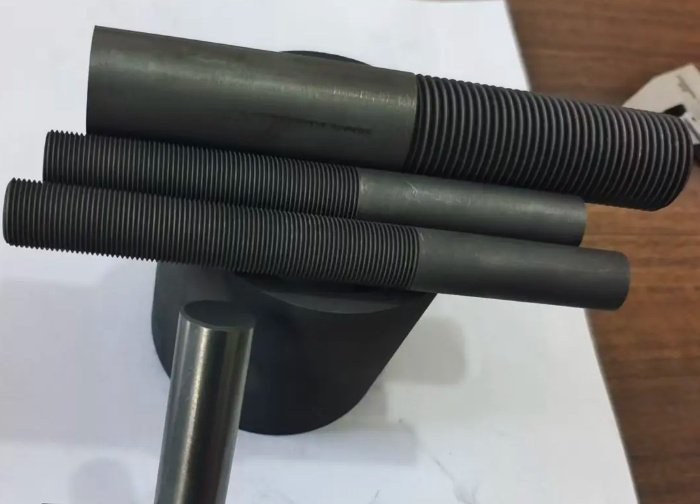
Compacted graphite iron, commonly abbreviated as CGI, is a high-performance cast iron engineered for components that must combine strength, stiffness, heat resistance, damping and castability. It is widely used in diesel engine blocks, cylinder heads, exhaust components, brake systems, hydraulic parts and heavy-duty industrial castings.
CGI sits between gray cast iron and ductile iron in both microstructure and performance. It offers better strength and fatigue resistance than gray iron while retaining better thermal conductivity and vibration damping than many ductile iron grades. For engineers, foundries, CNC machining suppliers and buyers, CGI is often chosen when a casting must survive higher combustion pressure, thermal cycling or mechanical load without excessive weight or section thickness.
What Is Compacted Graphite Iron?
Compacted graphite iron is a cast iron in which carbon appears mainly as short, thick, interconnected graphite particles. These graphite particles are neither long flakes, as in gray iron, nor fully spherical nodules, as in ductile iron. Because of this intermediate graphite morphology, CGI is also known as vermicular graphite iron.
The compacted graphite shape reduces the crack-promoting effect seen in gray iron flakes while preserving a continuous graphite network that supports heat transfer and damping. This gives CGI a balanced property profile for thermally and mechanically loaded castings.
In standards and foundry documentation, CGI may also be described by terms such as GJV, EN-GJV, vermicular graphite cast iron, compacted graphite cast iron, or ASTM A842 compacted graphite iron.
CGI Microstructure and Metallurgy
The performance of compacted graphite iron is controlled by graphite shape, matrix structure and alloy chemistry. The graphite phase is typically compacted or worm-like, with a limited amount of nodular graphite allowed depending on the specification. Excessive flake graphite can reduce strength, while excessive nodularity can reduce thermal conductivity and damping.
The metallic matrix may be ferritic, pearlitic, or ferritic-pearlitic. A ferritic matrix improves ductility and machinability, while a pearlitic matrix increases tensile strength, hardness and wear resistance. Alloying elements such as copper, tin, molybdenum, chromium and nickel may be used to adjust matrix structure, hardenability and high-temperature performance.
CGI production usually requires tight control of magnesium, sulfur, inoculation and cooling rate. Small process variations can change graphite morphology, which is why modern CGI production often uses thermal analysis, process simulation and metallographic verification.
Key Mechanical and Thermal Properties of Compacted Graphite Iron
The main advantage of CGI is its ability to deliver higher tensile strength and stiffness than gray iron while keeping useful thermal and damping properties. Exact values vary by grade, matrix and casting geometry, but the following ranges are commonly used for engineering comparison.
| Property | Typical CGI Range | Engineering Significance |
|---|---|---|
| Tensile strength | 300–500 MPa or higher, depending on grade | Allows thinner walls and higher load capacity than gray iron |
| Elastic modulus | Approximately 130–170 GPa | Improves stiffness and dimensional stability |
| Elongation | Generally lower than ductile iron but higher than gray iron | Useful for moderate ductility requirements |
| Thermal conductivity | Lower than gray iron, often higher than ductile iron | Supports heat dissipation in engine and exhaust parts |
| Damping capacity | Better than ductile iron, lower than gray iron | Reduces vibration and noise in machinery |
| Fatigue resistance | Significantly better than gray iron | Important for cyclically loaded castings |
| Hardness | Often about 170–260 HB, depending on matrix | Affects wear behavior and machinability |
For high-temperature applications, CGI is valued for thermal fatigue resistance, dimensional stability and resistance to crack initiation under repeated heating and cooling.
Compacted Graphite Iron vs Gray Iron and Ductile Iron
CGI is often selected after comparing it with gray cast iron and ductile iron. Each material has advantages, so the best choice depends on load, temperature, wall thickness, machining cost and production volume.
CGI vs Gray Cast Iron
Compared with gray iron, compacted graphite iron provides higher tensile strength, better fatigue strength, higher elastic modulus and better resistance to crack propagation. Gray iron still has advantages in machinability, thermal conductivity, damping and cost. CGI becomes attractive when gray iron cannot meet mechanical strength or durability requirements.
CGI vs Ductile Iron
Compared with ductile iron, CGI typically has better thermal conductivity, better vibration damping and lower thermal expansion. Ductile iron usually provides higher ductility and impact toughness. CGI is often preferred for engine and thermal-management components where heat transfer and stiffness are as important as strength.
| Material | Graphite Shape | Main Strength | Main Limitation |
|---|---|---|---|
| Gray cast iron | Flake graphite | Machinability, damping, thermal conductivity | Lower tensile and fatigue strength |
| Compacted graphite iron | Compacted or vermicular graphite | Balanced strength, stiffness, thermal performance and damping | More difficult casting control and machining than gray iron |
| Ductile iron | Nodular graphite | Ductility, toughness and strength | Lower damping and often lower thermal conductivity than CGI |
Common Applications of CGI Castings
Compacted graphite iron is used where components face a combination of high pressure, high temperature, cyclic stress and vibration. Its strongest adoption has been in automotive and heavy-duty diesel engine applications, but its use extends into energy, marine, construction machinery and industrial equipment.
- Diesel engine blocks: CGI supports higher cylinder pressure and thinner wall designs, helping improve power density.
- Cylinder heads: Good thermal fatigue resistance and stiffness make CGI suitable for demanding combustion environments.
- Exhaust manifolds and turbocharger housings: CGI can withstand repeated thermal cycling better than many conventional gray iron grades.
- Brake discs and drums: The combination of strength, heat resistance and damping can improve durability in severe-duty braking.
- Hydraulic and compressor components: CGI offers dimensional stability under pressure and vibration.
- Machine tool and industrial housings: Damping, stiffness and castability can benefit precision equipment structures.
In transportation applications, CGI can also help reduce casting weight because higher strength allows optimized wall thickness compared with equivalent gray iron designs.
CNC Machining Compacted Graphite Iron
CNC machining CGI requires a different process strategy than machining gray cast iron. Although CGI contains graphite that provides some lubricating effect, its higher strength, higher hardness and compacted graphite morphology increase tool wear. This is especially important in high-volume machining of engine blocks, cylinder bores, deck faces, bearing seats and threaded holes.
Compared with gray iron, CGI often requires lower cutting speeds than gray iron, more rigid fixturing, optimized insert geometry and careful control of tool life. Carbide tools are widely used, while ceramic, CBN or advanced coated tools may be selected for specific high-speed or finishing operations.
Machining Factors That Affect CGI Cost
- Matrix hardness: Pearlitic CGI usually machines slower than ferritic CGI.
- Graphite morphology: Higher nodularity can increase cutting forces and affect chip formation.
- Carbide-forming alloy content: Elements such as chromium and molybdenum can increase abrasiveness.
- Interrupted cuts: Casting surfaces, holes and thin features increase tool impact and wear.
- Coolant strategy: Dry, wet, MQL or high-pressure coolant should be matched to operation and tooling.
- Workholding rigidity: CGI’s stiffness is useful in service but can transmit vibration during machining if fixturing is weak.
Recommended CNC Operations for CGI
Typical CGI machining operations include face milling, drilling, tapping, boring, reaming, honing and precision surface finishing. Stable spindle load, predictable tool wear and consistent chip evacuation are more important than maximum speed. For production programs, tool-life trials should be performed on representative castings rather than generic test coupons.
Engineering note: how to specify CGI for CNC machining
When CGI parts require CNC machining, drawings and purchasing specifications should define the material grade, hardness range, microstructure requirements, casting cleanliness, machining allowance, datum scheme and critical tolerances. If cylinder bores, sealing faces or bearing seats are involved, it is useful to specify the required surface roughness, roundness, flatness and inspection method.
Casting, Quality Control and Material Standards
CGI casting is more process-sensitive than gray iron because the graphite form must remain in the compacted range. Foundries typically rely on controlled magnesium treatment, inoculation practice, sulfur balance, melt chemistry control and cooling-rate management.
Quality control usually includes chemical analysis, thermal analysis, tensile testing, hardness testing, metallographic examination and non-destructive testing when required. Critical castings may also require ultrasonic testing, X-ray inspection, leak testing, pressure testing or dimensional scanning.
Common Standards and Designations
- ISO 16112: International standard for compacted vermicular graphite cast irons.
- ASTM A842: Standard specification used for compacted graphite iron castings.
- EN-GJV designations: European-style material symbols commonly used for vermicular graphite cast iron grades.
- SAE and OEM specifications: Frequently used in automotive, diesel engine and powertrain production.
Typical CGI grades are often identified by minimum tensile strength, such as CGI 300, CGI 350, CGI 400, CGI 450 or CGI 500, although exact naming depends on the applicable standard. Buyers should avoid assuming that two grades with similar tensile strength have identical hardness, ductility, machinability or thermal conductivity.
Buyer note: what to confirm before ordering CGI castings
Before sourcing compacted graphite iron castings, confirm the applicable standard, grade, matrix requirement, nodularity range, tensile test location, hardness range, heat treatment condition, NDT requirements, machining allowance, coating requirement and inspection documentation. For safety-critical or high-volume programs, a production part approval process is commonly required.
Material Selection Guidelines for Engineers and Buyers
CGI is usually selected when gray iron is not strong enough and ductile iron is not thermally efficient enough. It is a practical choice when a part requires a balance of load-bearing capacity, thermal cycling resistance, damping and castability.
CGI may be a good fit when the design has one or more of the following requirements:
- Higher cylinder pressure or combustion load than gray iron can support
- Improved fatigue life without switching to steel or ductile iron
- Better heat transfer than typical ductile iron alternatives
- Lower vibration and noise than ductile iron or steel
- Potential wall-thickness reduction compared with gray iron
- Cast geometry too complex or cost-sensitive for forged or fabricated alternatives
However, CGI is not always the lowest-cost material. The total cost must include foundry process control, yield, tooling, CNC machining time, tool wear, inspection and any application-specific testing.
Procurement perspective: cost drivers in CGI parts
The main cost drivers for compacted graphite iron parts include casting complexity, annual volume, grade strength, matrix hardness, machining percentage, tolerance level, tooling investment, inspection requirements and scrap risk. A lower raw casting price may not produce the lowest total cost if the material is difficult to machine or has inconsistent microstructure.
Limitations and Design Considerations
CGI delivers a valuable balance of properties, but engineers should consider its limitations early in product development. The most important limitation is tight process control. Without stable melt treatment and microstructure verification, the material can drift toward gray iron or ductile iron behavior.
Machining is another major consideration. CGI typically increases cutting forces and tool wear compared with gray iron, which can affect cycle time, tooling cost and process capability. Designs with many drilled holes, threaded features or precision bores should include manufacturability review before tooling is finalized.
Thermal conductivity, although better than many ductile iron grades, is usually lower than gray iron. If heat dissipation is the dominant requirement and mechanical load is moderate, gray iron may still be the more efficient option. If impact toughness and elongation are the dominant requirements, ductile iron or steel may be better choices.
Conclusion: Why CGI Matters in Modern Engineering
Compacted graphite iron is a specialized cast iron developed for demanding components that need more strength than gray iron and better thermal-damping behavior than ductile iron. Its compacted graphite morphology gives it a unique combination of tensile strength, stiffness, fatigue resistance, thermal performance and vibration damping.
For engine blocks, cylinder heads, exhaust systems, braking components and industrial machinery, CGI can improve durability and power density while maintaining the design freedom of casting. Successful use depends on selecting the correct grade, controlling microstructure, planning CNC machining carefully and defining clear inspection requirements.
References and Further Reading
- ISO 16112, Compacted vermicular graphite cast irons — Classification.
- ASTM A842, Standard Specification for Compacted Graphite Iron Castings.
- EN material designation systems for cast irons, including EN-GJV compacted graphite iron designations.
- ASM Handbook resources on cast irons, graphite morphology, casting metallurgy and machining behavior.
- SAE technical literature on CGI diesel engine blocks, high-pressure combustion systems and production machining.