
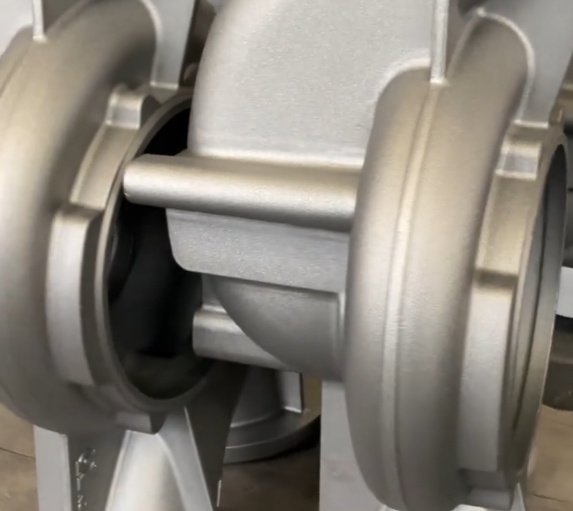
Gray iron, also written as grey iron, is one of the most widely used cast irons in industrial manufacturing. It is valued for its castability, dimensional stability, vibration damping, wear performance and cost-effective machinability. From machine tool bases and pump housings to brake components, valve bodies and hydraulic parts, gray iron remains a practical material when strength, stiffness, damping and production economy must be balanced.
The name “gray iron” comes from the gray appearance of its fracture surface, which is caused by free graphite within the metal matrix. Unlike ductile iron, where graphite forms nodules, gray iron contains graphite in flake form. This graphite flake microstructure is the key reason behind its excellent damping capacity and machinability, but it also explains why gray iron has lower tensile strength and ductility than nodular cast iron or steel.
What Is Gray Iron?
Gray iron is an iron-carbon-silicon casting alloy in which carbon exists mainly as graphite flakes. A typical composition includes iron as the base element, carbon, silicon, manganese, phosphorus and sulfur, with alloying elements added when specific performance is required. The exact chemistry depends on the grade, wall thickness, cooling rate and foundry practice.
In engineering terms, gray iron is selected not only for its tensile strength but also for its system-level performance. It is easy to cast into complex shapes, handles compressive loads well, absorbs vibration, and can be machined efficiently. These qualities make it especially useful for housings, beds, frames, covers, pulleys, manifolds and components that require good stiffness and dimensional repeatability.
Gray Iron Microstructure and Why It Matters
The properties of gray iron are controlled by its microstructure, especially the shape, size and distribution of graphite flakes and the surrounding metallic matrix. The matrix may be ferritic, pearlitic, or a combination of both. Ferritic gray iron is softer and more machinable, while pearlitic gray iron offers higher strength and wear resistance.
Graphite flakes act as internal discontinuities. They help break chips during machining and absorb mechanical vibration, but they also reduce tensile strength because cracks can initiate at the flake tips. For this reason, gray iron is generally not chosen for highly tensile or impact-loaded parts unless the design accounts for those limitations.
- Graphite flakes: Improve damping, machinability and thermal conductivity, but reduce ductility.
- Ferritic matrix: Provides softness and easier machining, often used where high strength is not required.
- Pearlitic matrix: Improves tensile strength and wear resistance, commonly used for higher-grade gray iron.
- Carbides: Increase hardness and wear resistance but may reduce machinability and tool life.
Common Gray Iron Grades and Standards
Gray iron is specified by mechanical properties, most often tensile strength. Common standards include ASTM A48 in North America and EN 1561 in Europe. Other national or historical designations, such as GG20, GG25 and GG30, are also commonly encountered in drawings and purchasing documents.
| Standard or Designation | Typical Grade | General Description | Common Applications |
|---|---|---|---|
| ASTM A48 | Class 20 | Lower tensile strength, excellent castability and machinability | Covers, light housings, non-critical castings |
| ASTM A48 | Class 30 | Balanced strength, damping and machinability | Pump housings, gear cases, bases, brackets |
| ASTM A48 | Class 40 | Higher tensile strength, often pearlitic | Machine components, cylinder blocks, heavier housings |
| EN 1561 | EN-GJL-200 | Comparable to moderate-strength gray iron grades | General engineering castings |
| EN 1561 | EN-GJL-250 | Widely used grade with good all-around performance | Machine bases, valve bodies, compressor parts |
| EN 1561 | EN-GJL-300 | Higher-strength gray cast iron | Structural machine castings, wear-related components |
For many industrial components, ASTM A48 Class 30 or EN-GJL-250 is used as a practical starting point because it provides a strong balance of performance, castability and machining economy. However, final grade selection should be based on load case, section thickness, service environment and inspection requirements.
Key Mechanical and Physical Properties
Gray iron does not behave like steel. It has relatively low ductility, but it offers high compressive strength, good thermal conductivity, natural lubricity from graphite and excellent damping. These features are especially valuable in machinery and rotating equipment where vibration control and dimensional stability matter.
- Tensile strength: Commonly specified by grade; higher grades generally require more pearlite and tighter process control.
- Compressive strength: Often much higher than tensile strength, making gray iron suitable for bases and supports.
- Hardness: Influenced by matrix structure, cooling rate and alloying; important for machining and wear behavior.
- Damping capacity: One of gray iron’s strongest advantages compared with steel and aluminum.
- Thermal conductivity: Useful in engine blocks, brake components and heat-related machinery parts.
- Wear resistance: Enhanced by pearlitic matrix and controlled hardness, especially in sliding contact applications.
When a component must reduce resonance, chatter or noise, gray iron’s vibration damping can provide a measurable engineering advantage. This is why it is common in machine tool beds, lathe bases, milling machine frames, compressor housings and heavy equipment structures.
Gray Iron Casting Process
Most gray iron parts are produced by sand casting, though shell molding, permanent mold casting and centrifugal casting may also be used depending on geometry and volume. The foundry process includes pattern design, mold making, melting, chemistry control, inoculation, pouring, shakeout, cleaning, heat treatment if required, inspection and machining.
Process control is critical because gray iron properties are strongly affected by cooling rate and section thickness. A thick section cools more slowly and may develop a different microstructure than a thin rib or boss. As a result, a casting can show variation in hardness and tensile strength across different areas if the design and foundry method are not controlled.
Important Foundry Control Factors
- Carbon equivalent: A chemistry indicator that influences fluidity, shrinkage tendency and graphite formation.
- Inoculation: Promotes graphite nucleation and helps reduce chill or unwanted carbide formation.
- Pouring temperature: Affects fluidity, surface finish, shrinkage and gas-related defects.
- Gating and risering: Controls metal flow, turbulence and feeding behavior.
- Cooling rate: Influences graphite shape, matrix structure, hardness and local mechanical properties.
Reliable gray iron casting depends on stable process control, not only chemical analysis. For parts with tight tolerances or CNC-machined sealing surfaces, foundries must also control distortion, residual stress, machining allowance and casting datum strategy.
Buyer and engineering note: what to confirm before ordering gray iron castings
Before purchasing gray iron castings, confirm the material standard, grade, test bar requirement, hardness range, surface finish, machining allowance, dimensional tolerance, inspection method and delivery condition. If the part will be CNC machined, define machining datums early and specify whether the supplier is responsible for rough machining, finish machining, coating or assembly-ready delivery.
Gray Iron vs Ductile Iron, Steel and Aluminum
Gray iron is often compared with ductile iron, carbon steel, cast steel and aluminum alloys. The best choice depends on the mechanical load, weight target, damping requirement, machinability, cost and production volume.
| Material | Main Strengths | Typical Limitations |
|---|---|---|
| Gray Iron | Excellent damping, good machinability, castability, compressive strength and cost efficiency | Low ductility, lower tensile strength, poor impact resistance |
| Ductile Iron | Higher tensile strength, ductility and fatigue resistance than gray iron | Usually higher cost and may have lower damping |
| Carbon Steel | High toughness, weldability and tensile performance | More difficult to cast into complex shapes and typically less damping |
| Aluminum Alloy | Low weight, good corrosion resistance, good thermal performance in selected alloys | Lower stiffness and often lower damping than gray iron |
For heavy equipment bases, machine structures and many pump or valve housings, gray iron remains highly competitive because stiffness, damping and casting economy matter more than elongation. For safety-critical, impact-loaded or highly tensile components, ductile iron or steel may be more appropriate.
CNC Machining of Gray Iron
Gray iron is known for excellent machinability because graphite flakes act as chip breakers and provide a lubricating effect at the cutting interface. In many applications, gray iron castings are supplied as near-net-shape blanks and then CNC machined to achieve accurate bores, faces, threads, sealing surfaces, bearing seats and mounting datums.
Although gray iron is easier to machine than many steels, machining success depends on hardness consistency, casting quality, tool selection and dust control. Abrasive graphite and hard spots can affect tool wear, while sand inclusions, chill zones or carbides may cause premature insert failure. For production machining, carbide inserts, CBN tools in specific high-volume operations and rigid workholding are commonly used.
CNC Machining Considerations
- Tooling: Carbide inserts are widely used for milling, turning and boring gray iron. Coated tools may improve wear resistance.
- Coolant strategy: Dry machining is common for gray iron, but dust extraction is important. Coolant may be used when part temperature, surface finish or tool life requires it.
- Workholding: Cast surfaces can be uneven, so fixturing should avoid distortion and provide repeatable datums.
- Machining allowance: Allowance must account for casting tolerance, scale, surface decarburization, distortion and cleanup needs.
- Inspection: Critical machined features should be verified with CMM, gauges, surface roughness testers or functional fixtures.
For CNC-machined gray iron components, the drawing should clearly distinguish cast dimensions from machined dimensions. It should also specify geometric tolerances for flatness, perpendicularity, concentricity and positional accuracy where assembly performance depends on them.
CNC machining note for procurement teams
If one supplier provides both casting and CNC machining, the project can benefit from better datum planning, fewer handoff errors and faster root-cause analysis when defects occur. However, buyers should still request documented inspection reports for critical dimensions, material certificates and any required hardness or microstructure verification.
Design Guidelines for Gray Iron Parts
Designing gray iron parts requires attention to section thickness, fillet radius, stress concentration, machining stock and casting orientation. Since gray iron has limited ductility, sharp corners and sudden section changes should be avoided. Smooth transitions reduce localized stress and improve mold filling, feeding and cooling behavior.
- Use generous radii: Rounded corners reduce stress concentration and improve casting quality.
- Avoid abrupt thickness changes: Uniform sections reduce shrinkage, hot spots and hardness variation.
- Design for machining datums: Include stable reference surfaces for CNC setup and inspection.
- Consider ribbing: Ribs can increase stiffness without excessive weight, but should be designed to avoid hot spots.
- Specify realistic tolerances: As-cast tolerances differ from machined tolerances and should not be confused.
- Plan for holes and threads: Critical holes are often cast undersize or drilled after casting for accuracy.
Engineers should avoid treating gray iron as a direct substitute for steel without recalculating stress, fatigue and impact conditions. Gray iron performs best when the design uses its strengths: compression, stiffness, damping, thermal conductivity and manufacturability.
Engineer’s checklist for manufacturable gray iron design
Review load direction, minimum wall thickness, fillet radii, rib-to-wall ratios, machining allowance, datum surfaces, tolerance class, expected hardness range and inspection points. For high-volume parts, involve the foundry and CNC machining team before tooling release to reduce pattern revisions and production risk.
Common Applications of Gray Iron
Gray iron is used across machinery, automotive, fluid handling, construction, agricultural, power transmission and general industrial sectors. Its best applications are those that benefit from cast complexity, vibration control, compressive strength and economical machining.
- Machine tool bases, columns, tables and frames
- Pump housings, compressor bodies and hydraulic valve blocks
- Gearbox housings, bearing housings and motor end covers
- Brake discs, drums and automotive cylinder blocks
- Pulleys, flywheels, counterweights and sheaves
- Pipe fittings, manhole covers and municipal castings
- Industrial brackets, covers, plates and structural supports
In many of these applications, gray iron offers a lower total manufacturing cost than a welded steel fabrication because it reduces assembly steps, allows complex internal features and provides stable machined surfaces after stress relief or natural aging when required.
Quality Inspection and Specification Best Practices
A good gray iron specification should be clear enough for foundry production, machining control and final inspection. Material grade alone is not always sufficient. Depending on the application, the drawing or purchase specification may include chemical limits, hardness range, tensile strength, microstructure requirements, pressure testing, non-destructive testing, surface quality and dimensional tolerances.
Common inspection methods include visual inspection, dimensional inspection, hardness testing, tensile testing using separately cast or attached test bars, metallographic examination, pressure testing and magnetic particle inspection where applicable. For machined gray iron parts, final inspection may also include surface roughness, thread gauging, bore geometry and flatness measurement.
When sourcing gray iron castings, prioritize suppliers that can demonstrate repeatable foundry control, traceable material certification, machining capability and corrective action discipline. The lowest unit price may not be the lowest total cost if scrap, machining variation, delivery delays or assembly problems occur.
Summary: When Gray Iron Is the Right Choice
Gray iron is a proven casting material for components requiring castability, damping, compressive strength, thermal conductivity and economical CNC machining. Its graphite flake structure gives it distinctive advantages in machine bases, housings, brake components, pump bodies and industrial equipment parts.
It is not the best choice for high-impact or high-ductility applications, but when used in the right design context, gray iron delivers reliable performance and strong manufacturing value. The most successful projects define the correct grade, account for casting behavior, plan CNC machining datums early and align foundry capability with inspection requirements.