
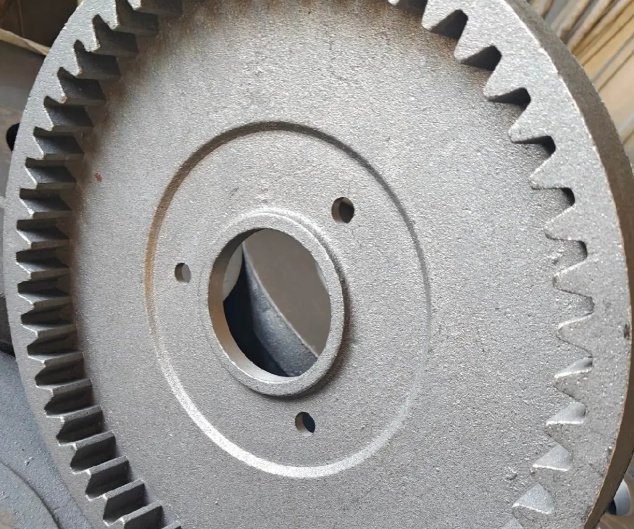
ASTM A897 cast iron is a specification for austempered ductile iron castings, commonly called ADI. It is selected when a component needs the castability of ductile iron combined with higher tensile strength, fatigue resistance, impact performance, wear resistance and reduced weight compared with many steel fabrications or forged steel parts.
In practical sourcing, the term “A897 cast iron” usually means ductile iron castings manufactured, heat treated and tested to ASTM A897/A897M. The material is not a single grade; it covers several strength classes. Choosing the correct grade depends on load, hardness, elongation, impact requirement, wear environment, casting geometry, machining sequence and inspection standard.
What Is ASTM A897 Cast Iron?
ASTM A897/A897M is the Standard Specification for Austempered Ductile Iron Castings. The base casting is nodular graphite ductile iron. After casting, the part is heat treated by a controlled austempering process to produce austempered ductile iron (ADI), a material with a high-strength matrix and graphite nodules that help retain useful ductility and damping behavior.
The key distinction between conventional ductile iron and A897 ADI is the heat-treated matrix. Standard ductile iron grades may contain ferrite, pearlite or a combination of both. A897 ADI is transformed into an ausferritic microstructure, giving it a different balance of strength, toughness, wear resistance and machinability.
ADI Microstructure and Why It Matters
The performance of A897 cast iron comes from ausferrite, a microstructure made primarily of acicular ferrite and stabilized high-carbon austenite. This structure is produced by austenitizing the ductile iron casting, rapidly cooling it to an austempering temperature and holding it until the desired transformation is achieved.
Because the graphite is present as nodules rather than flakes, ADI avoids the severe stress concentration typical of gray iron. The result is a cast iron family with much higher strength potential, good fatigue behavior and useful resistance to crack initiation. The austempering temperature and hold time strongly influence hardness, tensile strength, yield strength, elongation and impact toughness.
ASTM A897 Grades and Typical Mechanical Property Direction
A897 grades are commonly identified by minimum tensile strength, yield strength and elongation values. For example, a grade designation such as 900/650/09 indicates a minimum tensile strength of about 900 MPa, minimum yield strength of about 650 MPa and minimum elongation of about 9%, depending on the exact version of the standard and test method used.
| ASTM A897 Grade Type | General Strength Level | Typical Engineering Use |
|---|---|---|
| Lower-strength ADI grades | Higher ductility and impact toughness | Suspension parts, brackets, housings, structural castings |
| Medium-strength ADI grades | Balanced strength, elongation and wear behavior | Gears, sprockets, hubs, machinery components |
| High-strength ADI grades | Higher hardness and tensile strength, lower elongation | Wear parts, power transmission parts, heavily loaded components |
For procurement and design, the grade should be taken from the current ASTM A897/A897M document, because acceptance requirements, test locations, heat treatment controls and supplementary requirements may vary by project or revision. Buyers should not rely only on a generic ADI label; the purchase order should state the required grade, testing method, certification level and any special inspection criteria.
Key Properties of A897 Cast Iron
When properly produced, A897 ADI can offer a strong combination of castability and mechanical performance. It is often evaluated against forged steel, quenched and tempered steel, welded steel assemblies, pearlitic ductile iron and alloyed ductile iron.
- High strength-to-weight ratio: ADI can reduce component mass while maintaining load capacity.
- Good fatigue resistance: Nodular graphite and ausferritic matrix can support repeated loading applications.
- Wear resistance: Higher-strength grades provide useful abrasion and rolling contact performance.
- Damping capacity: As a cast iron, ADI can damp vibration better than many steels.
- Design flexibility: Complex shapes can be cast near net shape, reducing welding and assembly operations.
- Impact performance: Lower and medium grades can offer toughness suitable for dynamic components.
- Cost efficiency: For suitable geometries, ADI castings may reduce machining, fabrication and material costs.
A897 Cast Iron vs Ductile Iron, Gray Iron and Steel
A897 cast iron is part of the ductile iron family, but its application range is different from conventional ferritic or pearlitic ductile iron. Compared with standard ductile iron, ADI normally provides higher strength and wear resistance. Compared with gray iron, it offers much higher tensile strength and toughness because the graphite is nodular rather than flake-shaped.
Compared with steel, ADI may offer lower density, better vibration damping, near-net-shape casting advantages and competitive fatigue performance. However, steel may still be preferred for applications requiring high fracture toughness, very high impact energy at low temperature, extensive welding, or properties in very thick sections where ADI heat treatment is difficult to control.
Buyer perspective: when A897 ADI is a strong replacement candidate
A897 ADI is often worth evaluating when a steel weldment, forging or machined billet part is heavy, expensive or difficult to manufacture repeatedly. It is also a strong candidate when a conventional ductile iron casting does not meet fatigue, wear or yield strength targets. The business case is strongest when the casting design can consolidate multiple parts, reduce machining stock, remove welding operations or improve service life.
CNC Machining of A897 Cast Iron
CNC machining strategy is critical for A897 cast iron because machinability changes significantly after austempering. In many production routes, rough machining is completed before heat treatment and finish machining is performed after austempering. This reduces tool wear while still achieving final dimensional accuracy.
For many parts, machining before austempering is the preferred process because the as-cast or normalized ductile iron condition is easier to cut than fully austempered ADI. However, the engineer must leave enough machining allowance for heat treatment movement, surface cleanup and final tolerance control.
Tooling and Cutting Considerations
- Tool material: Coated carbide is common for general turning, milling and drilling. CBN or ceramic tools may be considered for hard, high-strength ADI grades.
- Cutting speed: Lower speeds are usually required for high-hardness ADI compared with ferritic ductile iron.
- Rigidity: Stable fixturing, short tool overhang and controlled interrupted cuts help protect edges.
- Coolant: Flood coolant or optimized dry machining may be used depending on operation, tool coating and chip behavior.
- Tool wear mode: Abrasion and edge chipping can occur, especially in high-strength grades or interrupted cuts.
- Surface integrity: Avoid excessive heat, rubbing and workpiece deflection that could affect dimensional accuracy.
Drilling and tapping ADI require special attention because higher grades can generate high torque and rapid tool wear. Threaded holes are often machined before austempering when possible. If post-heat-treatment threading is necessary, thread milling, rigid tapping with appropriate geometry or form-specific tooling may be evaluated through production trials.
Engineer perspective: machining process planning for ADI castings
Engineering drawings should define which surfaces are machined before and after heat treatment. Critical bores, bearing seats, gear features and sealing faces may need final machining after austempering. Non-critical pads, holes and rough profiles may be completed before heat treatment to reduce cost. The machining plan should be reviewed together with casting simulation, heat treatment distortion data and inspection requirements.
Heat Treatment and Process Control
A897 ADI properties depend heavily on process control. Typical production includes austenitizing, quenching into a controlled salt bath or equivalent medium, austempering at a specified temperature range and cooling to room temperature. The goal is to complete the desired ausferritic transformation while avoiding unwanted pearlite, excessive martensite or unstable retained austenite.
Critical process variables include chemical composition, casting section thickness, nodularity, nodule count, austenitizing temperature, transfer time, austempering temperature, hold time and furnace uniformity. Because thick and thin sections cool differently, ADI is more sensitive to section size than a simple grade label may suggest.
For reliable production, castings should be specified to ASTM A897/A897M with mechanical testing, microstructure checks and hardness requirements aligned to the application. In safety-related applications, buyers may also require traceability, heat treatment charts, lot control, ultrasonic testing, magnetic particle inspection or dimensional reports.
Common Applications of A897 Cast Iron
A897 cast iron is used in industries where cast geometry, mechanical strength and wear behavior are all important. It is especially useful when designers want to reduce weight or replace multi-piece assemblies with a single casting.
- Automotive and commercial vehicles: suspension arms, brackets, differential components, gears and wheel-end parts.
- Agricultural machinery: sprockets, hubs, arms, transmission components and wear-loaded brackets.
- Construction and mining equipment: track components, rollers, wear parts, housings and heavy-duty machine castings.
- Rail and transportation: structural and wear-resistant castings subject to repeated loading.
- Power transmission: gears, sheaves, pulleys, couplings and torque-loaded components.
- Industrial equipment: pump parts, compressor components, machine frames and rotating parts.
Design and Purchasing Considerations
Successful A897 ADI sourcing requires coordination between design, foundry, heat treater and CNC machining supplier. A part designed like a steel forging may not fully benefit from ADI, while a casting designed with proper radii, uniform sections, machining stock and heat treatment access can achieve better cost and performance.
Grade selection should be driven by service load, not only by the highest available tensile strength. Higher-strength ADI grades can reduce elongation and machinability. For impact-loaded or fatigue-sensitive parts, a lower or medium grade may provide a better service balance than the hardest grade.
Recommended Drawing and Purchase Order Items
- ASTM A897/A897M grade designation and revision year if required.
- Mechanical property requirements and test coupon location.
- Hardness range, if relevant to wear or machining.
- Heat treatment condition and certification requirements.
- Critical-to-quality dimensions and post-heat-treatment machining surfaces.
- Non-destructive testing requirements such as MT, UT or visual acceptance criteria.
- Surface finish, coating, painting or corrosion protection requirements.
- Lot traceability, material test report and inspection documentation requirements.
Procurement perspective: supplier questions before ordering A897 castings
Ask whether the supplier controls casting, austempering and CNC machining in-house or through approved partners. Confirm experience with the target A897 grade, maximum section thickness, heat treatment batch control, machining allowance recommendations and previous production of similar parts. For repeat production, request sample approval, dimensional capability data and a clear inspection plan before releasing high-volume orders.
Limitations and Risk Factors
A897 cast iron is not ideal for every application. Weldability is limited compared with many steels, and welding can damage the heat-treated microstructure. Very thick castings may be difficult to austemper uniformly. Sharp corners, abrupt section changes and poor gating design can create casting defects or heat treatment variability.
Dimensional change during heat treatment is usually less severe than many quench-and-temper steel processes, but it is not zero. Precision parts still need process trials, machining allowance and inspection feedback. Designers should also evaluate corrosion environment, operating temperature, lubrication condition and contact stress before replacing steel or standard ductile iron with ADI.
Reference Standards and Technical Basis
The primary reference for this material is ASTM A897/A897M, Standard Specification for Austempered Ductile Iron Castings, published by ASTM International. Related technical evaluation may also involve ASTM mechanical testing standards, foundry quality standards, customer-specific casting specifications and industry design guides for ductile iron and ADI.
For engineering use, the most reliable data should come from the current ASTM standard, certified material test reports, production-representative test coupons and supplier process capability records. Published ADI property ranges are useful for early design screening, but final approval should be based on tested castings produced with the intended process route.
Summary
A897 cast iron is an ASTM-specified austempered ductile iron material used when cast components require high strength, fatigue resistance, wear performance and design flexibility. Its properties come from an ausferritic matrix created by controlled austempering of ductile iron castings.
For the best result, engineers and buyers should define the A897 grade, heat treatment controls, CNC machining sequence, inspection criteria and application requirements early in the project. When correctly designed and produced, A897 ADI can be a practical alternative to steel forgings, weldments and conventional ductile iron castings in demanding mechanical applications.