
Global manufacturers seeking titanium machining services in China are tapping into an ecosystem that extends far beyond low-cost labor. China has built a vertically integrated titanium supply chain that spans from raw material production to finished precision components. For procurement professionals and engineers evaluating offshore partners, understanding the structural advantages, technical capabilities, and inherent trade-offs of Chinese titanium machining is essential to making informed sourcing decisions that balance cost, quality, and supply chain resilience.
China's Vertically Integrated Titanium Supply Chain
One of the most significant structural advantages of sourcing titanium machining from China is the concentration of the entire supply chain within a single geographic region. China is the world's largest producer of sponge titanium, with annual output reaching 25 million metric tons in 2024, according to industry data. This raw material dominance translates into stable access to titanium ingots, rods, and plates without the long lead times and price volatility that can affect shops dependent on imported feedstock. A machining service provider in China can often source certified material from a mill located within the same industrial zone, reducing both material cost and transit time before the first chip is cut.
Common Titanium Grades Machined by Chinese Suppliers
Chinese titanium machining services routinely process Ti-6Al-4V (Grade 5) for aerospace and high-performance applications, alongside Commercially Pure Grades 2 and 4 for chemical equipment and medical implants. Ti-6Al-4V ELI (Grade 23) is available for orthopedic devices requiring enhanced fracture toughness. Many suppliers also offer Grade 7 for highly corrosive environments and Grade 9 (Ti-3Al-2.5V) for thin-walled tubular components. Material certifications, including mill test reports and spectrographic analysis, are standard deliverables from established suppliers, though buyers should verify that certifications align with their specific ASTM or AMS requirements.
Technical Capabilities and Precision Benchmarks
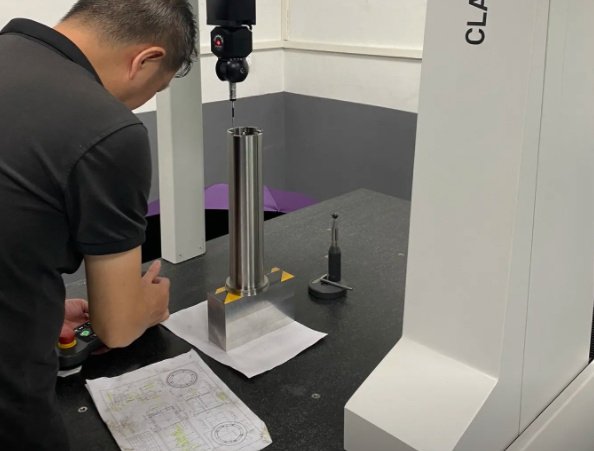
The perception that Chinese machining services are limited to low-precision work is outdated. Established suppliers with over a decade of experience in titanium CNC machining operate fully automated production lines with multi-axis equipment running unattended for 24-hour cycles. These shops routinely hold tolerances of ±0.01mm on critical features, supported by in-process probing and post-process CMM inspection. For micro-sized titanium components, such as surgical screws or electronic connectors, high-volume Swiss screw machining capabilities enable consistent production of intricate geometries with tight dimensional control. The key differentiator is not the equipment itself, but the process discipline and quality system maturity of the individual supplier.
Addressing Titanium's Machining Challenges
Titanium's low thermal conductivity and chemical reactivity present universal challenges, regardless of geography. Chinese shops that specialize in titanium have developed specific countermeasures. High-pressure through-tool coolant delivery, optimized chip evacuation strategies, and rigid fixturing are standard practice. For deep pocketing operations in Ti-6Al-4V, experienced suppliers use trochoidal milling paths and vibration-dampened tool holders to manage heat buildup and prevent work hardening. The most capable shops can achieve metal removal rates that rival Western benchmarks while maintaining surface finish requirements of 32 Ra or better on functional surfaces.
Cost Structure and Economic Advantages
The economic case for Chinese titanium machining rests on more than hourly labor rates. The proximity of raw material sources reduces logistics costs embedded in the material price. Factory-direct pricing models eliminate intermediary markups, and the scale of production facilities allows for amortization of tooling and setup costs across larger batch sizes. For a typical titanium component with moderate complexity, the total landed cost from a qualified Chinese supplier can be 30% to 50% lower than equivalent domestic production, even after accounting for freight and import duties. This cost differential is most pronounced in medium to high-volume production runs where process optimization and automation deliver compounding efficiency gains.
Real-World Data: Production Efficiency in Titanium Machining
A Chinese supplier with 12 years of dedicated titanium machining experience reported achieving a production capacity of 500,000 pieces per year across a range of non-standard precision parts. On a specific Ti-6Al-4V component requiring multiple setups and tight profile tolerances, the shop maintained a process capability index of Cpk ≥ 1.33 across a 10,000-piece production run. The combination of automated loading systems, in-machine probing, and statistical process control enabled lights-out manufacturing with minimal operator intervention, reducing per-part labor cost while maintaining dimensional stability throughout the batch.
Quality Certifications and Supplier Evaluation
When evaluating Chinese titanium machining partners, certifications provide a baseline filter but should not be the sole criterion. ISO 9001:2015 certification is widely held and indicates a foundational quality management system. For aerospace applications, some suppliers have achieved AS9100 certification, though this is less common than in Western markets. Medical device manufacturers should verify ISO 13485 compliance and FDA registration status if components are destined for the U.S. market. Beyond certifications, experienced buyers assess a supplier's approach to first article inspection, material traceability, and non-conformance management. The best Chinese suppliers have invested in English-speaking project managers and transparent reporting systems that bridge the communication gap with Western clients.
Navigating the Trade-offs: Advantages and Limitations
A balanced assessment of Chinese titanium machining services requires acknowledging both strengths and limitations. On the advantage side, the integrated supply chain, cost competitiveness, and production scalability are genuine differentiators. Suppliers with over a decade of specialization have accumulated deep process knowledge for titanium-specific challenges. However, limitations exist. Intellectual property protection requires careful contractual frameworks and due diligence. Lead times can be extended by international logistics and customs clearance, though experienced suppliers manage this through established freight partnerships. Communication barriers, while diminishing, still require proactive management to ensure that technical requirements are fully understood and executed. The most successful sourcing relationships are built on clear specifications, regular quality audits, and a mutual commitment to long-term partnership rather than transactional engagement.
OEM and ODM Capabilities for Custom Titanium Components
Many Chinese titanium machining services offer OEM and ODM capabilities that extend beyond build-to-print manufacturing. Suppliers can provide design-for-manufacturability feedback, suggest material substitutions that maintain performance while reducing cost, and manage secondary processes including anodizing, passivation, and laser marking. For brands seeking to scale their titanium product lines, this turnkey approach reduces the management burden of coordinating multiple vendors. Low minimum order quantities, sometimes as few as 10 pieces for initial orders, allow buyers to validate quality and fit before committing to full production volumes. This flexibility, combined with factory-direct pricing, makes Chinese titanium machining an attractive option for both startups and established manufacturers seeking to optimize their global supply chain.
The landscape of Chinese titanium machining has matured significantly over the past decade. The combination of raw material access, technical capability, and cost efficiency creates a compelling value proposition for global buyers. Success in this market depends not on finding the cheapest quote, but on identifying a partner with the process discipline, quality systems, and communication practices to deliver production-ready titanium components that meet the demanding requirements of aerospace, medical, and industrial applications.