
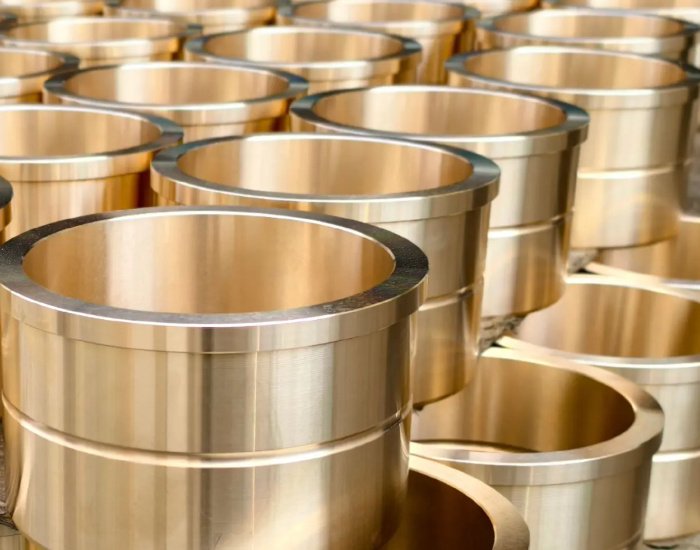
A bronze bushing is a plain bearing component used to support rotating, oscillating or sliding shafts under load. Unlike rolling-element bearings, Bronze Bushings rely on a controlled sliding interface, proper clearance and suitable lubrication to reduce friction and wear. They are widely used in construction equipment, agricultural machinery, pumps, valves, marine hardware, mining equipment, hydraulic cylinders, gearboxes and industrial automation.
For engineers and buyers, the value of a bronze bushing is not only the base material. Performance depends on alloy selection, hardness, shaft compatibility, lubrication groove design, wall thickness, surface finish, tolerance control and the operating environment. This page explains how to compare bronze bushing types, specify machining requirements and avoid common field failures.
What Is a Bronze Bushing?
A bronze bushing is a cylindrical sleeve, flange sleeve or thrust component manufactured from a copper-based alloy, usually containing tin, aluminum, lead, nickel, phosphorus or other elements depending on the application. The bushing acts as a sacrificial and replaceable wear surface between a housing and a shaft or pin.
In practical terms, Bronze Bushings are selected when the application requires high load capacity, shock resistance, good conformability, corrosion resistance and the ability to operate with grease, oil or embedded solid lubricant.
When to Use Bronze Bushings
Bronze bushings are suitable for applications where rolling bearings may be too sensitive to contamination, impact load or slow oscillating motion. They are especially effective in low-speed, high-load mechanisms where the shaft movement is intermittent rather than continuous high-speed rotation.
- Heavy-duty pivot joints on excavators, loaders, cranes and agricultural attachments
- Hydraulic cylinder eye ends, boom pivots and linkage systems
- Marine shafts, rudder hardware, deck equipment and seawater-exposed assemblies
- Pumps, valves, compressors and fluid-handling equipment
- Presses, molds, dies, conveyors and material-handling machinery
- Gearbox supports, low-speed shafts and sliding wear plates
A bronze bushing is often preferred when the operating environment includes dirt, vibration, edge loading or imperfect alignment. In these conditions, a plain bearing can tolerate contamination and shock better than many precision rolling bearings, provided the shaft and lubrication system are correctly designed.
Common Types of Bronze Bushings
The best bushing type depends on load direction, lubrication access, available space and maintenance expectations. Buyers should specify both geometry and material rather than ordering only by inside diameter and outside diameter.
Sleeve Bronze Bushings
Sleeve bushings are straight cylindrical bearings used for radial loads. They are simple, cost-effective and widely used in rotating or oscillating shaft assemblies. Common specifications include inside diameter, outside diameter, length, chamfer, oil groove pattern and press-fit allowance.
Flanged Bronze Bushings
Flanged bushings combine radial support with limited axial location. The flange helps control thrust movement and simplifies installation where a separate thrust washer is not desirable.
Graphite Plugged Bronze Bushings
Graphite plugged bushings contain solid lubricant inserts arranged in a pattern across the bearing surface. They are used in slow-speed, high-load or intermittent lubrication applications, such as mold plates, dam gates, construction pivots and high-temperature linkages.
Oil Impregnated Bronze Bushings
Oil impregnated bushings, commonly made from sintered bronze, store lubricant in interconnected pores. They are suitable for moderate loads and speeds where maintenance access is limited. They are not typically the first choice for severe shock loads or abrasive contamination.
Thrust Washers and Wear Plates
Bronze thrust washers and wear plates handle axial load or sliding contact. They are often used with sleeve bushings to control both radial and axial motion in compact assemblies.
Quick selection note for geometry
Use sleeve bushings for radial load, flanged bushings for radial load plus axial location, thrust washers for axial load, graphite plugged bushings for low-maintenance sliding, and oil impregnated bushings for light-to-medium duty applications with limited relubrication access.
Bronze Bushing Material Comparison
Material selection has a direct impact on load capacity, wear life, machinability, corrosion resistance and shaft compatibility. The table below compares common bushing materials used in industrial sourcing.
| Material | Typical Grade or Family | Strengths | Limitations | Typical Applications |
|---|---|---|---|---|
| Leaded Tin Bronze | C93200 / SAE 660 | Good machinability, embedability, conformability and general bearing performance | Lead content may be restricted in certain markets or potable water applications | General machinery, pumps, gearboxes, agricultural equipment |
| Aluminum Bronze | C95400, C95500 | High strength, shock resistance, good corrosion resistance | Requires compatible shaft hardness and careful lubrication control | Heavy equipment pivots, marine hardware, mining machinery |
| Manganese Bronze | C86300 | Very high load capacity and excellent strength | May be less forgiving under poor lubrication than softer bearing bronzes | Crane bushings, press components, heavy-duty linkages |
| Phosphor Bronze | C51000, C54400 | Good fatigue resistance, spring properties and corrosion resistance | Usually used for lighter bearing forms or precision components | Electrical mechanisms, precision sleeves, moderate load assemblies |
| Sintered Bronze | Oil impregnated bronze | Self-lubricating, economical, suitable for high-volume production | Lower shock-load capacity than cast bronze | Small motors, appliances, light industrial equipment |
For heavy-load applications, aluminum bronze bushings and manganese bronze bushings are often considered before standard tin bronze. For general-purpose machined bushings, C93200 remains common because it balances machinability, friction behavior and availability.
Bronze Bushings vs Other Bearing Materials
Bronze is not the only option for a plain bearing. Polymer, brass, steel-backed composite and cast iron bearings may be better in some applications. The right comparison should consider load, speed, contamination, lubrication, operating temperature and replacement cost.
| Option | Compared With Bronze | Best Fit | Buyer Risk |
|---|---|---|---|
| Brass Bushing | Usually lower bearing performance and lower wear resistance than proper bearing bronze | Decorative, light-duty or low-load hardware | Misusing brass as bearing bronze can shorten service life |
| Polymer Bushing | Lower weight, corrosion resistant and sometimes maintenance-free | Clean, light-to-medium loads, low noise applications | Temperature, creep and edge loading may limit performance |
| Steel-Backed Composite Bushing | Thin-wall design with PTFE or bronze powder layers | Compact assemblies with controlled alignment | Sensitive to installation damage and housing accuracy |
| Cast Iron Bushing | Good damping and low cost, but often lower corrosion resistance | Moderate-duty industrial machinery | May not match bronze in shock and corrosion environments |
| Rolling Bearing | Lower friction at high speed but less tolerant of shock and contamination | High-speed rotation with clean lubrication | Can fail early in dirty, oscillating or impact-loaded pivots |
A useful rule is that bronze bushings perform best where the design accepts sliding contact and can manage heat, lubrication and clearance. Rolling bearings perform best where alignment, cleanliness and continuous rotation are well controlled.
Design Factors That Determine Service Life
Bushing failure is rarely caused by material alone. Most failures result from a combination of insufficient clearance, poor shaft finish, inadequate lubrication, abrasive contamination, overload or misalignment.
Load and PV Value
Engineers often evaluate plain bearing duty using PV value, which combines pressure and sliding velocity. Pressure is calculated from load divided by projected bearing area, while velocity is based on shaft surface speed or oscillating movement.
For example, a 40 mm shaft carrying 12 kN over a 50 mm bushing length has a projected area of 2,000 mm². The approximate bearing pressure is 6 MPa. If the sliding velocity is 0.08 m/s, the PV value is 0.48 MPa·m/s. This may be acceptable for many lubricated bronze bearing systems, but final validation must consider alloy, grease type, temperature and duty cycle.
Clearance and Press Fit
A bronze bushing normally requires an interference fit in the housing and a running clearance on the shaft. After pressing into the housing, the inside diameter may shrink. For precision assemblies, final sizing by reaming, boring or honing after installation may be required.
Shaft Hardness and Surface Finish
A rough or soft shaft can destroy a bushing quickly. Many heavy-duty bronze bushing applications use hardened steel pins with a ground finish. As a practical engineering target, shaft surface finish is often specified around Ra 0.2 to 0.8 micrometer for demanding sliding applications, depending on lubrication and load.
Lubrication Grooves
Oil grooves, figure-eight grooves, spiral grooves and annular grooves distribute lubricant across the contact surface. However, excessive groove area reduces load-carrying surface. For high-load bushings, groove design should support lubricant flow without creating stress concentration or reducing projected bearing area too much.
The most important design choice is matching clearance, lubrication and material to the real duty cycle, not simply increasing wall thickness or choosing the hardest alloy.
Engineering problem: why a bronze bushing overheats
A common field problem is a newly installed bronze bushing that becomes hot within hours. Typical causes include too little running clearance after press fitting, blocked grease grooves, shaft roughness, edge loading from misalignment or grease that cannot withstand the contact pressure. Corrective action usually starts with measuring the installed bore, checking shaft diameter, confirming grease flow and inspecting the contact pattern.
Manufacturing and Machining Requirements
Bronze bushings can be manufactured by continuous casting, centrifugal casting, sand casting, forging, sintering or machining from bar stock. The process affects grain structure, porosity, cost, lead time and achievable tolerance.
Casting and Stock Preparation
Cast bronze is common for medium and heavy-duty bushings because it offers strong bearing properties and flexible sizes. Centrifugal casting is often used for tubes and rings because it can produce a dense structure with good mechanical consistency. Continuous cast bronze bar and tube are practical choices for CNC-machined bushings in small to medium batches.
CNC Turning, Boring and Grooving
Precision bronze bushings are commonly produced by CNC turning, boring, facing, chamfering, drilling and internal grooving. Machining must account for material behavior: leaded bronze machines freely, while aluminum bronze can be tougher and more abrasive to cutting tools.
Finishing and Inspection
Depending on the application, the final bore may be machined before shipment or left with stock for finish machining after installation. Inspection usually includes inside diameter, outside diameter, length, flange thickness, concentricity, roundness, chamfer, groove geometry, surface finish and material certification.
For high-load pivots, post-installation bore sizing can be more reliable than relying only on free-state bushing dimensions, because press fit changes the final inside diameter.
Quality Standards and Material Documentation
Professional sourcing should include more than a drawing and price. Material traceability and dimensional verification help prevent expensive failures after assembly. Relevant specifications may include ASTM, SAE, ISO, DIN or customer-specific standards, depending on region and industry.
- Material grade, such as C93200, C95400, C86300 or lead-free bronze
- Chemical composition certificate or mill test report when required
- Hardness test result for high-load bronze alloys
- Dimensional inspection report for critical tolerances
- Surface finish and groove verification
- RoHS, REACH or lead-content compliance when applicable
- Heat number or batch traceability for safety-critical equipment
If the component is used in food equipment, potable water, medical devices or export-controlled markets, confirm compliance early. Traditional leaded bearing bronze may not be acceptable for every regulatory environment.
Procurement checklist for custom bronze bushings
- Confirm drawing revision, units and tolerance class.
- Specify alloy grade instead of using only the word bronze.
- Define whether dimensions are before or after press fitting.
- State lubrication groove pattern and grease hole location.
- Confirm shaft material, hardness and surface finish.
- Request inspection reports for critical dimensions.
- Check lead-time risk for large castings or non-standard alloys.
Real Engineering Results: What Improves Bushing Life?
In maintenance reviews of heavy equipment pivots, the largest service-life gains usually come from correcting the system around the bushing rather than changing the bushing alone. Measurable improvements often include lower operating temperature, more uniform wear marks, longer grease intervals and reduced shaft scoring.
A typical reliability improvement project may include replacing an underspecified brass sleeve with a machined aluminum bronze bushing, increasing shaft hardness, adding a cross-groove lubrication path and correcting housing alignment. In severe pivot applications, these changes can multiply service life because they address pressure distribution, lubricant access and abrasive wear at the same time.
The most useful field metric is not only hours to failure. Track wear rate per 1,000 operating hours, shaft scoring depth, grease consumption, bushing temperature and clearance growth. These data points help determine whether the problem is material wear, contamination, lubrication starvation or structural misalignment.
How Buyers Should Specify Bronze Bushings
A complete bushing inquiry should give suppliers enough information to quote the correct product, not just the cheapest substitute. The following details reduce ambiguity and help ensure repeatable quality.
- Inside diameter, outside diameter, length and flange dimensions if applicable
- Material grade and required standard, such as ASTM B505 C93200 or C95400
- Quantity, annual demand and batch packaging requirements
- Running clearance, press fit and installed bore requirement
- Lubrication type: grease, oil, dry graphite plug or oil impregnation
- Load, speed, oscillation angle, temperature and environment
- Shaft material, hardness, coating and surface finish
- Inspection requirements, certificates and compliance documents
For replacement parts, send worn samples only as a reference. Used bushings may have distorted dimensions, enlarged bores and damaged grooves. A new drawing or reverse-engineered model should account for original clearance and housing fit.
Common Failure Modes and Corrective Actions
| Failure Symptom | Likely Cause | Corrective Action |
|---|---|---|
| Rapid bore wear | Abrasive contamination, soft shaft or insufficient lubrication | Improve seals, harden shaft, review grease path and groove design |
| Seizure or galling | Low clearance, high PV value, poor lubricant or overheating | Increase running clearance, improve lubrication, verify load and speed |
| Edge wear | Misalignment, housing distortion or shaft deflection | Correct alignment, increase support stiffness, review bushing length |
| Bushing rotates in housing | Insufficient press fit or housing wear | Adjust interference fit, repair housing bore or add retention method |
| Cracking | Excessive interference, shock overload or brittle material selection | Review press fit, select tougher alloy, check installation method |
A bronze bushing is a simple component, but its performance is system-dependent. Correct alloy selection, accurate machining, controlled installation and suitable lubrication are the factors that separate a low-cost wear part from a reliable bearing solution.