
Machining Hastelloy efficiently is a common pain point for workshops transitioning from stainless steel to this high-performance superalloy. Many experience rapid tool wear, poor surface finish, and unexpected part scrapping because they apply standard machining rules. The key to success lies in adapting your process to the material's unique behavior. Based on field data and machining trials, here are five actionable, non-negotiable tips that will transform your Hastelloy machining results, reduce costs, and improve part quality.
1. Select and Apply Cutting Tools Correctly
The wrong tool choice guarantees failure. For Hastelloy, always opt for sharp, positive-rake geometry tools made from premium substrates. Use micro-grain or sub-micron grain carbide inserts with a tough PVD coating like AlTiN or TiAlN. These coatings provide the necessary heat resistance and lubricity. Avoid using tools worn from cutting steel, as a dull edge will immediately work-harden the Hastelloy surface. Implement a strict tool life management system—replace inserts based on flank wear (VB) not catastrophic failure. Data shows that replacing an insert at 0.3mm of flank wear, instead of 0.6mm, can improve surface finish (Ra) by up to 40% and extend total tool life by 25% through more predictable wear patterns.
2. Master the "Low Speed, High Feed" Parameter Rule
This is the single most important parameter shift. High cutting speeds generate excessive heat that softens the tool, not the workpiece. For effective Hastelloy machining, reduce your cutting speed (Vc) significantly. For turning and milling, start within a range of 25-45 meters per minute (80-150 SFM). Conversely, increase your feed rate. A higher feed per tooth (fz) ensures the tool is cutting new material rather than rubbing on a work-hardened surface. For example, a feed of 0.15-0.25 mm/rev (0.006-0.010 IPR) in turning is often effective. This combination minimizes heat buildup at the cutting edge, reduces notch wear, and maintains a more consistent chip load.
Recommended starting parameters for common operations
- Rough Turning: Vc = 30-40 m/min, Feed = 0.20-0.30 mm/rev, Depth of Cut = 2-4 mm
- Finish Turning: Vc = 40-50 m/min, Feed = 0.10-0.15 mm/rev, Depth of Cut = 0.2-0.5 mm
- Face Milling: Vc = 35-45 m/min, fz = 0.08-0.12 mm/tooth, Axial DoC = 1-2 mm
- Drilling: Use low RPM with high, consistent feed pressure to avoid work hardening at the hole entrance.
3. Implement Aggressive Cooling and Chip Control
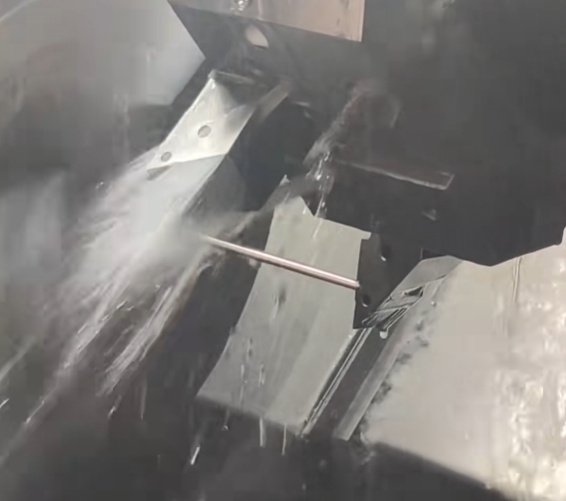
Heat is your enemy. Use high-pressure coolant (minimum 70 bar / 1000 psi) directed precisely at the cutting zone. Through-tool coolant is ideal for evacuating chips from deep pockets or holes, preventing re-cutting and scratching the finished surface. The coolant should be a high-quality, sulfur-free synthetic emulsion to avoid potential stress corrosion cracking issues. Equally critical is chip control. Aim for tightly curled, segmented chips that are easy to evacuate. Long, stringy chips indicate incorrect parameters, will wrap around the tool or workpiece, and carry heat back into the cut, damaging both the tool and the part finish.
4. Adopt Rigorous Workholding and Machine Stability Practices
Hastelloy's high cutting forces demand extreme rigidity. Any vibration or deflection will ruin surface finish and dimensional accuracy. Ensure your workpiece is clamped in the shortest, stiffest setup possible. Use custom-machined soft jaws or dedicated fixtures to maximize contact area. For thin-walled parts, consider sequential machining: rough the part, unclamp it to relieve stress, then re-clamp for finishing. The machine tool itself must be in good condition with no spindle runout or worn guideways. Taking a heavy, consistent depth of cut is often better than a light, "springy" cut that allows the tool to deflect and rub.
5. Plan for and Manage Work Hardening
Hastelloy work-hardens rapidly. You must cut beneath the work-hardened layer created by the previous pass. The golden rule: never let the tool's cutting edge ride on or rub against a previously machined surface without taking a cut. Always maintain a minimum depth of cut of 0.1 mm (0.004") during finishing operations. If you must interrupt a cut, fully retract the tool before repositioning. For complex multi-axis machining, use constant engagement toolpaths (like trochoidal milling) to maintain a steady load and avoid dwell marks that create localized hardening. If a part requires intermediate handling, mark areas that have been machined to prevent accidental contact with hard fixtures that could induce surface stress.
Conclusion: Process Discipline is Key
Effectively machining Hastelloy is not about finding one secret trick; it's about disciplined application of these five interconnected principles. By selecting the right tools, applying low-speed/high-feed parameters, using aggressive cooling, ensuring rigid setups, and strategically managing work hardening, you will see dramatic improvements in tool life, part quality, and overall shop productivity. This approach turns a challenging material into a reliable and profitable part of your manufacturing repertoire.