A copper bushing is a plain bearing component used to support rotating, oscillating, or sliding shafts in machinery where strength, wear resistance, heat conductivity, and dimensional stability are required. In industrial purchasing and engineering applications, Copper Bushings usually refer to copper alloy bushings such as tin bronze, aluminum bronze, brass, or graphite-plugged bronze rather than pure copper parts.
Compared with rolling bearings, copper alloy bushings have a simpler structure, better shock-load tolerance, larger contact area, and stronger resistance to contamination. They are widely used in construction machinery, hydraulic cylinders, mining equipment, agricultural machines, marine hardware, gearboxes, valve assemblies, and heavy-duty pivot joints.
Product Overview: What Is a Copper Bushing?
A copper bushing, also called a copper sleeve bearing, bronze bushing, or copper alloy plain bearing, is designed to reduce friction between a shaft and housing. It distributes load across the inner bearing surface and can operate with grease, oil, solid lubricant, or in some cases boundary lubrication.
The main engineering value of copper bushings is their combination of load capacity, machinability, corrosion resistance, and ability to embed small particles without rapid shaft scoring. For equipment exposed to impact, low-speed rotation, or intermittent movement, copper alloy bushings often provide a more robust solution than thin polymer bearings or standard rolling bearings.
- Common forms: sleeve bushing, flanged bushing, thrust washer, wear plate, split bushing, spherical plain bushing.
- Common materials: tin bronze, leaded bronze, aluminum bronze, manganese bronze, brass, and self-lubricating graphite bronze.
- Typical lubrication designs: straight oil groove, figure-eight groove, spiral groove, annular groove, oil holes, grease pockets, and graphite plugs.
- Typical operating modes: rotary motion, oscillating motion, reciprocating sliding, and high-load pivoting.
Material Options for Copper Bushings
Material selection determines wear behavior, allowable pressure, corrosion resistance, seizure resistance, and compatibility with the mating shaft. The correct alloy should be chosen according to load, speed, lubrication condition, temperature, environment, and required service life.
| Material Type | Typical Standard / Grade | Key Advantage | Common Applications |
|---|---|---|---|
| Tin Bronze | C93200, C90300, CuSn12 | Excellent wear resistance and good machinability | General machinery, pumps, gearboxes, agricultural equipment |
| Aluminum Bronze | C95400, C95500, CuAl10Fe5Ni5 | High strength, impact resistance, corrosion resistance | Heavy-duty pivots, marine equipment, cranes, mining machinery |
| Leaded Bronze | C93200, C93700 | Good seizure resistance and conformability | Low-speed shafts, industrial gear units, older machine repairs |
| Manganese Bronze / High-Strength Brass | C86300, CuZn25Al5Mn4Fe3 | High load capacity and good toughness | Presses, excavator joints, lifting machinery |
| Graphite-Plugged Bronze | C86300 + solid lubricant, C95400 + graphite | Self-lubricating performance under intermittent lubrication | Mold equipment, hydro gates, outdoor pivots, high-temperature sliding |
For general industrial service, bronze C93200 is often selected for balanced wear resistance and machinability. For higher load and shock applications, aluminum bronze or manganese bronze is usually preferred.
Types and Configurations
Copper bushings can be manufactured in multiple geometries to match shaft layout, lubrication access, installation method, and operating direction. Selecting the right configuration can reduce assembly time and prevent premature wear.
Sleeve Copper Bushings
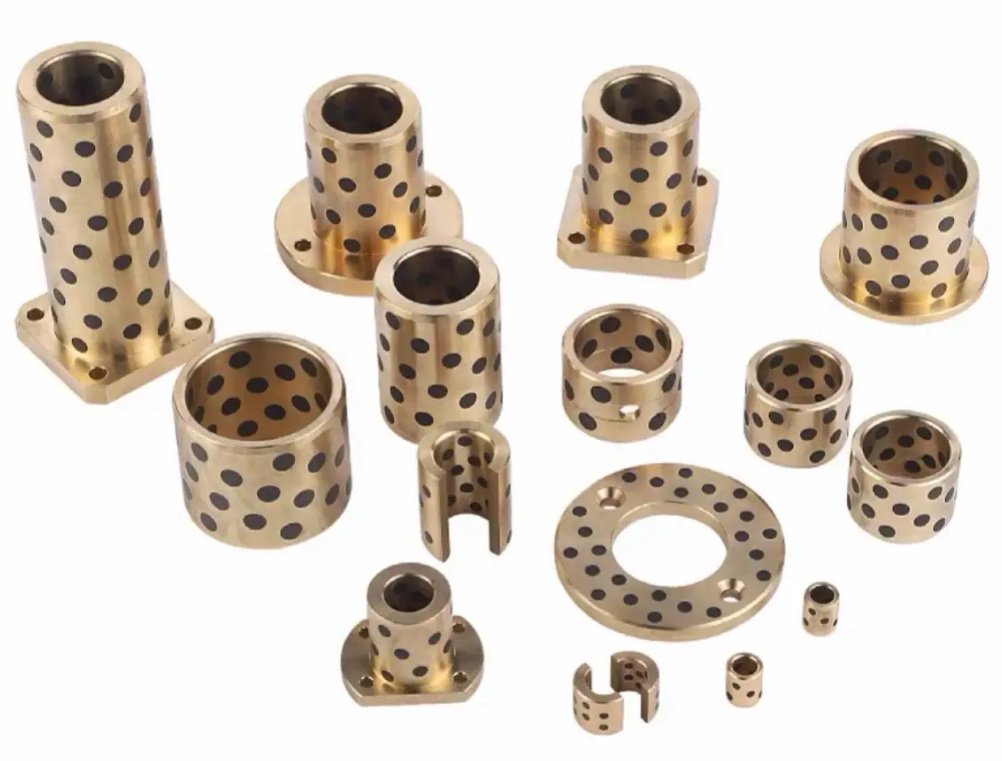
Sleeve bushings are cylindrical bearings installed into a housing bore. They are suitable for shafts, pins, rollers, hinge points, gearboxes, conveyors, and hydraulic cylinder eyes. They can be supplied with oil holes, grooves, chamfers, and customized wall thickness.
Flanged Copper Bushings
Flanged bushings combine radial support with axial location. The flange helps control thrust movement and simplifies installation when the bearing must resist side loading or maintain a fixed axial position.
Graphite-Plugged Copper Bushings
Graphite-plugged copper alloy bushings contain embedded solid lubricant plugs. These bushings are designed for low-speed, high-load operation, limited grease maintenance, outdoor equipment, and applications where oil film formation is difficult.
Grooved and Oil-Hole Bushings
Machined grooves and drilled holes distribute grease or oil across the bearing surface. Straight grooves are simple and economical, while spiral or figure-eight grooves improve lubricant coverage during oscillating movement.
Thrust Washers and Wear Plates
Copper alloy thrust washers and wear plates are used where axial sliding load must be controlled. They are common in excavator joints, presses, die sets, marine equipment, and hydraulic structures.
Copper Bushings vs Other Bearing Solutions
The best bearing choice is not always the lowest-friction option. Engineers must balance load, speed, lubrication, contamination, misalignment, maintenance access, and total lifecycle cost.
| Comparison Item | Copper Bushings | Alternative | Practical Conclusion |
|---|---|---|---|
| Copper Bushing vs Steel Bushing | Better anti-seizure behavior, corrosion resistance, and shaft protection | Steel bushings provide high hardness but may damage shafts under poor lubrication | Copper alloy is preferred where replaceable wear parts should protect expensive shafts |
| Copper Bushing vs Polymer Bushing | Higher thermal conductivity and better performance under shock load | Polymer bushings are lightweight and low-friction but may creep under heavy load | Copper alloy is stronger for heavy-duty pivots and high bearing pressure |
| Copper Bushing vs Rolling Bearing | More compact, tolerant of impact, and less sensitive to contamination | Rolling bearings offer lower friction at high speed | Use copper bushings for low-speed heavy load; use rolling bearings for high-speed rotation |
| Bronze Bushing vs Brass Bushing | Bronze usually offers better wear resistance under load | Brass is economical and easy to machine | Bronze is more suitable for critical bearing service; brass is suitable for lighter duty |
| Greased Bronze vs Graphite-Plugged Bronze | Greased bronze offers strong performance when maintenance is available | Graphite-plugged bronze supports boundary lubrication and intermittent maintenance | Graphite-plugged copper alloy is preferred for hard-to-service sliding points |
Machining, Tolerances, and Surface Finish
Copper bushings are commonly produced by casting, centrifugal casting, forging, continuous casting, or bar-stock machining. After material preparation, parts are turned, bored, grooved, drilled, chamfered, and inspected according to drawing requirements.
Machining quality directly affects bearing life. Poor roundness, incorrect clearance, sharp oil-groove edges, or excessive surface roughness can cause localized pressure, heat generation, lubricant starvation, and abnormal wear.
- Inner diameter machining: precision boring, reaming, or honing for shaft clearance control.
- Outer diameter machining: controlled interference fit for stable housing installation.
- Oil groove machining: CNC-cut straight, spiral, annular, or figure-eight grooves according to motion type.
- Chamfering: prevents edge shaving during press-fit assembly and shaft insertion.
- Surface finish: typical bearing bore finish may range from Ra 0.8 to Ra 1.6 μm depending on load and lubrication.
- Inspection: ID, OD, wall thickness, concentricity, hardness, chemical composition, and visual defect checks.
A common engineering mistake is assuming that tighter shaft fit is not always better. Insufficient running clearance can reduce oil film thickness, increase frictional heat, and lead to seizure, especially in high-load or high-temperature assemblies.
Engineering Performance and Real Application Considerations
Copper bushings are typically selected for low-speed, high-load, shock-loaded, and contaminated operating environments. Important design variables include projected bearing pressure, sliding speed, PV value, shaft hardness, lubrication interval, housing rigidity, and alignment accuracy.
In a heavy equipment pivot application, replacing a soft brass bushing with an aluminum bronze bushing and optimized grease groove can significantly improve service life. For example, in a loader arm pivot operating under oscillating load, changing from a low-strength brass sleeve to C95400 aluminum bronze with a hardened shaft surface and spiral grease groove can reduce wear depth by more than 30% over the same maintenance interval, provided that grease contamination is controlled.
| Engineering Factor | Recommended Check | Impact on Service Life |
|---|---|---|
| Load | Calculate projected pressure using load divided by bearing projected area | Prevents material overload and plastic deformation |
| Speed | Confirm sliding velocity and PV value | Controls heat generation and lubricant film stability |
| Shaft Hardness | Use a hardened and ground shaft for abrasive or high-load duty | Reduces adhesive wear and shaft scoring |
| Lubrication | Match oil groove geometry to motion direction and grease interval | Improves lubricant distribution and reduces dry contact |
| Contamination | Use seals, wipers, or grease purging in dusty environments | Reduces abrasive wear and premature clearance growth |
Specifications and Custom Manufacturing Range
Copper bushings can be manufactured to standard sizes or fully customized according to engineering drawings. Customization is often required for repair projects, imported equipment replacement parts, hydraulic pivots, die components, and non-standard machine assemblies.
| Specification Item | Available Options |
|---|---|
| Structure | Sleeve, flanged, split, thrust washer, wear plate, spherical, graphite-plugged |
| Material | C93200, C95400, C95500, C86300, C90300, CuSn12, CuAl10Fe5Ni5, custom copper alloy |
| Manufacturing Process | Centrifugal casting, sand casting, continuous casting, forging, CNC machining |
| Lubrication Design | Oil holes, grease grooves, spiral grooves, annular grooves, graphite plugs |
| Dimensional Control | Drawing-based tolerance, press-fit OD, controlled running clearance, concentricity inspection |
| Surface Treatment | Machined finish, honed bore, deburred grooves, anti-rust oil, special coating on request |
For reference, many copper alloy bearing materials are specified according to ASTM B505 for copper-base alloy continuous castings, ASTM B271 for centrifugal castings, or equivalent EN, DIN, JIS, and GB standards. Drawing tolerance may also refer to ISO 3547 for wrapped bushings and plain bearing dimensional guidance where applicable.
Buyer and Engineer Selection Checklist
From a purchasing perspective, the cheapest copper bushing is not always the lowest-cost part in operation. The correct selection should consider machining accuracy, alloy certification, lubrication design, shaft condition, replacement labor, and downtime risk.
- Confirm whether the application is rotary, oscillating, or linear sliding.
- Provide shaft diameter, housing bore, total length, flange size, and tolerance requirements.
- Specify load, speed, temperature, lubrication method, and working environment.
- Check whether the shaft is hardened, chrome plated, nitrided, or untreated.
- Choose groove design according to grease inlet position and movement direction.
- Require material certificates when alloy traceability is important.
- Evaluate total cost of ownership, not only unit price.
When should an engineer choose graphite-plugged copper bushings?
Graphite-plugged copper bushings are suitable when the equipment works at low speed, high load, intermittent movement, or in locations where frequent lubrication is difficult. They are commonly used in die molds, dam gates, heavy pivots, outdoor linkages, and high-temperature sliding surfaces.
What information should be provided for custom copper bushing machining?
Recommended information includes drawing or sample dimensions, material grade, inner diameter, outer diameter, length, flange dimensions, tolerance, oil groove type, oil hole position, required quantity, operating load, speed, temperature, and shaft material.
How can premature copper bushing failure be reduced?
Premature failure can be reduced by selecting the correct alloy, using a properly hardened shaft, setting suitable running clearance, improving grease distribution, sealing out abrasive particles, avoiding edge loading, and verifying alignment during assembly.
Common Applications of Copper Bushings
Copper bushings are used wherever heavy load, sliding contact, and controlled wear are more important than ultra-high rotational speed. Their ability to operate in compact assemblies makes them suitable for both OEM manufacturing and maintenance replacement.
- Excavator boom, arm, bucket, and linkage pins
- Loader, bulldozer, crane, and forklift pivot joints
- Hydraulic cylinder eyes and trunnion supports
- Gearbox shafts, pump housings, and compressor components
- Marine rudder systems, winches, and deck machinery
- Mining crushers, conveyors, and screening equipment
- Plastic injection molds, die casting machines, and stamping dies
- Valves, turbines, agricultural machinery, and industrial presses
For demanding applications, a well-designed copper bushing should be treated as an engineered wear component rather than a simple metal sleeve. Correct alloy selection, precision machining, suitable lubrication geometry, and controlled assembly clearance are the key factors that determine bearing reliability and long-term equipment performance.